

ealth
e t
44:74110153EMENE
Is
Health Care
A Right?
I
American Jews
debate
universal
health coverage
from many
different
standpoints.
I
LL,
LTJ
Lu
50
RUTHLITTMANN STAFF WRITER
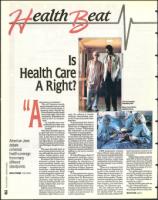
Left: Sinai Hospital:
Ambulatory care.
s si a c k . person
sool ds n i s a p n * s o ne e s d e
Yemenite
just one
of the most heated debate in
America today: Should the
United States consider health
care a basic right, vital to the
realization of freedoms set
forth in the U.S. Constitu-
tion?
Or, is health care a com-
modity like any other to be
purchased on the open
market?
"The issue of health care as
a right boils down to defining
the role of government and so-
ciety. It gets down to what this
country was founded upon,"
says Mary Byrne, vice president
of public relations for the South-
east Michigan Hospital Coun-
cil.
The issue also boils down to
some fundamental Jewish val-
ues, although the views of local
rabbis, Jewish doctors, busi-
nessmen and politicians clash.
President Bill Clinton has
proposed a system of govern-
ment-mandated health care
aimed at providing universal
coverage — insurance for all
Americans — while attempting
to control medical costs. Some
Jewish clergymen support uni-
versal health-care coverage.
Other Jews, including many
physicians, argue that govrn-
ment, by declaring health care
a right, violates other, more fun-
damental freedoms.
Rabbi Leonard Perlstein, di-
rector of pastor al care at Sinai
Hospital, believes health care
should be a right within any so-
Below: One of Sinai's
operating rooms.
ciety. He referred to Jewish
writings commanding mon-
archs to lead and protect their
populace.
"A government that doesn't
guarantee health coverage is
derelict in its obligation to its
citizens," he says. Withholding
life sustenance is the moral
equivalent of manslaughter."
Paraphrasing Torah, the rab-
bi describes the halachic per-
spective on health care: 'There's
an obligation of every member
of the Jewish faith not to stand
idly by his brother. That means
a person has a moral obligation
to prevent a person's blood from
spilling, in war and in matters
of health."
Dr. Paul Ehrmann, doctor of
osteopathic medicine, runs a
family practice in Royal Oak.
Stressing the importance of
tzedakah, he does not deny that
Jews should look out for the
well-being of others. However,
he does not consider health care
a right.
To demonstrate his opposi-
tion to the Clinton proposal and
similar plans, Dr. Ehrm arm co-
founded a local group called
Community Coalition For Con-
cerned Physicians and Patients
(C3P2). Members predict dete-
rioration to the American med-
ical field if health care becomes
a right and government be-
comes its guarantor.
C3P2 proponents contend
that a Clinton-style system of
government-mandated health
care would restrict patients'
choice of doctors, create long
waiting lists and penalize peo-
ple who attempt to go outside
the system.
"There is an argument that
health care is too important to
be left to the market, but the
Clinton plan is much more a vi-
olation of your rights than a
market-driven system. The gov-
ernment controlliiig your health
care is a violation of your free-
dom of choice...and individual
privacy," Dr. Ehrmann says.
He also believes that the
Clinton plan attempts to "level
the playing field" by taking
away the top-notch medical care
most Americans receive in or-
der to provide mediocre care for
everyone.
Phillip Schaengold, president
and CEO of Sinai Hospital, re-
gards basic elements of health
care as a fundamental right, but
compares the Clinton plan to
the benefits package of a For-
tune 500 company:
"In a global sense, having ac-
cess to the health care system
is a right. The ability to not wor-
ry about pre-existing conditions
is a right. To have portable in-
surance is a right."
But the Clinton plan goes too
far, Mr. Schaengold says.
"The cost of providing a ben-
efit package that has many elec-
HEALTH CARE page 52