

BUSINESS
The Peddlers
Once businesses that gave Jewish
immigrants a strong headstart in
America, the scrap industry
has been changed by recycling.
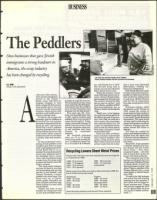
Left: Dave Guz and Steve Kaplan of H & H Metals.
Above: Howard Averbach has lost 70 percent of his business.
R.J. KING
SPECIAL TO THE JEWISH NEWS
A
t the turn of the century,
when Jewish immigrants
arrived in the United
States, many with their be-
longings strapped to their
backs, among the first occupa-
tions readily open to the new
arrivals was the scrap metal
business, where anyone with
ambition could peddle steel or
copper to salvage yards.
In Detroit, the market was
especially good for peddlers as
the birth of the auto industry
generated unprecedented de-
mand for steel. During both
World War I and II, peddlers
played an important role in sup-
plying defense factories with
scrap metal which could be
melted and used to build fight-
er planes, ships and ammuni-
tion.
As time progressed, enter-
prising Jewish peddlers saved
enough to open their own scrap
yards. And business boomed fol-
lowing World War II, as re-
turning GIs created demand for
homes, cars, appliances and of-
fice buildings. But in recent
years, with recycling becoming
a major force, the scrap metal
business has found it more dif-
ficult to compete.
"The scrap metal industry
has been hit hard by recycling
and returnables and now the
market is just flooded," said
Howard Averbuch, a former
peddler who owns Inner City
Scrap Yard, Inc. in Detroit,
which grinds discarded car
doors and sheet metal into chips
before selling it to steel mills
and foundries.
"Plastic has come in and
builders are using more vinyl
on new and remodeled homes.
It makes it tough for everyone.
The automakers are also using
more materials like fiberglass.
I don't know how the peddlers
do it. I've lost 70 percent of my
business over the last decade."
Five years ago, Mr. Aver-
buch, who founded Inner City
in 1961, said he routinely paid
peddlers $1 for every pound of
copper they brought in. Today,
copper commands between 50
and 60 cents per pound. Prices
for brass, aluminum, sheet met-
al and stainless steel have
dropped by comparable
amounts.
Mr. Averbuch estimated
there are 10 to 12 Jewish-
owned scrap yards in metro De-
troit. In addition to Inner City,
he co-founded H & H Metals,
Inc. with Harold Guz in 1978.
The five-acre scrap yard in
Inkster services the industrial
belt in the downriver area.
"Before the recession, we had
some of the best years in our in-
dustry. (Former President) Rea-
gan pumped a lot of money into
the economy (during the '80s)
and we saw an upturn," said
Ansel Aberly, president of SLC
Recycling Industries, Inc. in
Warren, which was founded in
1946.
"Right now, we're lagging.
Our cycle has always been a lit-
tle off from the rest of the econ-
omy. Over 1994, we could see a
rise in prices. We accumulate,
sort, pack and ship it out. It's
a basic, but essential business.
And we run the whole gamut,
from brass, aluminum, cooper
and stainless steel."
There are other problems.
Some suburban communities
have banned peddlers alto-
gether, citing concerns about
theft. Other cities have hired
private waste-removal compa-
Recycling Lowers Sheet Metal Prices
Nearly half of all steel cans were recycled last year as compared
to 15 percent in 1988.
1988- 15.0 percent
1989 - 17.9 percent
1990 - 24.6 percent
1991 - 34.0 percent
1992 - 40.9 percent
1993 - 47.2 percent
(estimated)
Metal prices have fallen as muc h as 40 percent since 1988. Be-
low is a list of prices per pound.
Aluminum
1988 - 35 cents
1993 - 20 cents
Brass
1988 - 55 cents
1993 - 30 cents
Copper
1988 - 90 cents
1993 - 50 cents
Stainless Steel
1988 - 25 cents
1993 - 15 cents
Steel Recycling Institute and Jewish News research.
nies to haul away discarded
dishwashers, washing ma-
chines and refrigerators.
Both trends limit the supply
for area scrap yard owners, es-
pecially as waste-removal firms
often profit from selling metal
to end users. Mother Nature
and the fall of communism
have also contributed to lower
prices.
Hurricane Andrew, which
devastated south Florida in
1992, caused the volume of
scrap metal in that market to
increase by four-fold, according
to the South Florida Recyclers
Association. The same trend
will play itself out following the
recent earthquake in southern
California, which by some esti-
mates caused $30 billion in
damage.
But while the market for
scrap metal declines initially in
disaster areas, Mr. Aberly said
it recovers once the affected ar-
eas reach consistent construc-
tion levels.
Meanwhile, huge quantities
of obsolete equipment in East-
ern Europe and the former
Soviet Union — from mine-
sweepers to tanks — are avail-
able at knock-down prices for
buyers with hard currencies.
"The industrial end of the
business is still good, but even
though parts of Eastern Europe
are being rebuilt, it hasn't cre-
ated an increase in prices," said
Julian Winston, president of the
Winston Morrow Corp., a scrap
metal dealer in Detroit found-
ed in 1926.
"It used to be this business
was cyclical. But with recycling
entering into the equation, I
don't think we'll see prices re-
bound anytime soon. Things
will just get tougher for all of
us, but I guess that's the price
you pay for a better environ-
ment."
❑
c)
cr)
co
>--
cc
co
LU U-
13
19