

BUSINESS
How's Business?
Professionals discuss business outlook for 1994.
LESLEY PEARL STAFF WRITER
Brian Goodman: Furniture
Sixty-one years in the business has established Harper Furniture as a word-of-
mouth operation.
Only in recent months have the owners begun to advertise.
"It (advertising) was always something we thought about," said Brian Good-
man, third-generation in the family business. "It must work. People come in now
and say, 'I want the sectional I saw in your ad.' "
Mr. Goodman attributes the store's success to its discounts. Harper opened
its doors in Detroit at Harper and Van Dyke roads
in 1927, offering mid-priced couches and tables.
The business moved to 5th Street in Royal Oak
in the 1970s. Now at its third location, on Main
Street in Royal Oak, Harper Furniture is still
known for its deals.
Items are tagged with manufacturers' prices
and Harper prices. Of course, then there is the
real price for which the piece goes out the door.
Many red-sale tags are tacked on with the ab-
solute lowest prices, no room for dickering.
"When times are tough the higher-spending
clientele finds us, looking for better-priced, qual-
ity items. That helps," Mr. Goodman said.
"In addition, we've begun stocking more items
here rather than having to special order. Your
average customer wants to spend the money now
and have something to show for it, not wait eight
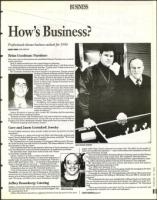
Brian Goodman
weeks for delivery."
Harper Furniture is open six days a week. Mr. Goodman and his associates
often wonder about working Sundays.
"Business is steady," Mr. Goodman said. "It's hard to chart how much you lose
by not being open an additional day. Royal Oak may not have a lot of traffic on
Sundays, but we're a destination location. Most people don't just happen in here.
"Weekend shopping is the busiest, though."
Gary and Jason Greisdorf: Jewelry
During tougher economic times, jewelry might not seem top priority to many
consumers.
Yet, knocking on a glass-and-wood case filled with diamonds, garnets and
topaz, Gary Greisdorf said the past 12 months have been profitable. "We've had
a good year," he said. "I really can't complain."
Mr. Greisdorf has run Greis Jewelers in Farmington Hills for nearly 20 years.
He spent his first year-and-a-half in Ferndale. The latest addition to the jew-
Jason and Gary Greisdorf
elry operation is his son, Jason.
Gary Greisdorf said he has developed a following of loyal customers, some
gogue rather than a hotel, restaurant or country club. The affair can be equally el-
even travelling from as far as Florida and Arizona to make their purchases.
egant, but usually less expensive — and it will continue the connection to the reli-
He advertises more. Sales don't work all that well. Watch-
gious institution, he said.
es have been a popular gift.
The man behind Jeffrey Rosenberg Kosher Catering, based at Adat Shalom
Lately, volume is up with a number of smaller sales.
Synagogue, has seen some tough years. He's optimistic about the future.
"It seems during the holidays we had more frequency of
Formerly known as Al Rosenberg Catering and Farn ington Meadows Cater-
smaller sales. It's a good sign," Jason Greisdorf said. "One hun-
ing, Jeffrey Rosenberg Kosher Catering has developed a new approach.
dred or 200 small pieces sold — as opposed to depending on
Mr. Rosenberg will not only plan a menu and create a meal, he'll assist in
three or four big sales to carry you — is definitely growth."
decorating and party planning as well.
Plans for 1994 include refurbishing and possible expansion.
"The 1980s were fantastic for us.
Competition does not scare Mr. Greisdorf and his son.
"The last few years, people have been going outside the synagogues for their
"A lot of businesses are dependent on the holiday season.
parties. That did hurt us, more than the economy."
Thankfully, we are not. For a lot of businesses, the holidays
To remedy the situation, Mr. Rosenberg began advertising. His business has
account for up to 40 percent of business. Here, December just
improved 20 percent. He's filling in 1994 dates. The year 1995 is "already look-
seems to be a better month than average," Jason Greisdorf
ing great."
said. "Of course, we'd like to have more Decembers, though."
"I'm working harder than ever and definitely willing to bend over backwards.
It's my friends' generation throwing these parties now. Money is tough. Peo-
ple are trying to cut costs rather than show up their neighbors," Mr. Rosenberg
said.
Rabbis, community leaders and concerned parents speak a lot
"We've got the family name back, but I'm not sitting on my parents' and
about b'nai mitzvah. Have they become too extravagant? Has Jeffrey Rosenberg
grandparents' coattails. It's a whole new ball game."
the meaning been lost?
•
Jeffrey Rosenberg responds by suggesting families keep the party in the syna-
HOW'S BUSINESS page B14
Jeffrey Rosenberg: Catering