

the one chosen. I had the ad-
vantage of already having a
relationship with the congre-
gation as its cantor," Cantor
Hirschenfang said.
Orthodox rebbetzin Chaya
Sarah Silberberg doesn't feel
pressured by congregants to
act a certain way.
Her husband, Elimelech,
leads Congregation Bais
Chabad in West Bloomfield.
Many members are newly ob-
servant, so they do not have
expectations of what an Or-
thodox rabbi's wife should be,
said Mrs. Silberberg.
Mrs. Silberberg teaches a
few classes, operates a small
writing business from her
home and raises 10 children.
She's a National Merit
Scholar who once taught sci-
ence, chemistry and math.
She's often seen cooking
cholent in a 20-pound crock-
pot for the congregation, but
not attending services.
"Outside of Orthodoxy,
women's liberation is alive in
the temples and synagogues.
When spirituality is defined
as only existing in the syna-
gogue, this move makes
sense. I think of spirituality
occurring mostly in the home.
"I don't need an aliyah," Mrs.
Silberberg said. "I show what
Jewish family life is all about:
Shabbat, holidays. I take the
holistic approach. The rabbi
talks about what it means to
study and pray as a Jew. I
show how to live as one."
The Silberbergs have com-
pany nearly every Shabbat,
the numbers of guests grow-
ing each year. Mrs. Silber-
berg enjoys sharing the
interaction of her family —
the time spent without dis-
tractions of phone or video —
with others.
"A rebbetzin is sort of like
the first lady. She's not elect-
ed and has no determined
role or job, but you know she's
important," Mrs. Silberberg
said. "First ladies choose how
to define their role, but
they're all essentially host-
esses.
"It's odd, a doctor's wife
isn't a doctor-ess. We have a
title because without being
chosen or paid, we perform a
service, we maintain a role."
Mrs. Silberberg's mother
didn't want to live that life,
so her father chose not to be
a rabbi. Her mother said it
would be a life of constant
scrutiny, with the phone al-
ways ringing and having to
share a father and husband
with the community.
But Chaya Sarah always
knew she wanted to marry a
rabbi and have lots of chil-
dren. It was a life that ap-
pealed to her.
Raquel Pomerantz Ger-
shon vowed she wouldn't
marry a rabbi, but admits she
really isn't surprised that she
has.
She's the daughter of a
Conservative rabbi and at-
tended college through a joint
program of the Jewish The-
ological Seminary and Co-
lumbia University.
"The odds were in favor of
(marrying a rabbi)," she said.
In New York, Ms. Pomer-
antz Gershon received a
bachelor's degree in Judaica
with an emphasis on sacred
music and a minor in Jewish
education. She later earned a
"I was lucky. In the
beginning, the
rebbetzin isn't always
embraced."
-- Gail Hirschenfang
master's degree in special
education.
"Being the rabbi's child
prepared me well. I knew
that people treated the fam-
ily of the rabbi differently. If
I did well, it was expected,"
Ms. Pomerantz Gershon said.
Oddly, as wife of Shaarey
Zedek's associate rabbi,
William Gershon, Ms. Pomer-
antz Gershon said she feels
less pressure. She walks to
services, follows the laws of
kashrut, participates in sis-
terhood and sings for various
groups within the congrega-
tion. She also wears a tallit
and openly longs for the com-
pletely egalitarian service
with which she was raised.
"Some people assume I am
observant or a committed
Jew because I am married to
the rabbi.
"That's not the case. This
is what I have always. done,"
Ms. Pomerantz Gershon said.
"I don't feel many expecta-
tions. It's as though what I do
is appreciated by congre-
gants. What I don't do isn't
noticed."
Ms. Pomerantz Gershon
admits she may not be as vis-
ible as some wives, but adds
she is raising two young chil-
dren and working part time
as the coordinator of instruc-
tional resources for the
Agency for Jewish Education.
She has taught in public, day
and congregational schools,
also.
"I enjoy working and being
a professional in my own
right. I'm proud to be married
to a rabbi, but I don't want to
just be identified as his wife.
That's why I don't like the
title `rebbetzin.' It implies a
role or job.
"In some ways it does feel
like a third job though, in its
social obligations."
Before Alicia Nelson mar-
ried Rabbi David Nelson,
Congregation Beth Shalom's
religious leader, she spoke to
a few rabbis, asking what the
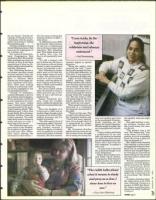
"The rabbi talks about
what it means to study
and pray as a Jew. I
show how to live as
one."
— Chaya Sara Silberberg
job entailed, what she might
expect.
One rabbi told her to sim-
ply meditate. Another said
she would marry the man,
not the job.
"The picture was a bit
rosy," Ms. Nelson said. "I see
us as a team. I try to be sup-
portive, to act as a sounding
board. But every so often my
toes are stepped on."
Mrs. Nelson cited examples
like inability to alter travel
arrangements when her hus-
band had an emergency in
Detroit and changed flights,.
or receiving an anonymous
letter telling her she should
not wear pants in public (she
still does.)
"I'm sure congregants have
comments. I'm never going to
please everyone. So I please
me. I attend services. Pm in-
volved in sisterhood, but I
participate as Alicia, not the
rabbi's wife. I don't have to be
at everything," Ms. Nelson
said.
A Judaica business keeps
Ms. Nelson busy much of the
time. Following 14 years as a
teacher at Hillel Day School,
Ms. Nelson opened her home-
based shop called Tradition!
Tradition!
SCENES page 72