
>-'
A Jewish temple and an Episcopal church are expanding
their unique housekeeping arrangement in Ann Arbor.
AUCE BURDICK SCHWEIDER SPECIAL TO THE JEWISH NEWS
ome 200 members
of Ann Arbor's
Temple Beth
Emeth and Saint
Clare of Assisi
Episcopal Church
stood side by side
this fall for a spe-
cial commemora-
tion. The two
congregations, which have
shared a place of worship for
nearly two decades, were cel-
ebrating the groundbreaking
of their long-awaited expan-
sion project.
Under a soaring steel Star
of David and Christian cross,
the clergy of both congrega-
tions led the group in prayer,
followed by the singing of
nondenominational songs di-
rected by the choirs.
"I think there was relief,
joy and anticipation that we
have finally moved from the
planning stage to building
stage," said Robert Levy, who
has been the rabbi at Temple
Beth Emeth for the past 10
years. "This represented a
new era in our relationship
with St. Clare's."
The building project was a
natural progression since the
inception of "Genesis of Ann
Arbor," the name of the legal
agreement in which both the
temple and the church joint-
ly own the building but con-
tinue to practice their
religions separately.
"Over the years both con-
gregations have grown
tremendously, creating a
need for more physical
space," Rabbi Levy said. "So
a building committee, con-
sisting of members from both
congregations, was formed,
and they have been working
together to design a building
that would meet the needs of
both Beth Emeth and St.
Clare's. With the addition, we
will be both better able to ful-
fill our missions —
and ours is to better
serve the Jewish
community of
Washtenaw Coun-
ty."
The partner-
ship between the
church and temple
began in 1970,
Building a new
Genesis.
when the small, recently
formed Reform Jewish con-
gregation was looking for a
new place to hold their ser-
vices. They asked St. Clare of
Assisi Episcopal Church if
they could rent space.
One of the first adjust-
ments was setting up the
sanctuary to accommodate
both religions. The cross that
hung over the alter was re-
constructed to swing back,
and an ark was made to open
from behind a panel on the
bimah for temple services.
The eternal light was put on
a track that can be moved to
the side for church worship.
Praying under one roof also
necessitated compromises.
Jewish religious school class-
es had to take place, and still
do, on Saturdays because the
church uses the building on
Sundays for services. And
when Christmas Eve falls on
a Friday night, the temple
has to move Shabbat services
to an earlier time.
Nonetheless, for five years
the two congregations con-
tinued to coexist smoothly,
each practicing their own
faith, observing their own re-
ligious holidays and cele-
brating their own life-cycle
events. As time went on, they
began to share some events.
They participated in a joint
Passover seder, held annual
pulpit exchanges and began
to help each other out as well.
During the High Holy
Days, church members would
babysit the children too
young to attend adult ser-
vices, and during Christmas
and Easter, temple members
would reciprocate.
When it came time for the
temple to establish their own
site, neither congregation
wanted to sever their com-
patible relationship.
"We had been renting for
two years; they knew we were
beginning to look and they
made us this offer," said Lin-
da Vanek, who was a temple
board member at the time.
"Although there were a few
people who were less-than-
enthusiastic, most saw this
as an economical advantage
and an opportunity to prac-
tice brotherhood. At the time,
both congregations were
about the same size — 150-
200 families each."
"Among the many reasons
we agreed to the joint venture
was a chance to make an
open statement about the re-
pugnance and horror of anti-
Semitism," said St. Clare's
Reverend Doug Evett, who
has been rector of the church
since 1972. "The original
agreement came right after
the Yom Kippur War, and
that was a good way to show
solidarity."
While a few members of
both congregations objected
to the arrangement and chose
to leave, most liked the idea
of different faiths living to-
gether in harmony. In fact,
one of the activities added af-
ter the Genesis agreement
was a Thanksgiving Eve ser-
vice, in which both congrega-
tions participate.
A few years ago "Genesis"
came to another crossroads.
Since the membership of
Beth Emeth and St. Clare's
grew, their needs changed,
and in order to continue to co-
exist there had to be some ex-
pansion.
"The growth of the congre-
gations required that we ex-
pand our facilities," said Alan
Cotzin, co-chair of the joint
building committee. "It has
been an integrated process
throughout. We looked at our
priorities, held numerous
meeting with both congrega-
tions, and voted almost unan-
SIDE BY SIDE page 110
109
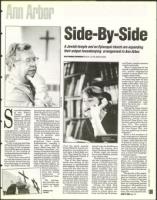
Scanned image of the page. Keyboard directions: use + to zoom in, - to zoom out, arrow keys to pan inside the viewer.
January 21, 1994 - Image 109
- Resource type:
- Text
- Publication:
- The Detroit Jewish News, 1994-01-21
Disclaimer: Computer generated plain text may have errors. Read more about this.