

Community Views
Editor's Notebook
Circling The Wagons Is Not
The Answer To Jewish Survival
Should Our Children
See 'Schindler?'
DAVID GAD HARF SPEC AL TO THE JEW SH NEWS
PHIL JACOBS EDITOR
For the past sev-
eral years, the
American Jew-
ish community
has been ab-
sorbed by issues
that are collec-
tively known as
"Jewish continu-
ity." The symp-
toms of the problem include a
higher rate of intermarriage, a
lower level of ritu-
al observance and
diminished affilia-
tion with syna-
gogues and Jewish
organizations. At
root, the concern is
about Jewish sur-
vival itself. Some
demographers
have even predict-
ed the disappear-
ance of American
Jewry or its rele-
gation to the ranks
of the Shakers,
during the first
half of the next
century.
A wide range of
cures has been pro-
posed to reverse
trends and to as-
sure Jewish com-
munal preserva-
tion. Among these
are more liberal (or
stricter) policies on
the inclusion of
non-Jews in Jew-
ish family and
communal life, ex-
panded Jewish
family program-
ming, enhanced
Jewish education,
increased opportu-
nities for Jewish
camping and Israel
study for youth and young
adults.
In fact, nearly every Jewish
institution has redefined its mis-
sion — or its marketing— to in-
corporate the Jewish continuity
theme. To the extent that these
are serious efforts and to the ex-
tent that our community com-
mits resources for initiatives
that show promise, the focus on
Jewish continuity is a healthy
phenomenon.
However, I am deeply con-
cerned that many people equate
Jewish continuity with Jewish
insularity. A new Jewish isola-
tionism would, in fact, defeat the
purpose ofJewish continuity.
By Jewish isolationism, I mean
the attitude that, "We have so
many problems within the Jew-
ish community, we can't con-
tinue to help society in general."
From a religious standpoint,
David Gad-Hart is executive direc-
tor of the Jewish Community
Council.
Jewish survival should be val-
ued not for its own sake, but
rather to preserve the Jewish
values we hold dear, including
tzedekah, doing justly, and
tikkun olam, the repairing of the
world. Hall we convey to young
people is that the Jewish com-
munity must continue for sur-
vival's sake alone we are
betraying Judaism.
Furthermore, serious efforts
to attract Jews back to the fold
and deepen their attachment to
Judaism will be undermined by
an insular approach. Many
Jews are infused with a sense
of social conscience and a corn-
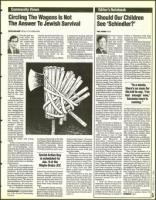
Social Action Day
is scheduled for
Jan. 9 at the
Maple-Drake JCC
mitment to social and political
action. Many of these same
Jews feel estranged from the or-
ganized Jewish community,
never realizing that their con-
cern for the society-at-large
flows from their Jewish her-
itage.
A successful Jewish continu-
ity initiative would capture this
spirit of social action and rede-
fine it as tikkun olam. It would
introduce into Jewish education
a component dealing with the
scriptural, talmudic and histor-
ical bases ofJewish involvement
in the society around us.
This cannot and should not
be the sum ofJewish continuity
efforts. But a comprehensive
and effective strategy would be
incomplete without it.
One such program, Social Ac-
tion Day, is scheduled for Jan.
9 at the Maple-Drake Jewish
Community Center. Nineteen
Reform, Orhtodox, Humanist
and Conservative synagogues
and organizations have decided
to join forces in mobilizing us to
help those in need, Jews and
non-Jews alike.
While other Jewish continu-
ity strategies are still on the
drawing board and while the
search for resources to support
new initiatives is being con-
ducted in earnest, we have an
opportunity before us to reach
out to many Jews and offer
them a good way to express
their Jewishness.
I look forward to the day
when every Jew in Detroit can
find his or her niche in the Jew-
ish community, whether that
niche is at a morning minyan,
on the board of a Jewish orga-
nization, or as an afternoon tu-
tor at a Detroit school. When
that day arrives, we can stop
worrying about Jewish conti-
nuity. ❑
By now it seems
we all know
someone who has
seen the movie
"Schindler's List,"
Steven Spiel-
& berg's adaptation
of the acclaimed
Thomas Keneal-
ly novel.
A follow-up question that
many have talked about with
their friends and colleagues is
the factor of exposing such a
movie to their children. For those
with teen-age children, the con-
census is to bring them to see it,
so that they can see the impor-
tance of the Holocaust in their
lives, not only as Jews but as
members of the human race. For
those with younger children, the
answer seems to be that when
they are ready, they will be :?x-
posed to the Holocaust, bit by bit.
Certainly, most of us agree
that graphic depictions of almost
anything of a violent nature need
to be screened from our children.
If there is an argument at all to
be made here, it comes in dis-
cussion of the children of the
Holocaust themselves.
Indeed, they more times than
not didn't have the opportunity
to have anything screened from
the misery they experienced. So
many of them were forced at
gunpoint to leave their very par-
ents' loving arms. In many cas-
es, children were "guardians" of
their younger siblings and
friends.
Many of us have a feeling re-
lated to the Holocaust that is os-
tensibly personal, a feeling that
gives us anxiety, hurt and anger
with its very thought.
For me, it's a photo I saw in
1988 during a tour of Yad
Vashem, Israel's Holocaust Mu-
seum and Memorial in
Jerusalem. I turned a corner
down a corridor in the Museum
when I was taken away from the
crowd and was held transfixed.
It was almost as if my soul was
shot down. There looking back
at me from a wall was an en-
larged photograph of two little
girls sitting on a curb side. One
tried to comfort the other, whose
mouth was gaping in hysterical
tears. They could have been any-
one's children, and they should
have been swinging on swings,
playing in a playroom instead of
destitutely hoping for help. At
this writing, it's even too difficult
for me to take the photo from my
personal mental file and re-
member it.
I "look" for these two girls
whenever I return to Israel. I've
seen them only one other time.
But I remember them, and when
I can, I'll introduce them to my
children as well. There is no pho-
to of the Holocaust, no stacks of
bodies or Germans with dogs
and guns, that motivates and
angers me more.
A friend of Eastern European
descent, who has an early recol-
lection as a five-year-old being
beaten up and verbally abused
because he was a Jew, feels there
is a certain difference between
experiencing the Holocaust and
witnessing a film some 50 years
later. He ended up in a concen-
tration camp at age 13 never to
see his parents and brothers
again. Now a grandfather, he
feels that children, our children,
his grandchildren, shouldn't be
exposed possibly until age 12 or
13 to the Holocaust. The abuse,
the butchering, was part of Jew-
ish life during that time period,
he said. The children were used
"In a movie,
there's no room for
the kid to say, 'I've
had enough now,'
because more is
coming."
to distrusting anyone not Jew-
ish. He and his friends were al-
ready "mature" by the time they
reached teen-age. Still, he said
children of the Holocaust be-
lieved in the strength of their
parents to protect them even
when they were in the camps.
Parents, he said, would shield
their children, by not telling
them what was really happen-
ing in the camps around them.
The children, he added, often
didn't think they would die.
Dr. Jeffrey Last, a child psy-
chologist based in Southfield,
said that the Holocaust shouldn't
be hidden from young Jewish
children. It should be given to
them at the level they are ask-
ing, no more, no less.
"One of the problems of a
movie is that you get answers for
questions that weren't asked,"
said Dr. Last. "It's different than
walking through a museum
where you can pause, look at a
photograph and discuss it. In a
movie, you can't stop, you can't
get feedback. There's_na room for
the kid to say, 'I've had enough
now,' because more is coming."
It's difficult enough to make
sense of a subject such as the
Holocaust for adults. While we
help our children grow into an
understanding of the Holocaust,
we should also be prudent with
ourselves, our parents, grand-
parents and friends.
It is not written anywhere
that when a person turns 18
SCHINDLER page 7