

gales was building a but of mud
and oak timbers, which became
the city's first store. Isaac served
as proprietor. Customers were
mainly railroad workers.
In May 1882, Jacob became
the town's first postmaster.
That same year, Nogales' third
resident, John Brickwood, came
on board. Brickwood later
served as mayor.
Meanwhile, Jacob, who for a
short time studied to become a
rabbi, found everything he
needed in the incomparable ad-
ventures of the Old West, and
in his faith. Years later, his sis-
ter would say of him: "He evi-
dently felt and knew that God
alone was right there with him
— watching, guiding, and lead-
ing him on to success. None
knew better than he did of God.
"The big event of Nogales'
early days was the completion
in 1882 of the junction of the
two railroads linking Tucson
with Mexico. (The line, the
Sonora Limited, was the first
railroad built in Mexico).
Among those attending the cel-
ebration was Jacob Isaacson,
who often had prepared meals
for men working on the rail-
road.
Three years after settling in
Nogales, Isaac Isaacson decid-
ed to leave. He sold the broth-
ers' store, located on Morley
Avenue, and moved to Los An-
geles, where he opened a pawn
shop. He married Emma Rosen-
becker, later returning to San
Francisco. Emma died in 1913;
Isaac died in 1926.
The new town in Arizona ini-
tially was named for its
founders, though no one knows
whether it was called Isaacson,
Isaactown or Isaacville. Then,
in the early 1800s, before Isaac
left, the name was changed to
Nogales (Spanish for "walnuts,"
which grow throughout the
Photo by Arizona Historical Society/Tucson #7855
area). According to author
Joseph Stocker, Jacob Isaacson
himself made the change after
realizing how difficult it was for
Spanish speakers to pronounce
his last name.
Some suggest Jacob picked
"Nogales" because the brothers'
first store had been founded in
a grove of walnut trees. Others
say he was inspired after hear-
ing a boy singing a Spanish
song about a monkey and a wal-
nut tree. Just about everyone
agrees that at some point, Ja-
cob Isaacson became known as
"Mr. Nogales."
Jacob left Nogales one year
after his brother, around 1884,
by which time the town had a
handful of residents. He went
to Mexico, where he became
deathly ill and was expected to
die. "Then an elderly Mexican
woman took charge of him," his
sister, Birdie, recalled in a
memoir written in 1940. "In
time, he recovered" and trav-
eled to Oregon, California, Mis-
souri, Texas and Utah. He
started numerous businesses,
including a mining foundry, all
of which were successful.
He married Bessie Wolf of
San Francisco, with whom he
had four children: Henrietta,
Lee, Flossie and Sammy. Hen-
rietta lived for a time in Detroit,
and Flossie, who was labeled
"feeble," was institutionalized
in Michigan. There's no record
of Sammy or Lee.
Among the few personal rec-
ollections of Jacob Isaacson is
the 1940 letter written by his
sister, Birdie Cornfield, who had
returned to live in New York
City.
She says ofJacob that he "was
always genuine in all dealings,
never told a lie" and "hated
wrongdoers." He loved Indian
relics — blankets, arrows and
headdresses — and was a mu-
sician and singer
with a "fine baritone
voice." He also loved
fancy clothes and
traveling.
Bessie Wolf Isaac-
son died in 1902. In
Denver, Jacob mar-
ried Jennie Pierce, a
widow with a 2-year-
old daughter. It was
not a happy union.
Jacob returned to
his home in El Paso,
Texas, from a busi-
ness trip to find that
Jennie had deserted
him and taken
everything he
owned. The shock of
Jennie's departure
apparently led to Ja-
cob's severe depres-
sion.
After receiving
what she labeled "a
Jacob Isaacson
Nogales Today
W
ere Jacob Isaacson to return today to
Nogales, at least one site would still be
familiar.
Morley Avenue, the street where Ja-
cob and Isaac Isaacson opened their trading
post, is still there. In fact, the Santa Cruz Coun-
ty Courthouse, erected in 1904, is on the corner
of Morley and Court Street.
Located 60 miles south of Tucson, Nogales is
probably best known for its tourist shops. These
offer everything from upscale Mexican arts and
crafts to the ultimate treasure for connoisseurs
of kitsch: black velvet paintings of Elvis. No-
gales also has an elderhostel.
In 1893, the year the city was incorporated,
Nogales was home to a handful of residents, only
nine of whom were women.
(They did not, however,
simply sit around and knit.
The women established a
dramatic society and pre-
sented a number of plays,
including Ten Nights in a
Barroom.)
Today, Nogales' popula-
tion is 24,000.
In addition to the Santa
Cruz County Courthouse,
travel books list a number
of points of interest for vis-
itors to Nogales. These in-
clude an immigration
inspection station, a U.S.
customs station and the
Nogales Public Library.
❑
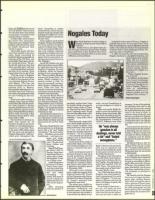
Modem-day Nogales.
peculiarly written letter" from
her brother, Birdie arranged for
Jacob to take a train to Chica-
go. She met him there, finding
Jacob "helplessly weak. We got
him into the coffee shop in (the)
depot and I fed him slowly —
carefully — soup, milk, a bit of
custard."
They then took a train to De-
troit, where Birdie and her hus-
band, Joseph Cornfield, were
living at the time. They arrived
at 1 a.m. and were met by
Joseph who quickly "phoned to
the doctor — Dr. H.L. Simpson
— who advised he (Jacob) be
taken at once to Grace Hospi-
tal," Birdie wrote.
Jacob spent three weeks at
Grace after which, at Dr. Simp-
son's recommendation, he was
taken to a home for the men-
tally ill.
Jacob would spend much of
the next 18 years in and out of
mental institutions. He first
went to St. Joseph's Retreat,
Michigan's first hospital for the
mentally ill. Located on Michi-
gan Avenue near Outer Drive
in Dearborn, the facility opened
in November 1883.
Although it was a Catholic
home, under the auspices of the
Sisters of Charity of St. Vincent
de Paul (the same order that es-
tablished Providence Hospital),
St. Joseph's welcomed both
Protestants and Jews.
The retreat was a highly so-
phisticated facility that featured
attractive landscaping and
beautiful rooms. It also catered
to sane patients who needed to
"mcover from the effects of over-
work, nervous breakdown or
unwise indulgence in drink or
drugs."
After one month, Birdie de-
cided to move her brother to a
facility closer to her home. She
had Jacob admitted to the No-
ble Sanitarium and Rest Home
for Convalescents. Located at
14742 E. Jefferson, near Alter
He "was always
genuine in all
dealings, never told
a lie" and "hated
wrongdoers."
Road in Detroit, the private fa-
cility was an expensive rest
home for the mentally ill. Jacob
would spend several years at
the Noble Sanitarium.
Though he never returned to
live in the West, Jacob made so-
journs back to Arizona. He vis-
ited Nogales, the population of
which had reached 1,761 by
1900. There, "the entire popu-
lace made much of their hero,"
his sister Birdie wrote.
In a 1910 interview with the
Douglas, Ariz., Daily Dispatch,
Jacob remembered the early
days of Nogales. ("A look sug-
gestive of distance crept into his
eyes" as he began to speak, the
reporter writes.):
It was lonely in those times —
yes, very, very lonely. On some
days there would be little or no
travel and during the nights I
had only the stars to keep me
company. On top of this solitude,
the Apaches were still in the
land, and always there existed
the awful dread that they would
come in the dead of night, or
with the rising of the sun, and
find me unprepared to fight for
my life. More than one visit did
I receive from them, but I always
managed to get away with my
life.
Jacob spent his last days at
Eloise Hospital for the mental-
ly disturbed, part of a state-run
facility in Wayne County that
included the Eloise Infirmary
for indigents and the Eloise
Sanitarium for patients with tu-
berculosis.
He died at 2:45 p.m. Dec. 27,
1928, at Eloise. He was 75 years
old. The cause of death was list-
ed as cerebral arteriosclerosis.
Three days later, he was buried
at Machpelah.
In recent years, representa-
tives of Nogales have expressed
interest in placing a stone on
the grave, according to Mach-
pelah office secretary Glenyce
O'Connor. One resident of No-
gales, Abe Rochlin, has for some
time been conducting a finan-
cial campaign to purchase a
marker.
Mr. Rochlin told the Nogales
Panorama he began the cam-
paign after visiting Detroit,
from which he hoped to return
with a picture ofJacob Isaac-
son's grave. Instead, he said, all
he could photograph was the
barren ground, the unmarked
grave where the founder of No-
gales lies.
❑