

•
Baltimore when he was 3 years
old. Movies had been in his
blood from infancy. His Russ-
ian grandpa, Jacob Saegel, was
a tobacco farmer who came to
the United States in 1912 hav-
ing never heard of motion pic-
tures. He read a textbook on
movies, then took an exam to
become a projectionist.
(The occupation required cer-
tification in those days because
it was dangerous. High-power
projectors often ignited, a la
Cinema Paradiso. Later on in
life, Grandpa Saegel was blind-
ed by an arc light.)
Undaunted, Sid pocketed all
of the $16 he received for his bar
mitzvah. He worked at his fa-
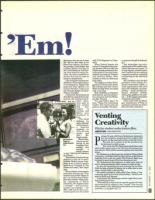
AWN saw a ther's down-
figlif
town store to
save another
$16,
then
walked
to
Crowley and
Milner (now
Crowley's) to
buy...
"The whole
— shebang. An
eight milimeter
movie camera,
a Keystone
projector, an
18-by-24-inch
screen and
film," Mr.
Siegel recalls.
Meanwhile,
Sid and Naomi
Siegel: An
Naomi was fol-
enterprising film lowing in the
duo.
footsteps of her
mother, who
brought
a
movie camera
on her 1936 trip to Palestine
and filmed...
"Everything: People waving,
walking in and out of doors.
Smiling. Mother was an inspi-
ration to me, in that if a person
could do it, I could do it. The
camera isn't sexist," Mrs. Siegel
says.
Sid and Naomi crossed paths
more than 50 years ago. They
married and pooled talents to
get in on the hey-day of Michi-
gan's film industry. After study-
ing engineering at Wayne
University, Mr. Siegel became
a "stringer" — free-lance cam-
eraman and reporter — for
NBC, CBS and Tel-RA, a syn-
dicated sports reel. He worked
with "P.M. Magazine" on Chan-
nel 2.
When Detroit became the
center of industrial film mak-
ing, between 1930 and 1960, the
couple created promotional doc-
umentaries for new and exper-
imental cars made by Chrysler
and American Motors. They
continue to work on a free-lance
basis today.
The Siegels and other Michi-
ganians involved in the state's
film industry can't deny a trend.
When the Big Three are doing
well, so are they.
Shev Goldstein, a long-time
local director, says the automo-
tive recession hurt the Michi-
gan film industry.
"It's seen better days," he
says. "Today it's a shrinking
market. The creative side has
gotten a lot smaller. The glam-
or comes in the gift of technolo-
gy. ”
But technology has mini-
mized much of the need for the-
atrical directors and actors. To
a large degree, theatrics have
been replaced by eye-catching
computer graphics, pulsating
and glowing on the television
screen.
Mr. Goldstein was the first
president of the Detroit Pro-
ducers Association (DPA), a
trade organization with more
than 700 members. Its mem-
bership — which includes pro-
ducers, directors, writers,
actors, grips, gaffers, even cater-
ers — is the largest association
of its kind nationwide.
DPA works with the Michi-
gan Department of Film in
Lansing to promote the state's
film and video industries.
Venting
Creativity
This law student makes feature films.
p
JENNIFER FINER JEWISH NEWS INTERN
erhaps 24-year-old Bryan Beckerman represents
the vast majority of aspiring movie-makers who
hope to one day see their movies on the big screen.
For now, he is content to air his movies on ca-
ble television's public access.
But, what sets Mr. Beckerman apart from most
other public access users is the fact that he produces fea-
ture movies. Most public access programs are interview
shows.
Mr. Beckerman, a third-year law student at Wayne State
University, would like to see his films shown at the Detroit
Institute of Art or the Ann Arbor Film Festival. Right now,
he plans to spend most of his time focusing on law.
Mr. Beckerman's first exposure to video came when he
was 9, using his parents video camera to make movies.
He does all the producing and directing for his films.
With the help of about 20 people, he is often able to com-
plete a movie within a few months.
His current venture is a film called Viper Valley, a "doc-
umentary spoof on love and relationships," which he ex-
pects to finish by February.
In the future, Mr. Beckerman said he might like to prac-
tice entertainment law.
`That could be a way for me to connect my love for mak-
ing movies and my interest in law," he said. "You can only
be so creative in law. Making movies allows me to vent my
creativity in a tangible way." U
c)
0)
0)
\
CC
LLJ
LU
69