

More Myth
I I . The service in
Solomon t Temple
was accompanied
by an organ.
Jewish Scripture says that the Temple service was indeed
accompanied by music. The Levites played a variety of string,
wind and percussion instruments. But the organ was not
among them.
The modern pipe organ is a descendant of the hydraulis in-
vented by Ctesibios of Alexandria around 250 BCE. This crude
instrument was developed by the later Greeks, Romans and
Byzantines who introduced it in the Middle East.
The legend that an organ was used in the Second Thmple
seems to have come into Jewish thought in the early Middle
Ages, when Talmudic commentators confused the hydraulis
with magrefa, a tool used to clean the altar.
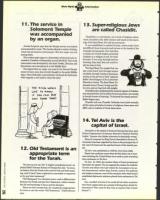
TIE KIN & WOULD
LIKE To KNOW
lF You cAN PLAY
ANY SNOW IlAWE5
Information
3. Super-religious Jews
are called Chasidic.
Chasidism is a movement, not a level of religious obser-
vance, founded in the 18th century and based on the teach-
ings of the Baal Shem Toy and his successors.
It was established in eastern Europe, where many Jews
led difficult lives of poverty and torture at the hands of the
Cossacks and peasants. Few had time
to study, yet Jewish leaders promoted
Judaism as a religion of and for intel-
lectuals. It was only through serious
learning, they said, that one could re-
ally be close to God.
The Baal Shem Toy taught that one
also could reach God through prayer
and faith, through "purity of intentions
and joy in the service to God," explains
Rabbi David Kagan of the Lubavitch
Education Center. The Baal Shem Thy
stressed ahavat Yisrael, loving one's fel-
low Jew, and serving God with delight.
Chasidism also emphasized the mystical aspects of Judaism
and asserted that God could be found anywhere, not simply
in Jewish houses of learning. "It elevated the simple person,"
Rabbi Kagan says.
Chasidic and non-Chasidic Orthodox Jews hold virtually
all the same principles in terms of religious observance and
differ only in matters of ritual observance.
•
I 4. Tel Aviv is the
capital of Israel.
12. Old Testament is an
appropriate term
for the Torah.
"As soon as you say 'old,' it implies something newer," ex-
plains Rabbi Norman Roman of Temple Kol Ami. "As Jews,
we believe that the Tbrah is the word of God and God's teach-
ing, and it hasn't been replaced or succeeded or improved
on by any later testament."
"Old Testament" is a Christian term, used to differentiate
between the Tbrah and the New Testament, which contains
the life and teachings of Jesus and his disciples.
"Since we don't accept that, it's completely inappropriate
for Jews to use the words 'Old Testament,' " Rabbi Roman
says.
Jerusalem is the capital of Israel and always has been, says
Zionist Organization of America Executive Director Ezekiel
Leikin. "Anyone who thinks otherwise is absolutely wrong."
Since its conquest by King David, described in Samuel II,
Jerusalem has been regarded by Jews as the principal city of
the Land of Israel and the spiritual heart of the Jewish peo-
ple.
Tel Aviv was established in 1909 by Jews from Jaffa.
Maybe the confusion comes from the fact that a lot of coun-
tries including the United States have made a point of putting
their embassies in Tel Aviv.
On Dec. 13, 1949, the modern State of Israel proclaimed
Jerusalem its capital. The act angered the Arabs, the Catholic
Church and others who had wished for Jerusalem to be un-
der international, rather than Jewish, control. For political
and religious reasons, most of the countries with which Israel
established diplomatic relations placed their embassies in
Aviv.
Gee, wouldn't it be fun if we could all tell other countries
what their capital cities are, instead of letting them decide for
themselves? Who votes for Bay City as capital of the United
States? ❑