

CONCLUSION
The findings of the 1992 Audit of Anti-
Semitic Incidents reflect some ground for
cautious optimism in the long battle against
anti-Jewish and other hate crimes. First
among these is a modest but noteworthy
decline in the overall total of anti-Semitic
acts reported nationwide, for the first time in
six years.
There are also some signs that greater and
more sharply focused efforts in the areas of
law enforcement and education, often with
intensive involvement by ADL, are achieving
positive results. Arrests have increased. The
most serious acts of vandalism (including
arson, bombings and cemetery desecrations)
have shown a significant decline, as have
neo-Nazi Skinhead-related anti-Semitic acts.
ADL's "A World of Difference" prejudice
reduction programs have reached hundreds
of thousands of students, teachers, and cor-
porate workplace professionals.
At the same time, certain danger signals
remain all too clear, tempering hope with
sobering realities. Anti-Semitic incidents on
U.S. college campuses continue to rise. Such
acts of hate - particularly troubling in a
venue dedicated to the advancement of
understanding - have jumped more than
100% over the past five years.
hate crimes against Jews comprised 17% of
the total of such crimes in 1991, even though
Jews make up only between 2 and 3% of the
U.S. population. ADL National Director
Abraham H. Foxman saw the release of the
FBI data as marking "the beginning of the
process that delivers a message that society
cares about hate crimes. Until now its been
the responsibility of each minority group to
fend for themselves.
"As efforts to implement HCSA continue
and expand, we will learn more about the
perpetrators of these especially hurtful
crimes - and how to prevent them."
The statistics only provide documentation
for the sense of unease long felt by many in
the community.
In conclusion, ADL has sought neither to
understate nor overstate the significance of
its Audit findings. Any measurable reduction
in Anti-Semitism is welcome. The problems
will not disappear overnight. Additional
efforts clearly are needed underlying atti-
tudes mired in bigotry.
AFTERWORD
The ADL Audit is an account of overt acts
or expressions of anti-Jewish bigotry or hos-
tility. It should be noted that many such inci-
dents are not crimes for example, distribut-
ing neo-Nazi pamphlets or directing slurs at
Jewish individuals. Thus, there are some dis-
crepancies between the totals of anti-Semitic
incidents reported in the ADL Audit and
those contained in official police reports of
bias crimes.
-
It should be remembered that the lower
total of anti-Semitic incidents in 1992 was
still the second highest total ever recorded.
Behind each of these statistics lies a commu-
nity outraged by the desecration of its holy
places, a family intimidated by hostility in
their neighborhood, an individual humiliated
and demoralized by an open affront to his or
her religious identity and personal dignity.
The pain of such distress and violation runs
deep, and is not quickly or easily assuaged.
Moreover, for many American Jews, 1992
was the continuation of a period of growing
unease. The Audit findings, notwithstanding
some measure of good news, come amid an
atmosphere of perceived growth in anti-
Semitism, especially in the influential areas
of politics and popular culture.
Political anti-Semitism, which had notice-
ably reared its ugly head in 1991 in connec-
tion with the Persian Gulf War continued to
be of concern as numerous extremists
learned to exploit the political process by
running for office, a la David Duke (though,
to be sure, few if any were elected). Pat
Buchanan, who had stirred the pot of bigotry
by accusing American Jews of promoting
war, achieved further prominence by chal-
lenging President Bush in several
Republican primaries and making a prime-
time speech at the GOP National Convention
which was widely criticized for its bitter tone
and polarizing themes.
In popular culture, certain rap and other
music groups continue trumpeting their mes-
sage of insult and violence toward various
minorities and women - and selling it by the
millions to impressionable youngsters. In the
general society, demagogues like Minister
Louis Farrakhan have been peddling hate
and finding large, receptive audiences to buy
it
In 1992, ADL, more than ever, was forced
to press and plead with responsible officials
and mainstream leaders to oppose and repu-
diate anti-Semitism.
Against this backdrop, ADL published the
findings of its national opinion survey on
U.S. attitudes toward Jews. As noted earlier,
the poll, by Marttila and Kiley of Boston,
found that 20% of the American people hold
strongly anti-Semitic views. While this repre-
sented some progress over the past 25 years
in reducing certain anti-Semitic attitudes,
the figure still represents 40 to 50 million
people. Moreover, approximately a third of
those polled expressed the opinion that Jews
hold "too much power" in the United States,
and the American Jews are more loyal to
Israel than to the United States. The results
within the American black community were
even more troubling: 37% of American blacks
were found to be strongly anti-Semitic.
On another front, the FBI in 1992, released
its first annual data collection report under
the provisions of the Federal Hate Crime
Statistics Act. According to the FBI data,
The paramount purpose of the ADL Audit
has always been to provide the community
and its elected and law enforcement officials
with an accurate and reliable measurement
of anti-Semitic activity, and thus, a basis for
responsible evaluation and counteraction
regarding a troubling and dangerous prob-
lem.
ADL'S COUNTERACTION
PROGRAM:
ADL has developed and supported a combi-
nation of preventive and counteraction mea-
sure over the past fourteen years to enable
the Jewish and other communities to protect
themselves and respond effectively to vandal-
ism, harassment, and other forms of bias
crimes. Major elements of this broad-ranging
program are detailed here.
CONFERENCES ON
SECURITY AND
BIAS CRIME
Together with law enforcement authorities,
educational, and other religious and ethnic
organizations, ADL offices at the local and
national levels have carried out programs of
public education, emphasizing the need for
effective security at houses of worship and
other community-based institutions.
In cooperation with Brandeis University's
Nathan Perlmutter Institute for Jewish
Advocacy and Cohen Center for Modern
Jewish Studies, the Anti-Defamation League
held its second Salzberg Conference on Anti-
Semitism in November 1992.
The consortium is made up of 80 local police
departments, three county prosecutors'
offices, three county sheriffs offices, and all
federal law enforcement offices in the state,
as well as the Michigan State Police.
New Jersey developed a state-wide tool in
the fight against bias crimes. The state
Legislatures set up a 21-member
Commission on Racism, Racial Violence, and
Religious Violence. The Commission will hold
public meetings around the state to hear
from experts, victims, and the public about
ideas which may become recommendations to
the Legislature within the year. The director
of ADL's New Jersey Regional Office is vice-
chair of the Commission.
Further, resolutions urging comprehensive
implementation of the Act have been passed
by the IACP, the U.S. Conference of Mayors,
the National Association of Attorneys
General, the National Sheriffs Association,
the Fraternal Order of Police (FOP), the
Association of State Uniform Crime
Reporting Programs (ASUCRP), and the
International Association of Directors of Law
Enforcement Standards and Training
(IADLEST).
During 1992, in addition to the previously .
mentioned community programs, ADL
regional offices have organized, cosponsored,
or participated in more than 45 security con-
ferences and training sessions for law
enforcement officials on anti-Semitism,
racism and extremism, covering the following
states: Alabama, Arizona, California,
Colorado, Florida, Georgia, Illinois, Iowa,
Louisiana, Maine, Massachusetts, Michigan,
Minnesota, Montana, Nebraska, New
Mexico, New Jersey, New York,
Pennsylvania, Ohio, Texas, Washington and
in the District of Columbia.
The League's testimony concluded:
"Obviously, even the best-trained officers will
not eliminate criminal activity motivated by
prejudice. The long-term solution is educa-
tion and experience, leading to better under-
standing and appreciation of diversity in our
society. But effective response to this type of
criminal activity by public officials and law
enforcement authorities can play an essen-
tial roles in deterring and preventing these
crimes. The success of the HCSA will be
determined at the local level - and it will be
measured by the response of these officials to
each criminal acts motivated by prejudice."
By coordinating police and local institution-
al leadership, ADL seminars, conferences,
and training have promoted greater commu-
nity awareness of practical bias-crime pre-
vention methods, stronger support among
cooperating agencies, and heightened sensi-
tivity by public officials for the citizens they
serve. They have also helped communities to
understand the important of reporting bias
crimes whenever they occur, and of extend-
ing community support to bias crime victims.
2. The Federal Hate Crime Sentencing
Enhancement Act
ADL also submitted testimony at hearings
on July 29 before Rep. Charles Schumer's
(D-IL) Judiciary Subcommittee on Crime and
Criminal Justice.
CONGRESSIONAL
INITIATIVES
THE U.S. CONFERENCE
OF MAYORS: ACTION
AGAINST HATE
VIOLENCE AT THE
MUNICIPAL LEVEL
Congressional attention has been focused
on the effectiveness and constitutionality of
two federal hate crime initiatives:
1. The Hate Crimes Statistics Act
(HCSA)
The HSCA, enacted in April, 1990, requires
the U.S. Attorney General to acquire data on
crimes which "manifest prejudice based on
race, religion, sexual orientation or ethnici-
ty." The law also requires the Attorney
General to publish an annual summary of his
findings.
ADL representatives had provided advice
and counsel as the Bureau's training materi-
als and implementation guidelines were
developed. These two resources have now
been distributed to the over 16,000 law
enforcement agencies nationwide that regu-
larly voluntarily report crime data through
the FBI's Uniform Crime Reporting Program.
The U.S. Conference of Mayors has played
a leading role in public pronouncements and
initiatives addressing hate violence. The
Conference passed a broad Resolution on
Racism and Hate Crimes, calling on Mayors
and other government officials "to exercise
leadership in addressing hate crimes in their
communities - including condemning hate
violence, pressing for enactment fully in the
Hate Crime Statistics Act's data collection
process."
In addition, the Conference released a
report, "Addressing Racial and Ethnic
Tensions: Combatting Hate Crimes in
America's Cities," jointly prepared with the
Anti-Defamation League. This report includ-
ed an analysis of results from a Conference
survey on the response of city governments
to hate violence, the texts of comprehensive
hate crimes policies and procedures from
police departments in five geographically-
diverse cities, and a listing of reference mate-
rials on topic, including many ADL
resources.
The League's resources on hate groups and
hate crimes are referenced in the FBI train-
ing materials, and the ADL police training
video - produced in cooperation with the New
Jersey Department of Law and Public Safety
- has been highlighted at many of the FBI
seminars and other law enforcement confer-
ences across the country.
In addition, the National Policy Center of
Around the U.S. in 1992, ADL sponsored,
cosponsored, or participated in conferences
on anti-Semitism, security, and extremism.
These meetings brought together all commu-
nity elements - institutional leaders, clergy,
educators, parents, and law enforcement offi-
cials - to discuss bias oriented attacks, and to
grapple with the how to's of stronger security
measures.
ADL, both regionally and nationally, partic-
ipated in various grass roots anti-bias activi-
ties such as the Northwestern Coalition
against Malicious Harassment, Inc.; the
Georgia Committee for Civil Rights Under
Color of Law; the Governor's Hate Crimes
Task force, Massachusetts; and the National
Advisory Panel for the Hate Crimes Training
Project, which is funded by the department
of Justice for victims of crimes. In Michigan,
the ADL regional director is a consultant to
the Michigan Association of Chiefs of Police
and convenor of an informal consortium of
police and law enforcement departments.
the International Association of Chiefs of
Police (IACP) published an excellent Model
Policy on the subject, accompanied by a com-
prehensive Concept and Issues Paper in
August 1991. The Federal law Enforcement
Training Centers (FLETC) has convened a
series of meetings with hate crime response
experts from around the country - including
ADL representatives - to develop a model
curriculum for delivery to federal, state, and
local law enforcement officials.
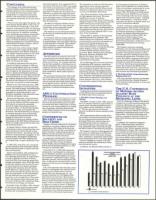
974
ADL AUDIT OF ANTI-SEMITIC EPISODES
950
VANDALISM
HARASSMENTS, 'THREATS AND ASSAULTS
YEAR-BY-YEAR
NATIONAL TOTALS
823
8 ,6 874
845
58
715
638
584
363 1 1312
32
758 1
1984
KEY:
111
VANDALJSMS
HARASSMENTS, THREATS AND ASSAULTS
1985
1986
1987
1988
1969
1990
1961
1992