

Surveying Our Neighbors
The Jewish News, Wayne State
and the Jewish Council take a
look at how Jews view them-
selves in relation to the people
they live and work with.
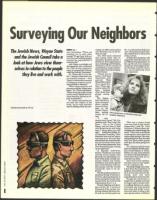
illustration and charts by Tim Lee
SURVEY page 1
tion Committee, "We're not
reaching out to each other
enough. We get busy with our
own lives and building bridges
becomes the responsibility of
someone else."
Jack Ukeles, a sociologist and
demographer who conducted
the 1989 Jewish population
study of metropolitan Detroit,
called the findings "interesting."
Dr. Ukeles said it is his be-
lief—based on observation and
not scientific analysis — that
"there is tremendous amount
of intergroup suspicion and la-
tent hostility in America."
"When times are good, and
jobs are available, things seem
better," Dr. Ukeles speculated.
"When times get rough, things
tend to erupt. Maybe the eco-
nomic downturn has had an im-
pact on attitudes.'
Dr. Ukeles cautioned he has
not seen the results of the
study, but he said attitudes
may be shifting within the corn-
munity. In 1989, concern about
No. 1 on 26 percent of the sur-
anti-Semitism was on the de-
veys. Enhancing Jewish iden-
cline, he said.
tity ranked first on 25 percent
The 1993 study indicated
of the surveys.
that among those who re-
Of these four questions, only
sponded to questions, the No. 1
support for Israel showed a ma-
priority for local organizations
jor difference by generations. In
was combatting anti-Semitism.
the age 65 and over category,
Working to rid the country of
23 percent Israel highest prior-
anti-Semitism ranks substan-
ity. For those under 45, 14 per-
tially hgiher than showingsup-
cent rated supporting Israel
port for Israel.
most important.
"Things are not
better," said Dena
Oppenheim, a 36-
year-old West
Bloomfield mother
of two small chil-
dren. "They may
even be worse. We
keep hearing
about these Nazi
groups emerg-
ing."
Ms. Oppen-
heim said she is
more concerned
about combat-
ting anti-Semi-
tism in the
United States =
than raising Dena O
ppenheim of West Bloomfield with
money for Is-
daughter, Stephanie.
rael.
"I
care
deeply about Israel," Ms. Op-
penheim said. "But I don't live
"This was a pretty broad
there. I live in the United
once-over-look at the Jewish
States, and we have to deal
community," said Dr. Cary
with things that go with living
Lichtman, a Wayne State psy-
here. I worry about my chil-
chologist who helped design the
dren." Added Neal Drilich, 37,
study. "There was a multitude
of Commerce Township, "Anti-
of perceptions that Jews had
Semitism has to be an impor-
versus other groups. The over-
tant issue to us. We may have
riding feeling was that Jews feel
assimilated into American life,
they love these other groups
but we must learn from histo-
more than the other groups love
ry. We've been persecuted. And
them."
Anti-Semitism keeps rearing
Dr. Lichtman said the study
up its ugly head."
does not indicate Jewish preju-
In separate interviews,
dice toward blacks or Arabs.
blacks, Chaldeans and Arabs
Rather, he said, Jews perceive
said the survey results were
non-Jews to be less friendly to-
generally not astonishing. Au-
ward them than they are to-
thors of the study, Jewish com-
ward the non-Jews.
munity leaders and blacks,
"Jews tend to live together,
Chaldeans and Arabs agreed
and they want to stay togeth-
er," Dr. Lichtman said.
that overall relations with out-
side groups and the Jewish
The study brings more dear-
community need to be im-
ly into focus the importance of
religious and cultural continu-
proved.
ity in an era when Jews are be-
The 58 questions posed to re-
coming more and more
spondents during 15-minute in-
assimilated into American life.
terviews asked participants to
Though the community no
choose among four issues, rank-
ing priorities for local Jewish
longer lives in shtetls, and most
no longer need to remain with-
organizations from 1 to 4.
Overall, fighting anti-Semi-
in walking distance to a place
of worship, the study showed
tism was the No. 1 concern on
29 percent of the surveys. Im-
that Jews still prefer to live
proving relations between Jew-
near each other, to shop in the
ish and non-Jewish people was
same grocery stores, to befriend