

Syria-Israel
Accord Next?
A deal giving Syria full sovereignty
over the Golan in return for full
recognition of Israel is reportedly set.
DOUGLAS DAVIS FOREIGN CORRESPONDENT
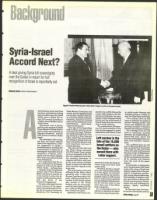
Egyptian President Mubarak greets Yitzhak Rabin in Egypt to confer on the peace process.
deal between Israel and Syria
has been concluded but is being
kept on hold to give the Israeli
public time to digest the re-
cent PLO accord, according to
a highly placed Middle East po-
litical source.
The source, who is Israeli,
said the main purpose of Israeli
Prime Minister Yitzhak Rabin's
visit to Cairo was to discuss an
Egyptian-brokered summit
with Syrian President Hafez
Assad.
The centerpiece of the emerg-
ing deal, say Israeli experts
close to the negotiations, is Syr-
ia's agreement to accept a
phased full peace, including full
normalization of relations, in
exchange for immediate Israeli
recognition of Syrian sover-
eignty over the Golan Heights
and a seven-year phased Israeli
troop withdrawal.
It is understood that the ac-
cord, confirmed by European
sources as well, may be signed
within weeks — perhaps days
— contrary to the conventional
wisdom that Prime Minister
Rabin will have to wait for up
to six months to allow his do-
mestic constituency time to ab-
sorb the shock of the
Israeli-PLO agreement.
It is also understood that the
broad contours of the agree-
ment were hammered out dur-
ing the Jerusalem-Damascus
shuttle by U.S. Secretary of
State Warren Christopher last
month, but that agreement has
not yet been reached with Syr-
ia on the fine details of demili-
tarization, electronic listening
posts and the deployment of an
international peace-keep-
ing/monitoring force.
One sign of the impending
shift in Syria's posture was the
news that the major Palestin-
ian rejectionist leaders are mak-
ing overtures to Iran, Iraq and
Libya, where they presumably
are seeking to relocate their mil-
itary and political bases and,
most important, find new fi-
nancial sponsors.
The Gaza-Jericho deal and
the White House encounter
with PLO leader Yassir Arafat,
however distasteful to Mr. Ra-
bin, are considered to have been
the essential precursors to
progress with Syria, which pos-
es the most serious strategic
threat to Israel and which the
prime minister regards as the
main prize.
The most serious domestic
difficulty for Mr. Rabin, who is
operating with a wafer-thin
Knesset (parliamentary) ma-
jority, will be to pacify the es-
timated 15,000 Israeli settlers
who moved to the Golan
Heights with the encourage-
ment of Labor leaders and who
are, unlike the West Bank set-
tlers, mostly vote Labor.
Agreement with Syria is ex-
pected to be swiftly followed by
a pact with Lebanon, the dis-
arming of Hezbollah, the paci-
fication of the Lebanese-Israeli
border and the withdrawal of
Israeli forces from the security
zone in south Lebanon.
The acquiescence of Damas-
cus, the most powerful of the
Arab parties engaged in peace
negotiations with Israel, is also
Left unclear is the
fate of the 15,000
Israeli settlers on
the Golan — who
moved there with
Labor support.
essential to make the deals be-
tween Israel and other Arab
parties stick.
President Assad is regard-
ed as the wiliest political play-
er in the region. In coming to
terms with Israel, his most im-
placable enemy, he will not only
have to make massive political
and psychological adjustments,
but he will also stand to lose
more than any of his fellow
Arab negotiators.
On an ideological level, he
will have to abandon the dream
of reconstructing Greater Syr-
ia, which under Ottoman rule
included Lebanon, Jordan, Is-
rael, the West Bank and Gaza.
On a military level, he will
have to abandon his quest to
achieve "strategic parity" with
Israel and redeploy his still-
growing stockpile of ballistic
missiles and chemical weapons.
On a strategic level, he will
have to rearrange, perhaps
abandon, his longstanding al-
liance with Iran, which will
have far-reaching political, mil-
itary and economic implica-
tions.
On a political level, he will
have to step away from the rad-
ical image he has cultivated
within the Arab world and pull
the plug on the 10 Palestinian
religious and political rejec-
tionist movements he has host-
ed for decades and fostered
since the start of the peace
process.
Domestically, a substantive
move toward peace with Israel
could, after years of hard-core
rhetoric, expose him to the per-
ception of weakness, particu- ( o,
-n
larly among Islamic extremists.cr,
Normalization of relations could
also open Syria to democratic —
trends and economic liberal- Li cc j
ization that will challenge his CO
opaque, tightly controlled c) ,
regime.
C_D
At the same time, however,
he has few alternatives and his
SYRIA-ISRAEL page 60