

A DAY OF PEACE
What's Next For Jewish Groups?
The prospect of peace presents a challenge for pro-Israel American leaders.
JAMES D. BESSER WASHINGTON CORRESPONDENT
1111 onday's dramat-
ic White House
ceremony mark-
ing the accord
also poses many
questions
to
Jewish activists.
"There will almost cer-
tainly be a period of appre-
hension and uncertainty in
Jewish organizational life,"
said Earl Raab, director of
the Nathan Perlmutter
Institute for Jewish
Advocacy at Brandeis
University. "There may
well be some shifts that are
difficult to anticipate."
A genuine peace, Mr.
Raab said, could do what
many Jewish leaders pri-
vately predict: cause a dip
in financial giving, and per-
haps a flagging of pro-Israel
energy.
"There may be a decline
in political activity on
behalf of Israel," he said.
"There could be short-term
declines in giving.
"The fund-raising arms of
the American Jewish com-
munity will have to shift
their emphasis. Support for
Israel will have to be based
on policies which may turn
over much of the occupied
territories to Palestinians, a
dream come true for many
American Jewish activists.
But it also signaled the
beginning of a new era for
Jewish groups in which
money may be harder to
raise, activism harder to
generate. Simply put, a
Mideast peace — if it
becomes a stable reality —
will pose enormous chal-
lenges for a Jewish commu-
nal world that has long
depended on the specter of
an endangered Israel as a
spur to activism.
Some Jewish leaders
began adjusting to these
new realities as long as two
years ago, when the peace
process first began in
Madrid. This week's aston-
ishing events will just accel-
erate a process that has
been quietly under way for
many months.
"Any major change that
happens quickly brings all
kinds of problems to exist-
ing institutions," said Rabbi
Brian Lurie, the president
and top professional leader
of the United Jewish
Appeal. "I'm sure we will
see adjustment problems.
But what a wonderful situa-
tion to have to adjust to."
In the short term, the
adjustments required of
Jewish organizations will be
more a matter of style than
substance.
"For the next five years,
at least, Israel is going to be
going through a very turbu-
lent period when the
changes we have seen in
recent days will be tested on
the ground," said Henry
Siegman, executive director
of the American Jewish
Congress. "Israel will be
exposed to many dangers —
and the American Jewish
community will continue to
play a role in helping shore
up the economic, political
and security situation in
Israel."
The actors may be differ-
ent — but American Jewish
groups will still prod the
White House to take an
active role in the negotia-
tions without pressuririg
Israel, to do all it can to
limit the flood of advanced
weapons into the volatile
region and to work to
counter Islamic extremism.
"Even if there is a peace
that holds, there will be a
continuing threat, because
there are well-armed
extremists in the region,"
Israel will be even more
critical in this transitional
period. It will be up to those
of us in Congress who care
about Israel and up to the
Jewish organizations to
make sure that support does
not waver."
During the transition to
Palestinian self-rule, Jewish
groups also will be busy per-
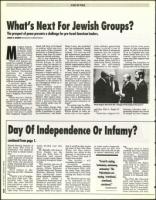
Henry Siegman (third from left): "Changes will be tested on the ground."
said Rep. Eliot L. Engel (D-
N.Y.).
"American support for
forming a familiar task —
protecting Israel's big chunk
of foreign aid from congres-
Day Of Independence Or Infamy?
continued from page 1.
Cr)
LLJ
Cr)
LIJ
CC
LLJ
LLJ
a
Yisrael Herczeg, formerly of
Oak Park, who lives in
Jerusalem. "I'm afraid all
we've done is reward terror-
ism."
Initial surveys showed a
slight majority of Israelis
supported the peace plan.
This week, the American
media reported that it had
gained in popularity over the
weekend.
Don't believe it, Mr.
Herczeg and Mr. Schaefer
say.
"There's a lot of trepida-
tion here right now," Mr.
Schaefer said. "Just the
other day some 300,000
demonstrators were out
protesting — and these are
not just members of the
`right wing.' The country is
badly divided over this
issue."
Mr. Schaefer, who lives in
Neve Yaakov not far
from the Arab town of
Ramallah, said rumors
about a peace treaty began
circulating throughout Israel
in July.
"Our reaction was one of
shock," he said. "In one fell
swoop, (Prime Minister
Yitzhak) Rabin and (Foreign
Minister Shimon) Peres
have legitimized some-
thing inherently illegitimate
(the PLO), created a
Palestinian homeland and
decided to 'give back' land,
though it's not 'giving back;'
it's actually giving it away.
"Everything was done so
quickly. Most of us agree
that it would be okay to give
up some of Aza (the Gaza
Strip), but then there's
Jericho, too, which is the
gateway to Jerusalem and
Eretz Yisrael (the land of
Israel) from Jordan.
"Aza, Jericho — will
Jerusalem be next?"
Jerusalem resident
Michael Neuvirth, formerly
of Farmington Hills, calls
the treaty "very, very scary.
I'm convinced it will bring
nothing but death on every
side."
Mr. Neuvirth said it's easy
to be impressed by the
"pomp and circumstance"
that accompanied Monday's
ceremony. "It was nice the-
ater," he said. "But ignore
the theater and take a look
at what really happened.
Israel gave up Aza and
Jericho and what did we get
in return? Absolutely noth-
11111111
■ 111 ■ 11111 ■ 11111111M1
"Israel is saying,
'autonomy, autonomy,
autonomy.' The
Palestinians are
saying, 'statehood,
statehood,
statehood."
Michael Neuvirth
ing.
"People need to listen
carefully and read between
the lines: Israel is saying,
`autonomy, autonomy,
autonomy.' The Palestinians
are saying, 'statehood, state-
hood, statehood.'"
He believes Mr. Rabin
acted now in an effort to
safeguard his political
future. PLO Chairman
Yassir Arafat signed
the treaty because his orga-
nization is in financial trou-
ble.
The PLO, Mr. Neuvirth
noted, was formed in 1964,
three years before Israel
took control of Gaza and
Jericho. The PLO was estab-
lished not to "recapture"
those territories, but with