

nity. Take a harder look at
what's going on with
American Jews who don't
talk about their needs, yet
the need exists. Why do the
Russians get a free ride?"
Sandy Hyman, director of
Resettlement Service, says
American Jews need to
understand that the Russian
Jewish community is "like
any population. Some are
good; some are bad. Some do
not know how to deal with
their freedom."
Local officials say Detroit's
Jewish community offers
21 — arrived here from
Uzbekistan three years ago.
In the former Soviet Union,
Mr. Krymgold was a con-
struction supervisor. He is
now a construction worker.
Mrs. Krymgold, a pub-
lished playwright, was
advancing in her career as a
journalist and high-ranking
public relations official for
the Ministry of Agriculture.
In the United States, she
works in the records depart-
ment of an insurance compa-
ny.
The Krymgolds left, in
to a doctorate program in
multimedia at Wayne State
University. When the family
has saved enough money, she
hopes to return to school.
"When I came, I had too
much ambition. I expected
everything," she said. "Now I
understand that nothing is
wrong with the jobs we have.
Without speaking the lan-
guage well, what could we
expect?"
All three Krymgolds found
work within three months of
their arrival here. Not all
immigrants have been this
ed doctors provide about
$500,000 worth of free health
screenings, mandated by the
federal government, to more
than 500 new Americans
each year. The hospital and
physicians contribute more
time and money when a
patient is diagnosed with a
serious disorder.
But making the diagnosis
can be an arduous task.
"Many new Americans
who have been hospitalized
here for heart problems won't
let us look and see if they
have heart disease. Many are
express anxiety over radia-
tion poisoning, but Dr.
Feldman said it is too early
to tell whether these individ-
uals exhibit a higher cancer
rate than individuals from
other areas. The Soviet gov-
ernment kept bad health
records with no baseline can-
cer rates for regions within
its republics.
"My guess is that we'll
never know," he said.
In recent years, several
agencies and individuals
have sought to make accul-
turation a personal, rather
afraid of injections and
catheterization," said Dr.
Marc Feldman, director of
Sinai's Primary Care Center
and outpatient training site,
where residents and physi-
cians screen refugees.
"The new Americans are a
very difficult group of
patients to work with," he
said. "They somehow think
we're the government. Some
yell and scream. The mental-
ity of some is, 'I waited in
line. I filled out the forms. I
want you to declare me dis-
abled so I can get govern-
ment money.' "
Many refugees do not
seem to understand that the
private doctors caring for
them are volunteering their
services, Dr. Feldman said.
"They're very ungrateful."
Refugees who come from
areas near Chernobyl, site of
the nuclear disaster, often
than
institutionalized,
process. One-on-one contact
with refugees was a goal of
Family to Family, estab-
lished by JFS and the
National Council of Jewish
Women during the late
1980s. The program matched
Russian and American Jews
in hopes of building friend-
ships and stronger religious
ties. It also aimed to help
new Americans find jobs.
But, by the early 1990s,
interest in Family to Family 0)
began to wane. Directors say
many Americans might have ti
been frightened off by the
time commitment the pro- CC
gram entailed. Also, some U-I
Russians arrived with
resumes in hand at the
homes of their American CL.
I-U
families. A number of Cr)
Americans began to complain
that the emigres were
aggressive and unapprecia-
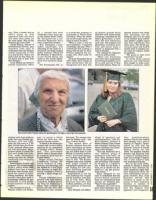
New American Mera Polyakhovskaya with granddaughter Irma Zager, a recent high school graduate.
emigres much more guidance
today than two decades ago.
Between 1973 and 1982,
when the first wave of 1,764
Jews arrived from the Soviet
Union, outreach efforts were
not well-developed. Many
emigres settled in places like
Troy and on the east side.
They never established
strong ties with the Jewish
community and eventually
assimilated.
Resettlement Service and
programs like Neighborhood
Project, which works with
Hebrew Free Loan to assist
first-time home buyers, have
eased the burden of estab-
lishing residency. But hard
economic times have made it
increasingly difficult for new
Americans to land profes-
sional positions in the job
market.
The Krymgold family —
Mikhail, Galina and Sergey,
part, to assure a better
future for their son, who
wants to become a doctor.
"A friend in the Soviet gov-
ernment told us not to bother
applying for my admittance
to medical school," Sergey
said. "The government
doesn't want to prepare Jews
for success in Israel (and the
United States)."
Sergey attends Oakland
Community College. He
tutors students in basic
anatomy and physiology and
has worked for a local physi-
cian. Recently, he began ded-
icating 13 hours a week to
tutoring a blind college stu-
dent.
Though somewhat disap-
pointed with their current
occupations, Sergey's parents
say they are beginning to
adjust. They recognize that
success will take time. Mrs.
Krymgold has been accepted
fortunate. The average time
span for finding a job — any
job — is seven months.
"The second wave of
Russian refugees faces the
same challenges as those
who immigrated 20 years
ago, but clearly there is a dif-
ference in economic environ-
ment," said Linda Reming-
ton, director of public rela-
tions at JVS. "The Russian
refugees today must compete
with larger numbers of
unemployed Americans who
are looking for new jobs,
often following corporate
downsizing or layoffs."
Employment is not the
only challenge for emigres
and the American Jews seek-
ing to help them. Many
Russians come here with
medical problems, yet they
are suspicious of American
doctors.
Sinai Hospital and affiliat-
51