

A DAY OF PEACE
Mutual Trust
Can Be Achieved
TERRY AHWAL SPECIAL TO THE JEWISH NEWS
ractically every other
night, after the evening
news, my mother comes
into my room and tells
me, "Did you hear? Another
Palestinian child was killed
today." Then she pleads for me
to "do something about this."
My mother feels that I, as
president of the American
Arab Anti-Discrimination
Committee in Detroit, can
personally affect what hap-
pens in the Middle East. But
as much as I wish that were
true, I know it is not, for as a
Palestinian, my voice is not
heard.
I, and all Palestinians have
been considered less than
human by most Israelis and
their supporters for 45 years.
Our pain and suffering was
cheered and our death was
applauded.
But with the signing of the
historic agreement between
our two nations, these
destructive actions may final-
ly meet their own death.
As I write this, I am also
finalizing my plans to go to
Washington, D.C. to witness
this historic event. And I am
hopeful that this agreement
will bring about a significant
change in the way Palestin-
ians and Israelis feel about
each other.
By the mere fact that I am
a Palestinian, I, and others
like me, have always been on
the defensive because accus-
ing fingers are always point-
ing at us and critical voices
are always shouting at us.
We have been accused of
being terrorists (or terrorist
sympathizers), lovers of war
or Israel bashers. Despite
these perceptions, we have
deplored any killing that has
taken place, reached out our
hands in the name of peace
p
and advocated for the human
rights of all people, whether
Arab, Jew or Palestinian.
Regardless of our actions, we
still have been viewed as the
enemy by most Israelis.
I am sure that many
Israelis and their supporters
feel animosity directed at
them by Palestinians. I am
also sure that many Israeli
families have suffered, as
mine has, the death of a loved
one or the fear of having the
place you call home taken
away from you.
Our experiences — my liv-
ing under Israeli occupation
and your living with insecuri-
ty over the possibility of the
destruction of Israel — have
created an atmosphere of
fear, mistrust and paranoia
which has led us to fulfill our
prophecy of killing each other.
Like it or not, Palestinians
and Israelis are inextricably
linked. Yet, because of our
claims over the same piece of
land and because of historical
injustice, we never connected
and refused to see each other
as human beings.
Today, our nations are tak-
ing the first, most important
step in ending the killing by
signing the peace agreement.
Both Palestinian President
Yasser Arafat and Israeli
Prime Minister Yitzhak
Rabin have demonstrated a
great deal of personal and
political courage in reaching
this accord.
As for me, I feel that the
fact that both sides have
negotiated in secrecy and
good faith, shows that mutual
trust can be achieved.
However, it is more diffi-
cult to attain peace than it is
to declare war. Each of us, as
Palestinians and Israelis,
must try to match the
courage of our leaders if we
expect peace to progress. We
must form alliances to bridge
the gap between us and work
together to encourage the
president and Congress to
fully support Arafat- and
Rabin in the future.
People are always saying
that Palestinians and Jews
are alike in many ways. Well,
now is the time we need to
start acting like it. Maybe
that way, my mother can
bring me some good news
after dinner. C.1
Ms. Ahwal is president of the
American Arab Anti-Discrim-
ination Committee, Detroit
Chapter.
Detroit Leaders
View First Step
LESLEY PEARL STAFF WRITER
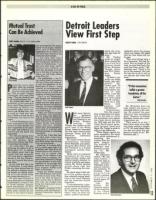
Joel Tauber
W
ile many Detroit-
ers gathered
around televisions
and listened to car
radios Monday
morning, Joel
Tauber was seated on the
south lawn of the White
House, where he witnessed
the first steps toward peace
between Israel and the
Palestine Liberation
Organization.
He joined Israel Bonds
International Chairman
David Hermelin and philan-
thropists Max Fisher and
Bill Davidson in a Jewish
contingent invited from
Detroit.
There were no engraved
invitations for the event
which Jewish, Arabic and
political leaders attended. In
a flurry of activity and prepa-
rations, Mr. Tauber received
several phone calls last
Friday requesting his pres-
ence.
He joined about 3,000 oth-
ers at the midday signing,
then attended evening recep-
tions at the Israeli Embassy
and the American Jewish
Committee.
"It was exhausting, a phys-
ical and emotional experience
which sapped your energy,"
Mr. Tauber said. "But every-
where I went, the mood was
upbeat. positive and encour-
aging the pros-
pect and hope for
peace."
Mr. Tauber
spoke at length
about viewing the
handshake
between Israeli
Prime Minister
Yitzhak Rabin
and PLO Chair-
man Yassir
Arafat.
"If Rabin and
Arafat can shake
hands, why can't
others?" Mr.
Tauber said. "If
you really care
about peace, you
have to take
action. I saw this
in action. And
now we're seeing
it with Jordan.
We'll see it with
Syria,
with
Lebanon
and
with Morocco."
Comparisons,
from the support
from a Democratic U.S. presi-
dent to the table on which
the documents were signed,
have been drawn between
the 1993 talks and the 1979
Camp David peace agree-
ment between Israel and
Egypt. Mr. Tauber is quick to
point out the differences.
"When Egypt signed the
peace agreement, the whole
Arab world condemned it,
expelling the
country from the
Arab League.
The attitude is
different now.
Everyone is join-
ing in," Mr.
Tauber said.
Mr. Hermelin
added, "We did
make history. I
think it's okay to
draw symbolic
inferences, to per-
petuate history
and ceremony. If
building that
momentum
builds a greater
foundation
toward peace. all
the better."
Like
Mr.
Tauber,
Mr.
Hermelin attend-
ed the reception
at the Israeli
Embassy and is
David Hermelin
optimistic about the process
which now begins. He added
that the time ahead will not
be easy.
"This event brings back a
lot of memories. You look for-
ward. But as people of the
book, we must look back. Our
road has been rocky," Mr.
Hermelin said. "There is the
joy in the moment. But now
it's time for us all to roll up
our sleeNies and make this
work."
If that momentum
builds a greater
foundation, all the
better."
Dabid Herrnern
Mr. Hermelin does not
take lightly the honor of
attending history in the mak-
ing. He enjoyed the seat
where he "saw everything
great." However, he believes
television viewers got a pret-
ty good show, too.
"This event is so big, I
didn't have much of an edge
over those seeing it happen
on TV. It's more about what
you feel and what this day
meant to each of us," Mr.
Hermelin said. ❑