

Slow, But Steady
Israel's absorption of nearly 500,000
Soviet immigrants has been difficult.
But signs of success are evident.
Photo by G. Fe in b la tt/Me dia
INA FRIEDMAN ISRAEL CORRESPONDENT
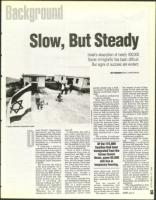
A typical settlement of caravans in Israel.
irah! Dirah!" (Apartment!
Apartment!) was the chant
that greeted Prime Minister
Yitzhak Rabin when he vis-
ited the Nahal Beka'a
mobile home camp outside
Beersheba on a sweltering
day last week.
If adopting a nation's
standard of demands and
style of protest is any sign of
successful integration, then
the immigrants from the
former Soviet Union (FSU)
can certainly be said to have
undergone rapid absorption
in Israel.
But of course the picture
is far more complex. As it
enters its fifth year, the
drama of the mass influx of
Jews from the FSU seems to
have receded into the back-
ground of Israeli life. The
initial novelty and excite-
ment of enriching the
national melting pot with a
refreshing new ingredient
— educated, professional,
and for the most part
"Western" (or at least
Ashkenazi) Jews — have
worn off.
In their place, has come a
more sober assessment of
the impact that the new-
comers are having on Israeli
life and to the long-term
task of helping them estab-
lish themselves in new lives
— and not necessarily the
ones they bargained for.
Close to half a million
immigrants have come to
Israel from the FSU in the
past four years. The peak
year was 1990, when more
than 185,000 people flooded
into the country. Since then
the trend has been down-
ward: 148,000 arrived in
1991 followed by a precipi-
tous drop to 64,000 the fol-
lowing year, though a
slightly higher number is
forecast for 1993.
The decline resulted from
the immigrants bumping up
against the hard reality
that, as a small country
boasting limited opportuni-
ties (and plagued by an
already high rate of unem-
ployment), Israel could
quickly absorb only a limit-
ed number of professionals
offering a restricted range of
skills.
The medical professional
is a prime example.
More than 9,000 Soviet
physicians came to Israel
between 1989 and the end of
1992. (The number of physi-
cians per capita among the
Soviet immigrants was nine
times as high as among the
Israeli population, which
was already the highest
ratio in the world.) More
than half of these doctors
passed the necessary licens-
ing exam, but many have
still found it difficult to find
jobs. The rest simply had
their careers cut short or at
least rerouted onto a lower
level.
The number of engineers
in Israel doubled during the
Of the 170,000
families that have
immigrated from the
former Soviet
Union, some 95,000
still live in
temporary housing.
same three-year period,
with 50,000 such newcom-
ers (between 20-and-25 per-
cent of the incoming work
force) entering the job mar-
ket.
And the number of
artists, musicians, and
teachers in the arts was
similarly far out of propor-
tion to Israel's size or needs.
The result — even after
the creation of tens of thou-
sands of new jobs and the
institution of courses to help
people acquire new special-
izations — is that 75 per-
cent (165,000) of the new
immigrants are currently
employed in some job. But
only between 30 percent
(according to the Soviet
Zionist Forum) and 60 per-
cent (according to the
Absorption Ministry figures)
are working in their profes-
sions.
Hardest hit from this
standpoint is the population
aged 45 and over. The grim
fact is that for many people
in this category, the early
tales of surgeons and profes-
sors sweeping the streets
until they could find suit-
able positions have become
a permanent condition.
Having failed the licens-
ing exam, Leora
Makadinsky — a divorced
44-year-old internist from
Moscow who has been in
Israel for two-and-a-half
years and shares a two-
room mobile home (known
as a caravan in Israel) with
her 17-year-old daughter —
is reconciled to the fact that
her medical career is over.
Determined to remain
upbeat, however (or at least
not show her distress), she
takes pride in having been
promoted from chamber-
maid to secretary (part-
time) and quietly aspires to
return to one of the "people-
helping professions."
Meanwhile, her priorities lie
elsewhere.
"The big problem is how
to get out of this caravan —
which is suffocating in the
SOVIET page 56