

that was on everyone's lips at
year's end.
Of course, nothing was final.
Neither Israel nor a Palestinian
had yet dotted a single "i" or
crossed a single "t" on the flimsi-
est scrap of paper, let alone on a
formal document etched on
parchment or papyrus or what-
ever they're using in the Mideast
these days.
But the reigning hope — the
dream — in the closing days of
5753 was that the almost half
century of terror, wars and
round-the clock insecurity that
had been part of the texture of
Israeli life since its inception
might soon be in the past tense.
The stunning announcement
that an Israeli-PLO peace accord
was imminent came after 20
months and 10 often frustrating
rounds of the Middle East peace
talks. The probable accord will
lead to Israeli and PLO mutual
recognition, to be followed by
Palestinian autonomy in Gaza
and the West Bank town of
Jericho within six months. Over
the next five years, Palestinians
will gradually gain limited
authority over most of the West
Bank.
The future status of perhaps
the greatest flashpoint of all —
Jerusalem, holy to Jews and
Moslems — has been delayed
indefinitely.
The preliminary agreement
was reached in 14 secret talks in
Norway between Israeli and
Palestinian officials.
But while the vibes were
mostly positive — "a blessing to
both peoples," said a New York
Orthodox rabbi — not everyone
was dancing in the streets.
Norman Podhoretz, the grand-
daddy of neo-conservatives and
editor of Commentary, grum-
bled, "Far from being a cause of
peace and justice, I think it will
be a cause of war ... The
Palestinians finally have decided
to adopt the so-called 'phase
strategy,' which calls for getting
a foothold to begin with, a state
in Phase Two, and then using
the state as a launching pad for
a final assault."
But from Israel came this cau-
tion to the naysayers from Prime
Minister Yitzhak Rabin: "It is
easier to remember than to
think," easier to remember
about the killings and the
slaughters and the bombings
done in the name of "Palestine"
than to think about engineering
a peace, a peace on which Mr.
Rabin was betting his political
legacy — and the future of
Israel.
The Intifada
And Syria
A
lthough the year-end
reshuffling of the odds
for Mideast peace
made almost every-
thing else pale by comparison,
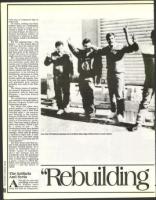
Four of the 415 Palestinian deportees sent to the Bekaa Valley village of Marj-al-Zohour in south Lebanon.