

Editor's Notebook
Community Views
Taking A Courageous Risk
For Middle East Peace
A Hothouse For
Jewish Continuity
PHIL JACOBS EDITOR
LEONARD FEIN SPECIAL TO THE JEWISH NEWS
In the March 30,
1979 issue of The
Jewish News, the
now famous, his-
toric photograph
of Egyptian
Prime Minister
, Anwar Al-Sadat,
President Jimmy
Carter and Is-
raeli Prime Minister Menachem
Begin hand in hand, with smil-
ing faces in celebration of the
signing of the Camp David Ac-
cords, was published.
There were six basic elements
to the peace treaty: Israel's with-
drawal from Sinai; security
arrangements between Egypt
and Israel; establishment of nor-
mal relations between the two
countries; right of passage of Is-
raeli ships through the Suez
Canal, and the ships of both na-
tions through each other's ter-
ritorial waters; Israel's right to
buy Sinai oil; and negotiations
on Palestinian self-rule.
The treaty had survived se-
rious opposition from both the
Israeli side and the Arab side.
Mr. Sadat would omit part of a
speech he delivered in the pres-
ence of Mr. Begin and Mr.
Carter where he originally
wrote, "no one is more entitled
to your support and backing
than the Palestinian people. A
grave injustice was inflicted
upon them in the past. They
need a reassurance that they
will be able to take the first step
on the road to self-determina-
tion and statehood. A dialogue
between the United States and
the representatives of the Pales-
tinian people will be a very help-
ful development..."
This issue of linking the self-
determination of Palestinians
living in Gaza and the West
Bank was debated and post-
poned. Mr. Begin, himself,
stared it down into near impos-
sibility with his continual sup-
port of Jewish settlements. He
was publicly admonished by the
left wing for failure to act. But
he was also under criticism from
his own party and the right
wing for even giving back the
Sinai.
Moshe Arens, then the Knes-
set Foreign Affairs and Defense
Committee chairman, criticized
Mr. Begin's removal of the Rafi-
ah settlements in the Sinai as
"taking a brick out of the na-
tion's defense wall."
Peace with the Egyptians
was labeled by the Gush Emu-
nim leader Hanan Porat as a
"fact which goes in direct oppo-
sition to Zionist tradition, and
which therefore has no moral
validity."
On the other side, Sadat and
the peace process were drubbed
into the figurative dirt by the
Soviet Union and leaders of oth-
er Arab nations. Jordan's King
Hussein ran away from any
suggestion that his country take
in the Palestinians living on the
West Bank as citizens of his
country.
As we now know, Anwar Sa-
dat would be killed by Arab ter-
rorists for making peace with
the Israelis. And as we've seen
now since his death, any mod-
erate Arab voice has more to
worry from the rage of his own
people than any IDF soldier.
We're 17 years older, but who
knows if we're any wiser. There
is no more Soviet Union to agi-
tate a peace. Yet, there's a rise
in Islamic fundamentalism that
and "expert" journalist has a
theory to make peace work. But
the real key is that Israel and
the PLO make this work. The
PLO must show that it is the
real spokesman for Palestinian
interests, and that it can stand
up to the militant Hamas and
other dissenters who would
rather use guns than words. It
must also show Israel that it is
good to its word in respecting Is-
rael's security and right to ex-
ist. It would be good also if
Syria's Assad do something he's
never done before: show that he
has the courage to step forward
and also make peace with Is-
rael. Maybe then, the histori-
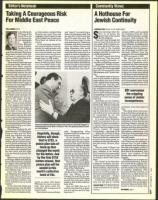
Israel's Prime Minister Menachem Begin travels to Cairo for the funeral of Egypt's as-
sassinated leader, Anwar Sadat, in October of 1981. He is greeted by Sadat's succes-
sor, Hosni Mubarak
Hopefully, though,
history will show
that in 5753, a
peace plan was of-
fered up that
changed the world
for the better. And
by the time 5754
comes around, that
peace plan will be
sealed in this
world's collective
book of life.
wants no peace with Israel.
With that is a rise in anti-Ara-
bism that shows itself dis-
turbingly with a large part of
Israel's youth.
Every street corner politician
cally disappointing King
Hussein would also make a pos-
itive move for once.
On the Israelis' side, com-
promise must also be commit-
ted to the plan. Too many times,
Israel has shot itself in the foot.
Israel must be willing to test the
word "trust." Yes, it's easy for
me to say thousands of miles
away how I feel about this issue.
And talk is very cheap. But Is-
rael too often hides behind that
premise. Now there's opportu-
nity, now there's a possibility.
This probably won't happen
overnight. There could be blood-
shed, especially among the fac-
tions of the Palestinians.
Hopefully, though, history
will show that in 5753, a peace
plan was offered up that
changed the world for the bet-
ter. And by the time 5754 comes
around, that peace plan will be
sealed in this world's collective
book of life.
Let's not fight this one. It
could be the best shot at peace
any of us will ever see for a long,
long time.
❑
S
tart worrying; letter fol-
lows" is, of course, the
generic text of the classic
Jewish telegram.
Fear not; I may be tough, but
I am not cruel. (In truth, I'm not
even tough.) And it would be cm-
el in these dog days of late sum-
mer to add to the lumpish
worries that already cause us to
perspire internally no matter the
outside temperature.
So while I cannot quite bring
myself to say, "Stop worrying"
— that would be unJewish — I
can offer a refreshing compress.
Remember "Jewish continu-
ity"? Of course you do; how could
you forget? It's all the rage these
days, the '90s incarnation of the
'60s obsession with "Jewish iden-
tity."
The instant cause of our con-
cern is that swollen intermar-
riage statistic the size of which
I here refrain from mentioning.
Just call it big. Very big. And,
underlying the statistic, there's
the widespread sense that one
of two things must be true: ei-
ther we have nothing adequate-
ly compelling to say to our young
people, or we are not saying it
very well.
Anecdotes are not evidence,
and one example does not a re-
buttal make. But it is worth call-
ing attention to the occasional
success story, if only to encour-
age the hope that our failure is
not written in the wind, and may
be interrupted by our own
thoughtful action. Here goes:
In a place called Brandeis,
Calif. (no connection to the uni-
versity save common homage to
a name), which is 45 minutes
north of west Los Angeles (as the
Taurus cruises), 50 Jewish
young people — age range 18-28
— gather for a month of doing
Jewish. Most come from Cali-
fornia, but there's a substantial
minority from other places, in-
cluding not only the other states,
but also Israel, Ukraine, Eng-
land.
They've come to figure out
how to be Jewish, or, in some
case, whether to be Jewish.
Their parents have persuaded
them to give it a shot, or an old-
er sibling or friend who's been
there.
The "there" is the Brandeis
Collegiate Institute, the pre-
miere program of the Brandeis-
Bardin Institute, which has been
up and running for some 50
years now, inviting college stu-
dents and recent graduates to a
one-shot experience — 28 days
of living and learning together.
It had been nearly 20 years
since my last gig as visiting
Leonard Fein is a Boston-based
writer and lecturer on Jewish
themes.
scholar at BCI, and I accepted
the invitation from Dr. Alvin
Mars, Shlomo Bardin's worthy
successor, with curiosity. The
limited question was how any-
one could follow in the giant foot-
steps of Bardin, founding genius
of the place; the larger question
was whether this new genera-
tion of students would be sub-
stantially different from the
generation I'd encountered back
in 1970 and again in 1975.
The short answer is BCI
works. The kids come with a
wide array of questions, some
wondering why their parents are
so down on their current signif-
icant (and, significantly, non-
Jewish) partners, others trying
to figure out where they belong
on the denominational spectrum,
some fretting about the age-old
tension between particularism
and universalism, some trying
to answer for themselves what
God expects of them, and some,
BCI overcomes
the crippling
sense of Judaic
incompetence.
inevitably, what they expect of
God.
The thing about such ques-
tions is that they rarely get an-
swered, not anywhere. But the
thing about BCI is that such
questions get shared. There's a
curriculum, of sorts, but the real
teaching happens during the
long walks or the short breaks
between activities when the kids
explore each other's confusions,
perceptions, experiences, and
when they chat informally over
a meal or on a hike with one of
the staff people.
Each summer and each ses-
sion (there are two sessions a
summer) has, I'm told, a differ-
ent character, and the reason is
that the core subject matter is
provided by the kids themselves.
Now God is the obsession, now
Israel, now another of the
themes with which a Jew must
struggle.
The effort's not to master an
area of Jewish learning. Instead,
it's to kick off an ongoing con-
versation, one that will long out-
last the month in the mountains
of southern California. (The
Brandeis-Bardin Institute, at
3,200 acres, is, after Israel, the
largest piece of Jewish real es-
tate in the world.)
At its best, BCI offers a loose
framework for that conversation,
and some ideas and some infor-
mation to move it along. And,
HOTHOUSE page 8