
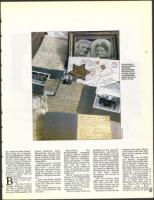

Elsie Simkovitz's
great-grandparents,
the Gutmans
(the photos Bertha
Weinschenk put in
her shoes and took
to Theresienstadt);
Bertha's star and, at
bottom, her diary.
t"'""Asairtrwir
her "beloved sister-in-law,"
taken away on a transport;
her grandchildren, includ-
ing little Steffi; her brother-
in-law; and finally "my
dearest husband Yaakov,"
who died in Theresienstadt.
After these terrible events,
I became weak and sick and
could hardly go on. If she
managed to survive, Bertha
wrote, it would only be
"with God's help."
ertha Gutman was
about to get mar-
ried.
She was born in
Ottinge, Germany, a pretty
girl from a religious family
who was eager to step into
the role of homemaker. Her
B
future husband, Jacob
Weinschenk, was one of 10
children and a widower with
three children of his own.
His first wife had died while
giving birth.
Bertha always treated
Jacob's children — two girls
and a boy — as her own.
When she and Jacob had a
daughter, Hanna, no one
spoke of stepsisters or half-
brothers: everyone was fam-
ily.
Jacob and Bertha settled
in Nuremberg and lived a
quiet life. Then the Nazis
came to power.
The couple applied to emi-
grate, but permission did
not come.
the
Meanwhile,
Weinschenks' youngest
daughter, Hanna, married
Jacob Buehler, a salesman.
They had two children,
Elsie and Ernest. In 1938,
Jacob Buehler secured an
exit visa. He came to
Detroit, where relatives
lived, and planned to save
money to get the rest of the
family out.
But it would be too late
for two of the Weinschenks'
children: a daughter and
her family, as well as the
couple's only son, were mur-
dered by the Nazis. A sec-
ond daughter, Paulina,
escaped into France.
Hanna stayed with her
children at her parents'
Nuremberg apartment.
There was little to do but
wait. Just venturing outside
was hazardous. Elsie
Simkovitz still remembers
when Jews were forbidden
to sit on park benches and
Hitler Youth regularly beat
up Jewish passersby. On
Kristallnacht, she watched
as the Adas Yisroel
Synagogue was burned to
the ground.
"The fire trucks came
right away," she says. "And
then they just sat. They
were there to make sure the
surrounding homes (of gen-
tiles) didn't catch fire."
And then in 1940 the bit-
tersweet news came: Hanna
could leave with her chil-
dren, but her parents would
have to stay.
Elsie, who was 12 when
the family emigrated,
remembers little of the jour-
ney to America, "except eat-
ing an orange on the way."
Her father had paid for the
trip with money he saved
working — at an annual
salary of several thousand
dollars — as a night watch-
man at Davidson Brothers,
Inc. on Nine Mile and
Woodward. The store owner
was famous for helping
refugees from Nazi
Germany; when the Buehler
children arrived, he gave