

Special Circumcision
Russian teens undergo brit to demonstrate their
Amerian Jewishness.
DAVID JARCAIG, WAYNE STATE UNIVERSITY
ircumcision
isn't the typical
American teen-
ager's choice of weekend
activities. But for 19 boys
from Michigan, Ohio and
Indiana, obtaining their
brit milah became top pri-
ority last spring.
The young people —
most members of the
National Conference of
Synagogue Youth (NCSY)
— are new Americans who
were prohibited, by law,
from getting circumcised
in their homeland. No
longer under communist
rule, many of these boys
are using their freedom to
study Torah and enhance
their Jewish identity.
Some say they have decid-
ed to get circumcised to
show their covenant with
God.
"For the kids involved, it
is a tremendous act of
bravery. American kids
don't usually make that
kind of commitment," said
Rabbi Bezalel Freedman,
who serves as the central
east regional director for
he was a Jew, though it
was 'probably dangerous."
Last May, Philip decided
he, like his great-grandfa-
ther, wanted to demon-
strate his commitment to
Judaism. He accompanied
Rabbi Freedman to
Columbus, where Dima
Khaikin, one of his peers
from NCSY, had arranged
for new Americans to
obtain their brit free.
"For the kids
involved, it is a
tremendous act
of bravery."
Rabbi Bezalel Freedman
Michael Harpaz felt like part of the majority.
Uncommon Reunion
A graduate of Hillel Day School and Berkley High
remembers his trip to Israel.
MICHAEL HARPAZ, UNIVERSITY OF MICHIGAN
1
n 1986, I graduated
from Hillel Day School
"I think there are some
with plans to enter
things Jews shouldn't for- the public education system
get about, like circumci- in the fall. I was more than
sion and Shabbatlradi- a little bit nervous.
tions," Philip said. "My
I had been a devoted
great-grandfather never Hillel student since return-
forgot that he was a Jew ing from Israel in 1978 at
— under any conditions. I the age of 5. Between the
don't want to either."
first and ninth grades, I
Dima, also a recent emi- developed meaningful rela-
tionships with classmates
and teachers at Hillel. I
depended on their cama-
raderie for 10 years.
Fearful of moving on to
Berkley High, I spoke to my
cousin, Beverly Kent, the
director of social work at
Hillel. She encouraged me,
as well as other graduating
students, to attend work-
shops during which we
would discuss our anxieties
about that ominous institu-
tion: high school.
Ms. Kent, who designed
the program, invited Hillel
alumni to speak to us about
their own high school experi-
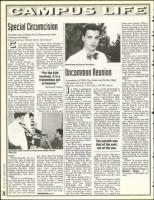
Dima Khaikin, Rabbi Freedman and Philip Barash (seated) celebrate
Philip's brit.
ences. An Israel-born friend,
who attended Berkley High,
NCSY.
gre, knew that the former invited me to follow him
Philip Barash, 14, is a Soviet government levied from class to class one day.
Detroiter who emigrated severe punishments for
Near the end of my day at
from the former Soviet people who performed Berkley High with my
Union a year ago. An such simchahs. In fact, friend, I was mortified by a
active NCSY member who Rabbi Freedman remem- blatant act of anti-Semitism.
attends Berkley High bers that undercover Moments before the last
School, Philip has always American mohels often bell, someone had run
highly respected his great- traveled to the former through the halls throwing
grandfather, who was a Soviet Union to perform papers in the air.
rabbi.
the rite for Russian Jews
My heart stopped when I
"There is something in in secret. His parents read one of the papers. It
me that wants to be like wouldn't let him — there said: "Niggers, camels,
him," Philip said. "He was was always the threat of Jews...You had better
an optimist. He was in being discovered.
BEWARE!...The (KKK)
Russian concentration
Dima wanted to obtain a Grand Wizard wants you."
camps under Stalin for 17 brit in Russia, but his par-
Never in all my years had
years, but it didn't break ents wouldn't let him. I seen something so dirty
his will. He never denied CIRCUMCISION page 78
and vile as this. This seemed
to be a rude awakening to
the "real" world outside of
Hillel: a world of hate.
"That flier did indeed
occur," said Berkley High
School Principal Jane
Makulski. "I remember it as
a pretty awful experience. I
was not raised to tolerate
prejudice. In running a
school, I cannot tolerate it."
Let me make one thing
clear: Berkley High School
is not a breeding ground for
anti-Semitism. In fact, my
experiences at Berkley High
were fruitful ones, because
the administrators and gen-
eral student body were there
to learn. This instance does
not reflect on the school
itself, but on the sorry few
who perpetrated it. It is,
nonetheless, my experience.
The warmth was
that of the soul,
not of the sun.
Little by little, I fell into a
Jewish niche at Berkley
High. I found a friend who
would become like a brother
to me, as well as a girlfriend
who helped me through
some very tough times. I
integrated myself into a
group of Jewish kids from
Huntington Woods. We
called ourselves the "Jew
Crew."
Such associations made
my days in public school
happier ones. I graduated in
1990 and went on to the
University of Michigan.
In October of 1992, I
departed for Tel Aviv
University to spend my
junior year abroad. When I
got there, I found that three
former classmates, all Jews
from Berkley High School,
were already enrolled: Paula
Hirshorn, Hilary Krystal
and Randy Horton. One day,
when the four of us were sit-
ting on the grass outside of
our Tel Aviv University dor-
mitory, Rob Malkin, another
Berkley High classmate,
walked through the gates
with a hiking pack in hand
and greeted us with a warm
"Shalom."
Randy and I sat there
stunned. We couldn't believe
what a coincidence it all
was. Here we were, the five
of us, together in Tel Aviv.
The location of our reunion
was especially meaningful, I
think, because of our shared
origin: Berkley High.
"It was an exhilarating
experience," remembers Rob
Malkin.
"It was a twist of fate, I
suppose," Alan Landau
adds. (Alan, yet another
Berkley High School grad,
joined our group in Israel
later that month.) "It's ironic
that Israel can bring people
together the way it brought
us together. It's proof posi-
tive that Israel binds us.
"As a Jew coming from
Berkley, I felt like I stuck
out. (In Israel), it was nice
feeling that I was in the
majority," Alan said.
As for me, I'm back in Ann
Arbor now. I often reflect on
what my experience in
Israel taught me.
One cold January day last
year, after my return to the
States, I sat in my 18th-floor
apartment near U-M's cam-
pus and remembered the
warmth Israel offered.
Oddly, the warmth was that
of the soul, not of the sun.
The presence of millions of
Jews blanketed the heart on
even the chilliest of nights.
From my high-rise abode,
I pictured central campus
down below: Palestinian stu-
dents protesting the "occu-
pation" and skinheads spew-
ing their ignorance, evange-
lists standing on benches,
screaming at the top of their
lungs.
Albeit 18 stories above
them, I could hear their
words and feel their passion,
and I yearned for the com-
fort of my days in Yisrael. ❑
a
is
Harpaz
Michael
University of Michigan stu-
dent.
N