

vs)
.11
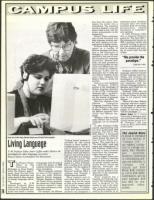
Edna Amir Coffin helps Daniella Harpaz use a Project Flame program.
Living Language
U-M Professor Edna Amir Coffin makes Hebrew the
paradigm for other language curricula.
SHEILA JELEN, UNIVERSITY OF MICHIGAN
Cf)
LU
Cf)
THE D ETRO
LU
74
he Project Flame
office
at
the
University of
Michigan is three flights
below the Hebrew depart-
ment, down the hall from
the Yiddish classroom and
miles ahead of other projects
in foreign language educa-
tion.
Developed by U-M
Hebrew Professor Edna
Amir Coffin, Project Flame
consists of multimedia pro-
grams that teach a variety
of languages with the help of
a laser disc player, an IBM
computer keyboard, a mouse
and a microphone.
When language students
sit down at the computer,
they can study Hebrew,
Spanish, French, Japanese,
Chinese, Russian or Polish.
All Project Flame programs
are interactive, which means
students respond to what
they read and observe on the
computer screen.
For example, the Hebrew
line from the scene, then individual basis. Students
repeat the words into a evaluate their own skills
microphone. The computer and select their own writing,
records a student's voice and pronunciation, reading
plays it back to him with the translation or comprehen-
correct pronunciation in the sion exercises.
In 1989, Professor Coffin
background.
Project Flame programs won a national EduCom
also include functions that award for "The Safe Affair."
help language students per- She subsequently became an
fect their spelling and com- IBM consultant scholar and
received funding to expand
prehension of foreign words.
Professor Coffin began her her work on multimedia pro-
career as a teacher of jects for students and teach-
Hebrew language and litera- ers in junior high through
ture at the University of college.
Michigan in 1970. She was
appalled by the lack of qual-
ity resources for language
instruction. Hebrew text-
books, she said, provided no
instructional guides for edu-
cators and offered scant cul-
tural context for students.
Professor Coffin saw no
Professor Coffin's Hebrew
alternative but to write her language expertise became
own Hebrew textbook. It has foreign language expertise.
since been adapted into Today, she oversees the
Modern Hebrew, levels one development of 11 Spanish,
and two.
seven French, six Hebrew,
Just as a new textbook two Japanese and two
was Professor Coffin's Chinese language programs.
answer to the challenges of Russian and Polish are on
Hebrew language education the drawing boards.
in the 1970s, multimedia
Professor Coffin says one
classroom aids — as demon- of the most exciting aspects
strated by Project Flame — of Project Flame is the fact
are her answer to language that it all started with
instruction in the 1990s.
Hebrew:
Nira Lev, director of the
"Most of the time, Hebrew
Hebrew Interactive language education materi-
Language Learning Center als are based on paradigms
in the Detroit area, says established in other lan-
Professor Coffin's multime- guages. In our case, we pro-
dia Hebrew programs "revi- vide the paradigm." ❑
talize" the Hebrew lan- Sheila Jelen is a recent
guage.
University of Michigan grad-
Professor Coffin says they uate and former editor of the
make Hebrew into a "living Jewish student journal at U-
language, not an idealized M, "Prospect." She now
one."
works for B'nai B'rith Hillel
In 1984, Professor Coffin in Ann Arbor.
started experimenting with
her first multimedia IBM
program. This led to "The
The Jewish News
Safe Affair," a simulated
courtroom drama in Hebrew
is proud to introduce
which formed the basis for
its first edition of
"Talking Poetry" program is later Project Flame pro-
"Campus Life" —
narrated by two young grams. The characters in
Israelis in Neve Tsedek, a "The Safe Affair" used legal
our
readers' connec-
neighborhood in Tel Aviv jargon and colloquialisms. It
tion to college stu-
that is well-known for the was Professor Coffin's first
dents, their interests
artists who have lived there. attempt to help students
Students watch and listen to experience the language,
and activities.
Israelis discussing poetry rather than just hear it.
Students interested
Every
Project
Flame
pro-
with each other in a natural,
free-flowing manner. The gram is different because
in contributing arti-
students respond by partici- each has been tailored to fit
cles
and editorials to
pating in a series of transla- its specific cultural context.
Joanna
Povrin,
French
and
tion, reading and writing
"Campus Life"
exercises. For the student of Spanish developer for
should
call Staff
French, the "Quinze Project Flame, says an accu-
Writer Ruth Littmann
Minutes" program offers a rate cultural context is fun-
walking tour through a damental to the acquisition
at (313) 354-6060.
of language skills.
French open-air market.
Contributors will be
Every program has a
When students want to
read what they've just wit- teaching and learning com-
paid between $25
nessed, they use the mouse ponent. The teaching compo-
and $50 for pre-
to click on the screen, which nent is designed for the
approved manu-
teacher
to
use
in
the
class-
will provide a transcription
of the dialogue. To double- room to facilitate discussion.
scripts.
check their pronunciation, The learning component is
students can designate a used by the students on an