

Officially At The Table
When the Middle East peace talks
resume, for the first time Israel and
the PLO will be directly negotiating.
DOUGLAS DAVIS
FOREIGN CORRESPONDENT
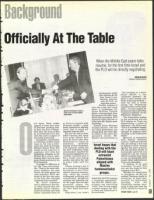
Warren Christopher meets in
Syria to try to revive stalled
peace talks.
nce again, Yassir Arafat
appears to have done what
he does best: plucking victo-
ry from the jaws of defeat.
This time, the irony is that
he accomplished the feat
with the active support of
the Israeli government.
Jerusalem's contribution
to Chairman Arafat's latest
lease on life was a state-
ment last week by Foreign
Minister Shimon Peres that
Israel would continue to
negotiate with three key
Palestinian delegates to the
Middle East peace talks,
despite their having been
given formal positions in the
PLO hierarchy.
"It makes no difference to
us," Mr. Peres told journal-
ists. "They're the same dele-
gation members, the same
names, the same people, the
same procedure. We're also
aware of the fact that prior
to this they also consulted
whomever they consulted."
Mr. Peres' comments
were a reference to the thin-
ly veiled charade that saw
delegates Hanan Ashwari,
Faisel al-Husseini and Saeb
Erekat repeatedly flying off
to Tunis to consult with
Chairman Arafat — while
Israel continued to officially
insist that it would not
negotiate with the PLO.
But now the veil has been
lifted because the three
were given official PLO
posts by Tunis after they
threatened to resign as
mediators, ostensibly
because of their frustration
with Chairman Arafat and
the PLO leadership. Some
commentators regarded the
threatened resignations as a
carefully contrived ploy to
force Israel into taking
another step down the road
to direct talks with the
PLO.
Others, however, saw it
as a symptom of growing
frustration at the PLO's
chaotic financial steward-
ship, which has caused
widespread suffering and
transformed delegation
members into lightning rods
for the anger that has been
generated among the
Palestinian inhabitants of
the West Bank and Gaza
Strip.
Regardless, last week's
development ended
that pretense for all
time. Israel is now
dealing directly
with the PLO, its
long-time enemy.
Further evidence of
this also came last week
when a spokesman for
Prime Minister Yitzhak
Rabin acknowledged that
Environment Minister Yossi
Sarid had met senior PLO
executive Nabil Sha'ath in
Cairo with Mr. Rabin's prior
knowledge.
Former Prime Minister
Yitzhak Shamir, who led
the Likud government, was
among those who were high-
ly critical of the Labor gov-
ernment's moves. Mr.
Shamir told journalists in
Israel hopes that
dealing with the
PLO will blunt
extremist
Palestinians
aligned with
Muslim
fundamentalist
groups.
Israel that the PLO remains
a "murderous organization"
and that Mr. Rabin's gov-
ernment was destroying
"walls" that he had sought
to create between the PLO
in Tunis and Palestinians in
the territories.
But according to a senior
Israeli • official, it was
"politically necessary" for
Israel to start dealing with
Tunis at this time because —
while the PLO is reviled
among the Palestinian
masses for their current hard-
ships — its overt support for
the peace process is providing
"essential credibility" for the
Palestinian delegation.
"The Palestinian leaders
in the territories and the
PLO leaders in Tunis are
experiencing a crisis of
legitimacy," the official said,
"and it is considered expedi-
ent to ignore the cosmetic
changes to improve their
standing in the Palestinian
street."
Moreover, in comparison
with Hamas' fanatical
Islamic fundamentalists
who are willing to kill and
be killed in their crusade
against the peace process,
the old terrorist Arafat is
increasingly perceived as a
moderate and the Israeli
official conceded that there
is now an inexorable drift
toward direct talks between
Tunis and Jerusalem.
"I believe it is now
inevitable," he said. "You
can see the signs of this
emerging every day."
Whether by contrivance
or coincidence, all this has
enabled Chairman Arafat to
surmount, at least tem-
porarily, his diminished
standing with the
Palestinian masses, stem-
ming in large part from the
PLO's disastrous financial
PEACE TALKS page 60