

■
lirHe Was
Good To
■ ■ • His Mother
They killed, they robbed, they kidnapped. But they took care of family, too.
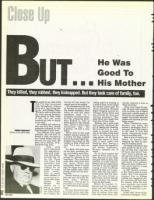
Jake Guzik
111
AP/Wide World
52
he people in my walk of life
that I've been associated
with throughout... always
had a very, very strong fam-
i ly tie," said Mickey Cohen.
T "We had a code of ethics like
the ones among bankers,
other people in other walks
of life, that one never
involved his wife or family
in his work."
As ruthless and violent as
they may have been, Jewish
gangsters adhered to this
code throughout their lives.
ROBERT ROCKAWAY
Dave Berman was a good
SPECIAL TO THE JEWISH NEWS
example. He was born in
Russia in 1904, and came to
the United States with his
parents one year later. He
grew up in Ashley, N.D.,
and Sioux City, Iowa.
Very
early
Dave displayed
the aggressive-
ness and tough-
ness that charac-
terized him all
his life. Those
who knew him
remember that
"he was always
looking for an
angle" to make
extra money.
Like so many
other children of
immigrants,
Davie sold news-
papers.
He
bought
the
papers for a
penny a piece
and sold them for
two cents, three
for a nickel. He
turned all the money he
earned over to his mother.
His fearlessness led him
to become the protector of
the Jewish newsboys. Once
when he and the other
newsboys were in a
drugstore drinking sodas,
two big, strapping farm-
boys walked in. One of
them glared at the Jewish
boys, and in a loud voice
announced that "for
a penny, I'd kill a Jew
today."
Davie went to the cash
register and got change for
a nickel. He then walked
over to the much bigger boy,
dropped the money on the
counter in front of him and
said, "I'm a Jew, take me
on."
In a flash, both boys were
on the floor, punching, bit-
ing and kicking each other.
The bigger boy's friend
jumped in, followed by the
newsboys. They battered
each other with their fists
and chairs. Blood was
everywhere. When it looked
like the bigger boys might
kill the smaller ones, Davie
pulled a knife and the farm-
boys fled.
Davie's friends regarded
him with awe. As he put the
knife away, Berman
remarked, "You've got to
use what you have to get
by." This became his lifelong
motto.
He soon discovered that
he would never earn the
kind of money he wanted by
selling papers or working in
a shop or store. So he looked
for another career path. He
chose gambling. Berman
began hanging around the
Chicago House Hotel and
ran errands for local and
visiting gamblers. They
liked Davie and taught him
the tricks of their trade.
Berman was a good pupil
and rapidly mastered the
art of rigging and cheating.
He learned how to mark
cards, to conceal tiny mir-
rors in the palm of his hand
and to use loaded dice in
crap games. At 15, Davie
could beat anyone in Sioux
City at pool, poker and
shooting dice. Seeing a
bright future for himself in
his chosen profession,
Berman dropped out of
school.
By 16, Davie worked full
time for Sioux City's gam-
blers. Because he was tough
and good with his fists, they
used him as a debt collector.
Berman saw his opportunity
and took it. He put together
a gang of local hoodlums
and hired them out to gam-
blers. After the boys admin-
istered their first few beat-
ings, the mere threat to
send Davie and his friends
to see someone was enough
to get the debts paid.
Before he reached 17,
Berman had his own apart-
ment and wore fashionable
clothes. He was tall, at 5
foot 10 inches, lean and
with high cheek bones. His
friends referred to him as
"Dave the Dude."
Davie never forgot his par-
ents. He kept them supplied
with the finest cuts of kosher
meat and a steady supply of
fresh fruit and vegetables. He
bought his mother beautiful
clothes and regularly gave his
father money.
When Prohibition came,
Berman was ready. He
became a bootlegger. Still a
teen-ager, Davie rode shotgun
in the back of cars and
trucks, transporting illegal
booze to and from Iowa.
After a year of working for
others, he became self-
employed. By 1921, he oper-
ated 20 distillery plants.
His family still had no idea
what exactly he did for a liv-
ing. All they knew was that
he was in some kind of "busi-
ness." Davie's parents saw
less and less of their son, but
he still supported them gen-
erously. Berman also distrib-
uted money to his relatives.
When his sister Lillian mar-
ried, Davie paid for a huge
and lavish wedding.
In 1927, Berman ventured
to New York to work in a new
racket. New York mobsters
retained him to kidnap
wealthy men engaged in ille-
gal activities and hold them
for ransom. Since the men
were criminals, they would
not readily complain to the
police. It seemed like a per-
fect setup.
In May 1927, Davie and his
associates kidnapped a boot-