
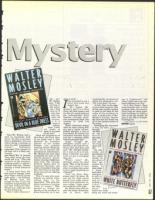

Then Mr. Mosley took a
shot at mysteries with
Devil. He did eventually
find a publisher, but not
before facing a barrage of
what he calls "commercial
racism." Publishers
expressed little interest in
his book, set in a black com-
munity in
post-World War II, because
"they didn't know who they
would sell it to." (The vast
majority of the mystery-
reading public is white.)
Another told him, "There's
already a black detective
writer."
It must have been the
best kind of revenge when
Devil began making money
right away — not millions,
Mr. Mosley says, but
enough for him to quit his
computer programming job
and start writing full time.
Those 5 a.m. wake-ups were
the first thing to go.
"Now I write whenever I
get up,"
Mr. Mosley
says. "I like
writing in
the morn-
ing. I find
myself
very clear
and cre-
ative. Of
course,
t h e
muse is
always
there. I have
all kinds of
books in my head
all the time."
With the popularity of
Red Death and Devil (soon
to be made into a film
directed by Jonathan
Silence of the Lambs
Demme and possibly
starring Denzel Washing-
ton), not to mention the
presidential endorsement,
Mr. Mosley has more than
established his name in the
murder-mystery genre.
Author Jonathan Kellerman
loves him. The Chicago
Tribune likens him to
Raymond Chandler, and
critics everywhere from the
New York Times to the Wall
Street Journal are offering
accolades.
This of a man who never
follows an outline when
sitting down to the
typewriter. Who calls the
whole business of writing
"kind of murky." Who
decided to change the
identity of the murderer in
White Butterfly as it was
INSIMMIMW
going to print.
was surprised to see a
white man•walk into
Joppy's bar.
So begins Mr.
Mosley's Devil in a Blue
Dress, his first mystery and
the first of a series featuring
the unforgettable Easy
Rawlins, a smooth, sharp,
and unemployed black war
veteran in 1948 Los
Angeles.
Easy's adventure begins
when he starts talking with
the bar's white visitor,
DeWitt Albright, a man so
formidable he makes the
otherwise fearless Joppy
look like "a salesman whose
luck has just gone bad."
Joppy brought Mr.
Albright's scotch and a
bourbon on the rocks for me.
He put them both down and
said, "Mr. Albright lookin'
for a man to do a lil job,
Easy. I told him you outta
work an' got a mortgage
t'pay, too."
"That's hard." Mr.
Albright shook his head
again. "Men in big business
don't even notice or care
when a working man wants
to try to make something out
of himself"
"And you know Easy
always tryin' t'be better. He
just got his high school
papers from night school
and he been threatenin' on
some college." Joppy wiped
the marble bar as he spoke.
Mr. Mosley loves what he
calls "the music" of that first
line in
Devil.
He's
l
unabashedly sentimental
about his characters, too.
"Oh, I love them," he says.
In fact, that on-the-edge-
of-your-seat-suspense that
drives some weaker readers
to peek at the back for the
name of the murderer is
only a small part of Mr.
Mosley's writing, despite
the fact that his books are
all in the mystery section of
the stores.
Developing the characters
is key, he says,
though
"it's hard
to say
where
they come
from. I
just like
writing
about peo-
ple."
He also
works at
developing
the jazzy,
smoky at-
mosphere
that per-
meates his
books, a
place where
a black-
and-white
television
is still a
novelty
and ev-
erybody
takes
the Grey-
hound bus,
where the worst
thing you could call some-
one is "communist" and
where black men are rou-
tinely referred to as "boy."
In A Red Death, Easy
finds himself with a little
problem when the govern-
ment finds he owns apart-
ment buildings he failed to
note on his tax records. He
goes to the IRS to straight-
en things out.
I sat down in the most
MYSTERY page 58