

Close Op
Making
It Hosher
And tin will slaughter it
as I have commanded it.
Ueuteronomq 12:21
The manual used by
. kosher slaughterers
(shochtim) supervised by
the Council of Orthodox
Rabbis of Greater
Detroit contains 160
pages. The council's
kashrut administrator,
Rabbi Joseph Krupnik,
summarized the require-
ments for The Jewish
News:
* The animal must be
healthy, as seen by how it
walks around. The ani-
mal must also meet mini-
mum age standards.
* During slaughter, the
animal must be held
properly so the shochet
can do his job quickly and
smoothly.
* The shochet's knife
must be as sharp as pos-
sible and be resharpened
between uses.
* The shochet has to
feel the knife go through
the animal's air pipe
and food pipe as smoothly
and as quickly as
possible.
kosher butcher. He has
to look for other cus-
tomers for the hind.
Every time they break
down a cattle, they still
have the expenses of
kosher slaughter.
"If Farmer Jack comes
in and wants a kosher
rib steak sale, Cornbelt
can't give away all those
extra non-kosher chucks.
Lately, skirt steaks
depend on the Japanese.
We paid a dollar a pound
a year ago (wholesale).
Now it's $3 a pound.
"It's not all cut and
dried."
Would extra competi-
tion cut the costs? Morris
Flatt doesn't think so.
He says his company
already subsidizes the
kosher meat industry in
Detroit by charging high-
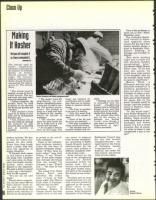
Yaacov Feurstein cuts freshly slaughtered beef.
* The animal must die
immediately. (In non-
kosher slaughterhouses,
a stun gun is used to ren-
der the animal uncon-
scious. The animal is
hung on a hook and then
its throat is slit, usually
within 30 seconds of
stunning.)
* The shochet must
place his hand inside the
cut to make sure it was
smooth and thorough.
* An air pipe is used to
blow up the lungs. The
lungs are checked for
smoothness and to make
sure there are no lesions,
holes or unusual attach-
ments.
* The liver is checked
to be sure it is healthy.
* Only the meat from
the front of the animal is
used.
* Some of the fat and
the veins are removed.
* The meat is soaked in
water, salted and rinsed.
* The shochet must be
properly trained and cer-
er prices to its out-of-
town customers.
Some of the indepen-
dent butchers, however,
yearn for the days of
greater wholesale compe-
tition. "If they raise my
price today," says Jack
Cohen, "I say 'Thank
you.' If the meat weighs
less through shrinkage
than the weight I'm
charged, I say, 'Thank
you.'..." He says he has
no choice.
But asked if he faults
Morris Flatt and
Cornbelt, Mr. Cohen
says, "I pray to God
every night that Morris
Flatt stays in business.
He's the only one left."
The Council of
Orthodox Rabbis of
Greater Detroit has been
asked twice in the last
two years to approve
other kosher slaughter-
ers. According to Rabbi
Joseph Krupnik, kashrut
administrator for the
council, their problem is
different standards with-
in the kosher rules.
Some lesions on the
lung of the slaughtered
animal are deemed
acceptable within the
kosher laws, but no
lesions are acceptable
with glatt kosher meat,
and glatt is the standard
the council is now enforc-
ing.
Cornbelt and an Iowa
slaughterhouse are the
only sources presently
approved by the council.
Other cities in the
Midwest have varied
sources. Rabbi Benjamin
Shandalov of the Chicago
tilled.
* Nothing can be done
to interefere with the
kosher slaughtering
process, such as cutting the
animal in any way that
would prevent the proper
checks from being made.
Any animal that fails
any of the checks is
deemed not kosher
(treife), even though it
may meet or exceed U.S.
Department of Agri-
culture-standards.
"One of the problems is
there are so few," Rabbi
Shandalov says.
The Orthodox Rabbi-
nical Council in Cleve-
land approves three
sources for the city's four
kosher butcher shops: a
plant in Sandusky, Ohio,
Aurora Packing in
Chicago, and Cornbelt in
Detroit.
"But we're working
right now to have our
own shachita (kosher
slaughtering) here,"
Cleveland's Rabbi Daniel
Schur says. "If we had
only one source, we
would have total control
of the slaughter. Also, all
the butcher shops would
be equal in supervision."
Morris Flatt, a
Holocaust survivor who
describes himself as "a
stubborn gentleman,"
does not plan to close
Cornbelt or retire or die.
And his son Sam has
been part of the business
for years. But in the
event Cornbelt could no
longer provide kosher
meat in Detroit, what
would happen?
"In the worst case,"
says Rabbi Krupnik of
the Council of Orthodox
Rabbis, "there would be
more dependence on pre-
packaged and frozen
meats. It's not a crisis
situation. But, of course,
it's nicer to know it was
slaughtered a day or two
ago."
Rabbinical Council says
his city has several
slaughterhouses: one
supervised by the Union
of Orthodox Jewish
Congregations of
America, one under the
local council, and several
under private rabbis.
Butcher
Eugene Feldman