

The Memory Of All That
Ten local students amaze everyone, from rabbis to laymen,
with their powers of memorization and comprehension.
ELIZABETH APPLEBAUM ASSISTANT EDITOR
U
nlike most boys
their ages, Moishe
and Mencahem and
Yoisef might not
have memorized the bat-
ting averages for the
Tigers in 1993 or know
just which Teen-age Mu-
tant Ninja Turtle is
Donatello.
But they seem to know
everything — everything
— one could imagine
about the Talmud's
Tractate Mesechta of
Ketuvot.
Even leading Detroit
rabbis were impressed.
"I can't take this," said
Rabbi Yitschak Kagan of
the Lubavitch Education
Center in Farmington
Hills as he watched the
boys get tested on their
knowledge of the text.
"It's too humbling."
For the past year, 10
students, all aged 13-15,
at the Lubavitch Cheder
in Farmington Hills, have
been memorizing the
tractate. Late last week
they were tested both on
their memory and com-
prehension of the 225-
page text.
The Talmud is divided
into six sections called
orders, all of which are
partitioned into tractates
(about 12 each). Ketuvot
deals mainly with laws of
marriage and divorce. It
also includes commentary
by Rashi and other lead-
ing scholars.
"On kuf yud lamed bet
— what does it say about
Eretz Yisrael, approxi-
mately 12 lines from the
bottom?" one guest asked
a boy during the testing.
It took the young stu-
dent less than a moment
to come up with the cor-
rect answer.
Rabbis from throughout
the country were invited
to test the boys at
Congregation Dovid Ben
Nuchim in Oak Park.
Community members also
attended and asked ques-
Japanese Consul General
Meets With AJC Leaders
KIMBERLY LIFTON STAFF WRITER
B
ecause of more ties
between govern-
ment and business
in Japan, the Jap-
anese government is try-
ing to change the popular
perception of being "pro-
Arab," the Japanese
Consul General to Detroit
told a group of Jewish
leaders last week.
In a speech during a
luncheon with Jewish
leaders at the Skyline
Club, Yasukuni Enoki,
who came to Detroit four
months ago, said the
Japanese government is
trying to convince its cor-
porations to publicly
renounce the boycott.
This was the first meet-
ing of its kind for Mr.
Enoki and members of
the Detroit Jewish corn-
munity. Mr. Enoki told
the leadership of the
American Jewish Com-
mittee that prior to 1973
Japan was indifferent to
the Middle East.
The only concern of the
Japanese, Mr. Enoki said,
was that the Middle East
had a plentiful oil supply.
Today, he said, the situa-
tion is different as Japan
takes a more visible role
on the world economic
scene.
Today, Japan views the
Arab boycott as counter-
productive, Mr. Enoki
said. The country hopes
to cultivate a more even-
handed approach to
Middle East affairs.
Members of the AJC
Arab boycott of
Israel is refuted.
and Mr. Enoki hope to
continue work on the
Japanese-Jewish dialogue
that was begun by the
AJC in 1987, following
anti-Semitic writings by
Japanese authors.
David Harris, executive
vice president for the
AJC, also spoke at the
luncheon, saying the
human rights organiza-
tion first became involved
in Japanese-Jewish rela-
tions after he read a dis-
turbing article in the New
York Times about anti-
Semitic writings in
Japan.
'We were surprised and
disturbed," Mr. Harris
said. "But we didn't know
how to proceed."
Mr. Harris spent the
following year studying
the issue, from which the
AJC created the Pacific
Rim Institute in Los
Angeles. The institute is
developing programs that
will help the American
and Japanese people
learn more about each
other's history, culture
and traditions.
The institute seeks to
identify the primary
issues troubling Jews and
others about cultural, eco-
nomic and political trends
in Eastern Asia. In the
United States, the insti-
tute tries to build bridges
between American Jews
and Japanese living in
the United States. E
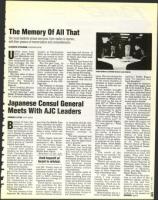
Rabbi Goldman and Rabbi Grubner quiz students.
• tions. Not once during the
90-minute session did any
of the teens stumble or
hesitate or prove unable
to come up with the cor-
rect answer.
One mother brought
her video camera. Other
parents took photos as
their sons answered such
questions as, "What is the
first word on the top of
page 22?" or "Where does
it say that under certain
conditions someone might
be permitted to leave
Eretz Yisrael?" or "What
did Rashi say about what
we just read? What do
other rabbeim say?" or
"This paragraph begins,
`If a man goes to...' What
comes next?"
Memorizing of sacred
texts was traditional in
the cheder of Eastern.
Europe, though it has
faded in popularity over
the years. It is an option-
al program at the Luba-
vitch cheder, which Rabbi
Kagan believes offers
great rewards to the stu-
dents.
"The words of the
Talmud are sacred," he
said. "They are vehicles
for God's wisdom.
"There's not much you
remember 20 years from
now — but with this,
whole chunks will always
come to their fingertips
with tremendous ease.
"I also memorized
(when I was young),
though never a whole
tractate. You recall the
language, which can be
critical when you're try-
ing to deduce a parallel
(in Halachah).
"Memorization also is a
kind of spiritual self-dis-
cipline," Rabbi Kagan
said. "It requires very
hard discipline."
Boys begin by memoriz-
ing about two pages, then
ask to be tested for fluen-
cy and analysis. When
they have perfected those
two, they learn another
two and another two. It is
a constant process of
review and re-review.
But the memorization
is only the start, Rabbi
Kagan said. "Learning by
rote is not considered
much of an accomplish-
ment if its not accompa-
nied by understanding."
Those who memorized
the entire 225 pages are
Yirmiya Berkowitz of
Southfield; Moishe Gou-
rarie, Schneur Keselman,
Yoisef Stein, Shmuel
Fishel Zaklos and Yoisef
Zaklos of Oak Park;
Mencahem Mendel Hecht
of Chicago; Melech Jaffe
of St. Paul, Minn.;
Shmuel Reich of Brook-
lyn; and Yitzchok Sando-
mire of Seattle.
Another six students
memorized at least 100
pages. They are: Levi
Goldstein of Ann Arbor;
Levi Chanowitz of Mon-
treal; Yoisef Charyton of
Winnipeg; Asher Deren of
Stamford, Conn.; Chaim
Lazaroff of Houston,
Texas; and Zaki Tamir of
Miami Beach, Fla.
Memorizing the trac-
tate is not part of the c;),
yeshiva's regular curricu-
lum. In the last few -
months students were >7
given a little extra time -J
during the school day, but
for the most part they
worked on the project on 15
MEMORIZE page 16