

Evolution Of A
Humanistic Service
The Birmingham Temple's ritual committee worked with Rabbi Sherwin
Wine to create services unique to the congregation.
The first services, however, included theistic language and recitations
common to the Hebrew Union Prayer Book, used by the Reform Movement
(Service One).
On March 1, 1964, the temple conducted Shabbat services from its first
completely original text (Service Two). Little by little, all theistic language
was removed. By September, 1964, the service (Service Three) was entirely
Humanistic.
SERVICE ONE
LEADER
The gaps of history reveal the exploits of brave men —
men who defied the limitations of their time, their
place, and their society to create what the fearful
dared not do. The defiance of Isaiah, the proclamation
of Jeremiah, the dream of a Micah survive their
authors to become for the world a heritage of courage.
Progress with man is the fruit of his boldness. Did
Galileo fear the heavens, or did Einstein stand fright-
ened before the mystery of physical matter? Were the
depths of the human mind too awesome for Freud? Or
was the thrill of discovery, the sensation of holiness,
the consciousness of the divinity within us? The power
of man in its fullness is the power of God. The glory of
man is in his restless will to conquer the chaos and
evil of a world that needs the discipline of human
genius.
What is like true divinity among all things,
enabling man to create wonders and to perform awe-
some deeds?
SERVICE TWO
LEADER AND CONGREGATION
The disappointments and tragedies of life limit our
vision. In every failure and frustration our confidence
in living is diminished. We feel ourselves truly help-
less before the might of the world. Like pawns on a
chessboard we are moved across the map of our years
without the courtesy of consent... The dignity of being
noticed by the forces that persecute us collapses
before the dumbness of nature. In our despair we
often appear to ourselves less than we are, - and our
energies are exhausted in fear and self-pity. Yet,
through all this admission of weakness, our godliness
cries out for recognition. We are, in a real sense,
greater than the forces which defeat us. The wind and
the flood and the earthquake can never know us, but
we can know them. We can know, and we can, through
understanding, control. Knowledge is divine power. In
its persistent pursuit by men lies the surrender of
dumb fate and our holy victory over despair.
SERVICE THREE
SILENT MEDITATION
The truly sacred is the possibility within each and
every one of us to become the confident master of the
evil that defies us. Against the natural world that
knows no purpose, we stand to choose and achieve our
destiny. Man must not worship what he is; he must
rather revere the god he can become.
CONGREGATION AND CHOIR
We revere the best in man, all holy thoughts, all
sacred acts, all words divine. We find in them our
need; we see in them our dream. We affirm the love in
man in every breath, in every wish, and in every deed.
We find in love our life; we see in love our hope. The
strength of truth is within us; we serve the best in
man.
times, when individuals
feel they need to rely on
something omnipotent,
albeit never fully com-
prehensible.
"People are turned on
emotionally by the mys-
tical," said Conservative
Rabbi David Nelson of
Congregation Beth
Shalom. "Humanistic
Judaism doesn't offer the
mystery and the mystic
approach. It is very
intellectual. Judaism has
always welcomed intel-
lectual pursuits, but
sometimes, when you
intellectualize something
too much, it loses the
power to move you."
Some local rabbis
refuse to discuss
Humanistic Judaism.
Though they respect
Rabbi Wine as a teacher,
they have nothing good
to say about the move-
ment. One remarked that
a "Godless Judaism" for-
sakes the cause for
which 6 million people
died during the Holocaust.
But a majority of rab-
bis interviewed said
Humanistic Judaism has
a useful place within the
Jewish community. Most
important, they say, it
retains non-theistic Jews
who otherwise would dis-
affiliate from the com-
munity.
The rabbis also agree
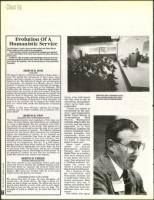
Rabbi Wine leads a Humanistic service.
Below, founding member Harry Velick
served two years as temple president.