
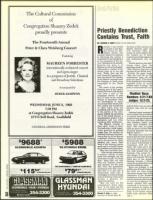

The Cultural Commission
of
Congregation Shaarey Zedek
proudly presents
The Fourteenth Annual
DR. RICHARD C. HERTZ SPECIAL TO THE JEWISH NEWS
R
Peter & Clara Weisberg Concert
Featuring
MAUREEN FORRESTER
internationally acclaimed concert
and opera singer
in a program of Jewish, Classical
and Broadway Selections
Accompanied by
DEREK BAMPTON
WEDNESDAY, JUNE 2, 1993
7:30 PM
at Congregation Shaarey Zedek
27375 Bell Road, Southfield
GENERAL ADMISSION FREE
9688*
'93 HYUNDAI EXCEL
THE DE TRO IT J E WIS H NE WS
OLDSMOBILE ACHIEVA
38
si 15
miff
FREE MAINTENANCE, 2 YEARS OR 24,000 MILES
Per Maidh With No Money Dont
'Sale price plus tax, lie., & freight. Special Purchase '92 A4hieva. 60 mo. financing at
99,9 APR. 6 mo. at $115.54 after dealer rtioi on •54 mo. at 5215,54
OLDSMOBILE • SAAB • HYUNDAI
OnTelegraph at the
Tel-Twelve Mall. Southfield 3514,a3304° )
k b,
IOCISMObile
THE POWER OF INTEL. LUCENT ENGINEERING.
•sou) pries Plus
7 19
Pa lhati With No Noisy Dint
ta, fie., 8 freight and ciselsr prep. 80 MN financing *II% APR. Rebate to dear. 6
me. at Mil aft* des*'
84Mo. et $179.81 tv/ roved credit
GLA'SSMalf
tralltiDel
On Telegraph at the
Tel-Twelve Mall. Southfield
Priestly Benediction
Contains Trust, Faith
3544300
ecently I was invited
to preach at the Sun-
day service of a Pro-
testant church. The
minister asked if in addition
to delivering the sermon I
would deliver the benediction
at the conclusion of the ser-
vice. I decided on the priestly
blessing but gave it in
Hebrew as well as in English.
Afterwards, a member of the
church came up to me and
said, "Rabbi, that was the
most beautiful benediction I
have ever heard. The rhythm
of the Hebrew language made
the blessing so much more
meaningful to me. Thank
you."
The power of the priestly
blessing, part of this week's
sedrah (Numbers 6:24-26) has
long been a part of the
synagogue service. It goes
back to time of the ancient
Temple in Jerusalem when
the descendants of Aaron
would raise their hands aloft.
The custom was transferred
in later times from the
sacrificial cult of the Thmple
to the service of the syna-
gogue. Indeed, the spreading
out of the hands became a
characteristic symbol of the
Aaronites and was often
carved on their tombstones.
The Hebrew consists of
three short verses of three,
five and seven words respec-
tively, mounting by gradual
stages from the petition for
material blessing and protec-
tion to that for divine favor as
a spiritual blessing, climax-
ing in the petition for God's
greatest gift, peace. Each
word of the blessing implies
much and is a fruitful theme
for comment and inspiration.
"May the Lord bless thee"
. . . with enough possessions
to sustain a person in body,
mind and strength, but not
more than enough "and keep
thee." Keep thee not only
from evil, sickness, poverty
and calamity, but also keep
thee from thy possessions
possessing thee! How impor-
tant this is in this day of
materialism, when man is
worshipped as God and things
instead of things of the spirit
become a person's all-
important desires.
"May the Lord let His
countenance shine upon
thee." It can mean may the
Lord give enlightenment of
Richard C. Hertz is rabbi
emeritus of Temple Beth El.
the eyes, so that a person can
discern between good and
evil, between right and
wrong. It could request that
the radiant joy of God's
countenance bring happiness
and contentment into our
lives.
"And be gracious onto thee"
means more than the
preceding words. This means,
"May God give thee grace in
the eyes of your fellow man."
Finally, the great words,
"May the Lord lift up His
countenance upon you and
grant you peace." The climax
of the benediction has always
regarded peace as man's
noblest state of being." By
peace is meant between man
Shabbat Naso:
Numbers 4:21-7:89
Judges 13:2-25.
and his fellow man as well asl
between man and his own,
self.
Judaism's great message of
social justice was proclaimed
in ancient times because the
prophets long ago recognized
the cause and effect relation-i
ship between justice and
peace. And, therefore, they
said, "The work of justice
shall be peace and the effect
of justice quietness and con-
fidence forever.:'
The rabbis must also have
known that the state of peace
must exist between man and
his inner self. A person must
be at peace with himself, his
conscience, with his own
heart. For when all is said
and done, every person musty
live with himself first and
foremost. One cannot be a'
real person if he is not at
peace with himself. Thus the
third part of the priestly
blessing becomes a fitting
climax for evoking God's most
precious blessing, peace.
Much has changed in the
3,000 years of Israel's history
but there are some things
that never change. Just as the
inspiration of the threefold
benediction of the priests has
moved countless generation0
to leave the synagogue with
hearts uplifted and steps
quickened, so its beauty will
ever continue to inspire the
generations of Israel yet to
come. It will forever remain
God's most precious bless-
ing. ❑
,