

. Asti
MIDDLE EAST Page 22
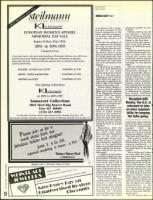
Ku
EUROPEAN SELECTION
by Karl Lagerfeld
EUROPEAN WOMEN'S APPAREL
MEMORIAL DAY SALE
Begins Friday, May 28th.
30% to 50% OFF
(Original Prices)
If you have taste, style and understanding of European fashion, you will be sur-
prised how far your fashion budget will take you at Steilmann's fantastic
Memorial Day Sale. You will find this season's best co-ordinated Sportswear,
Jackets and Dresses.
BLAZERS, JACKETS and COATS
STARTING AT $59
SKIRTS, PANTS and BLOUSES
STARTING AT $29
DRESSES and SUITS
STARTING AT $79
Our Spring Collection
K
'
by Karl Lagerfeld
at 40% to 60% OFF
Somerset Collection
2801 West Big Beaver Road
Troy MI 48084
(313) 637-3006
For This Sale, The Store Will Be Open Memorial Day, Monday, May 31st., 12-5
Store Hours: Monday, Thursday, Friday 10-9; Tuesday, Wednesday, Saturday 10-6; Sunday 12-5
Applegate Square • Northwestern Highway At Inkster
11.11111.1www--
Nkt_ISVIAIN
11LCUS
■
J0
SUNSET
4k-
PHONE: 35'7-
HOURS:
4000
Satur da y 10
am - 5 p m
Monday -
Highway,
Southfield, MI
48034
Norti-Ivvestern
STRIP 29636
ma y
store
very
10-
d
is
lioad*ertise peso
SaNie
of activities in the territo-
ries and a member of the
Israeli delegation to the
talks, told the government
on Sunday that matters
weren't that drastic as of
yet.)
Though the refugees in
the camps are the hardest
hit, they are not the only
ones suffering from the poli-
cy. Merchants in east
Jerusalem report a steep
drop in business because
the 30,000 people who come
to east Jerusalem from the
West Bank and Gaza daily
are now prevented from
doing so.
It should not be surpris-
ing, then, that Palestinian
support for the peace
process seems to be unravel-
ing at a dizzying pace.
Delegation head Haidar
Abdel Shafi has again rec-
ommended suspending the
talks in light of the fruitless
results of the ninth round.
Sheikh Abdel Hamid a-
Sayah, a venerable religious
figure who is also chairman
of the Palestinian National
Council (PNC, the parlia-
ment of the PLO),
announced his intention to
resign in protest over the
delegation's continued par-
ticipation in the talks.
Along with Hamas, the
left-wing opposition to the
talks is again gaining
ground in the territories.
And even more important,
observers report that Yassir
Arafat has lost the majority
favoring the peace process
within the PLO, or at least
the PNC.
Meanwhile, both the
Hebrew and Arabic press
are filled with items
describing the Palestinian
man in the street as
increasingly bitter over
Israel's policy of "wooing"
the Palestinian delegation
back to the negotiating
table with symbolic gestures
while making life increas-
ingly difficult for the com-
mon people.
In addition to the econom-
ic hardship suffered by tens
of thousands of families, the
Palestinians remain up at
arms about their lack of
access to east Jerusalem,
which they see not only as a
form of harassment but as a
political move to further dis-
tinguish the city from the
rest of the territory cap-
tured by Israel in 1967.
Even if Prime Minister
Yitzhak Rabin (whose gov-
ernment is split on the
issue) were to have a change
of heart about the closure,
he would have a hard time
allowing the situation
revert to the previous status
quo because the policy
remains as popular as ever
in Israel.
Political violence has all
but vanished — after the
rash of harrowing murders
in March that prompted the
closure in the first place —
and the crime rate (particu-
larly of car theft and bur-
glary) has absolutely plum-
meted.
People are growing accus-
tomed to the enhanced secu-
rity, so that after two
months the closure has
turned into what is referred
to in computer software ter-
minology as "the default
mode."
Still, the relief hasn't soft-
ened many hearts to the
Palestinian dilemma or
even secured Mr. Rabin's
political position. One inter-
esting indication of this
paradox came last week,
after the Likud Conference
passed a series of resolu-
tions showing that the party
was sticking to its hard-line
position on the territories.
It reaffirmed, for example,
that Jewish settlement
should continue at an accel-
Occupied with
Bosnia, the U.S. is
reluctant to take
on more responsi-
bility for keeping
the talks going.
erated pace; that autonomy
must be the final, not just
the interim, accommodation
reached with the
Palestinians, and that the
party will work to extend
Israeli sovereignty over the
West Bank and Gaza Strip.
Such a policy would, of
course, destine Israelis and
Palestinians to live in close
company indefinitely — a
notion that seems to have
lost public favor in the past
months.
Yet a Gallup poll taken
two days after the confer-
ence ended showed Likud
Chairman Benjamin
Netanyahu outstripping Mr.
Rabin (42 percent to 35 per-
cent) on the question of who
would win an election if the
vote were held that day. The
poll may, of course, reflect
Mr. Netanyahu's personal
appeal to Israeli voters,
rather than the popularity
of the political positions for
which he stands. But either
way, the figures are neither
complimentary to the
incumbent prime minister
nor a signal from the public
that he should be liberaliz-
ing his views.
For the coming days, at