

k
Editor's Notebook
Community Views
Talking It Out
lome Alone IV
Left In Detroit)
GARY ROSENBLATT EDITOR
-.DR. MYER H. ROSZLER SPECIAL TO THE JEWISH NEWS
ndeed, the Michigan Mir-
acle Mission touched and
changed the lives of all the
participants who were for-
4 iunate enough to go to Israel.
-'-' It also changed my life, and I
didn't even leave Detroit.
\_. My wife, Janis, went on the
Mission, leaving me home
alone with my four children,
ages 2, 4, 5 and 8. Janis may
Shave,
indeed, driven jeeps in
)
the Golan Heights, but I got
)to drive carpool. She may
have gone swimming in the
;salty water of the Dead Sea,
I\ but I was fortunate enough to
- 'wash my dishes in water sup-
1\ plied courtesy of the Detroit
/-sewer after the pipes got
) clogged up with week-old
Brussels sprouts.
> This whole business start-
ed approximately a year ago
when my wife was asked to
\ join a committee, as a repre-
/=sentative of the Orthodox
community, that would orga-
nize a trip to Israel. This corn-
>mittee
was later to be called
/-
a cabinet, and the trip became
>known as the Michigan Mir-
acle Mission.
In my usual unselfish fash-
ion, I told her she could not
/serve, and if she had extra
time, I had many personal
"miracle missions for her to ac-
`„complish around the house.
(\ But, as most married couples
do, we compromised — she
could serve on the cabinet,
out she would not attend any
Meetings at night and cer-
tainly not go on the Mission.
After Janis went to her first
(meeting and met the likes of
her new friends — David,
Susie and Jane = she was
told she could not serve on the
cabinet without attending the
Mission (how could she re-
::ruit if she wasn't even go-
ng?). I said absolutely not;
he sent in the deposit.
This was the beginning of
line months of constant
)hone calls and nighttime
meetings for orientation and
recruitment. I tried to use
:Massive denial, but it was be-
, coming evident to me that in
brder for the kids to get into
o ed you had to put them in
'
'
pajamas
first. (I still don't un-
derstand why they can't sleep
in their school clothes).
Following Passover, a suit-
case appeared in our bed-
room, and I literally started
to see the writing on the wall
(why do kids always write on
the walls with pens instead of
pencils?). On April 18th, I be-
, came a mommy with four kids
4.1
!,
whose spouse decided it was
time to make a pilgrimage to
the Holy Land.
I immediately swung into
action. Sara's Kosher Deli in
Southfield named a sandwich
for me to commemorate my
patronage. The kitchen in my
house stayed clean a record
11 days and 10 nights (it was
only used for what it was
made for — eating, not cook-
ing). However, my 4-year-old,
Rachel, sustained a magnifi-
cent burn when soup from the
microwave spilled on her.
The first night, though,
wasn't that bad. Amichai, 2,
She made lots of new friends
and managed to convince all
of my co-workers that she was
still hungry after four cans of
pop and five ice-cream cones.
The next couple of days
weren't too bad. Amichai still
wouldn't take a bath. Rachel
didn't let me dress her burn,
and I never understood why I
invested in mattresses for the
kids, or a house with more
than one bedroom. My bed-
room became command head-
quarters.
When Janis called from Is-
rael, she asked me if there
was anything in the media
h
i
Dr. Myer H. Roszler, his
wife Janis and children live
in Oak Park, two minutes
from Sara's.
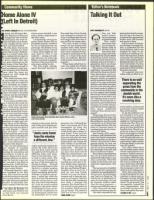
Daddy held hostage: (from left) Shira, Myer, Rachel, Elisheva, Janis
and Amichai Roszler.
refused to take a bath, but the
rest of the girls helped pre-
pare lunches and get their
"Janis came home
from the mission
a different Jew."
clothes and books together for
school. My wife's side of the
bed was kept warm during
the night by all three girls, at
different times and some-
times at the same time. I nev-
er had to sleep alone. The
next morning I managed to
get two of the three girls on
the bus to school. At lunch
time I returned home to take
Rachel to a plastic surgeon
whom I worked with and
found something drastically
different in Rachel's appear-
ance. I asked her what she
did to her hair? She answered
that she cut her hair to look
like that of her friend Emma.
So I took my newly punked
daughter to the doctor where
he bandaged her burn and ex-
pressed his condolences on
my predicament. Rachel was
an immediate hit at work.
about her trip. I informed her
that I was saving all of the
newspapers for when she
came home (that's when I
would finally get a chance to
read them). I also told her
that the house was cleaner
than ever and when she came
home I would let her in on my
secrets (don't cook, change the
kids' clothes or use the bed-
rooms and the house stays
pretty neat). My major ex-
cursions were to Sara's (do
you know they have over 45
different sandwiches?), the
video store, and occasionally
work.
The 28th of April, the day
the Mission returned to De-
troit, finally came, and some-
one out there decided that
this day was National Father-
Daughter Day at work. So, I
took my new best friend,
Rachel, in to see the plastic
surgeon and to keep me corn-
pany at work again. Rachel's
burn did just fine considering
how often I changed the
dressing. She thinks that all
I do at work is play games on
the computer, drink pop and
eat ice cream. The nation's
GNP lost at least 12 percent
HOME ALONE page 6
Can you help
build a commu-
nity by reporting
- 41 fit- its shortcomings?
That wasn't
the formal topic
of a two-day con-
ference held at
the New York of-
fices of the Anti-
Defamation League last week,
featuring about a dozen editors
of American Jewish newspa-
pers and several executives of
national and local Jewish or-
ganizations. But it was always
at the heart of the discussion.
The purpose of the unique
conference, sponsored by the
ADL and the American Jewish
Press Association, was to ex-
plore the complex relationship
between Jewish newspapers
and the organized Jewish com-
munity in an open and honest
dialogue, and tackle such ques-
tions as: is the primary goal of
the Jewish press to inform, to
be an advocate for Jewish caus-
es, or to support fund-raising?
Should the Jewish journalist
approach his or her task in any
way different from a secular
journalist? Should Jewish or-
ganizations give preferential
treatment to Jewish newspa-
pers? Should Jewish organiza-
tions expect preferential
treatment from Jewish news-
papers?
These issues did not revolve
around hypothetical cases. One
strong current running through
the conference was the recent
controversy on the West Coast
over charges that the ADL has
spied on innocent people in
overplaying its role as a cham-
pion of civil rights.
Abe Foxman, ADL's nation-
al director, said it bothered him
most when Jewish newspapers
featured articles on the accu-
sations. He expected it from
general dailies, he said, but
shouldn't the Jewish newspa-
pers be out front proclaiming
the admirable work ADL had
done in its 80-year history?
Some editors responded that
they owe it to their readers to
present both sides of this, or any
other, controversy. Their first
loyalty is to the truth, not to any
particular organization, they
said.
The top executive of another
national Jewish organization
weighed in by asserting that for
the most part, Jewish newspa-
pers "just try to bloody us." He
said he has no intellectual re-
spect for journalists who look
for dramatic conflict rather
than the more important —
though more difficult to get at
— story of how and why orga-
nizations work the way they do.
One editor responded by sug-
gesting that Jewish newspa-
pers can't get at the inner sto-
ry because the organizational
leaders won't talk honestly
and openly to them.
And so it went. In one ses-
sion devoted to coverage of Is-
rael, a spokesman for the
Israel Embassy said he was
troubled by what he de-
scribed as a belittling of Is-
rael in the American Jewish
community. He said that too
many well-meaning philan-
thropists feel they can "save"
Israel with dollars. But they
have little understanding or
appreciation of the real Israel,
its people and pulse.
He suggested that jour-
nalists make an effort to cov-
There is no wall
separating the
press from the
community in the
Jewish world.
It's more like a
revolving door.
er the culture, economy and
psychology of Israel rather
than just its politics.
In all, the conference was
not intended to solve prob-
lems so much as to air them,
and it did in a refreshingly
candid way. Participants dis-
cussed cases from their own
experience and asked the
group how they should have
handled them. Should a re-
porter do a story if it could
lead to the drying up of funds
for a worthwhile cause in Is-
rael? Should a federation ex-
ecutive tell the local Jewish
paper about a safety problem
in the day school, or just take
care of it quietly?
Both sides talked about
the inevitable tension when
Jewish organizations try to
present a unified communi-
ty and the newspaper points
out conflicts. Often the orga-
nizations attempt to control
the news by refusing to dis-
cuss a controversy until after
it has been resolved, while
the newspapers want to de-
scribe it as it is taking place.
Both sides noted that it
would be beneficial for orga-
nizations to share more in-
formation up front with the
journalists, even if it is off the
record. "Co-opt us more," was
my suggestion. I argued that
when organizations take
journalists into their confi-
dence and explain their posi-
TALKING IT OUT page 6