

ackorou
Are The Arabs Serious.
fter two weeks of
sterile conversation,
the Mideast peace
talks in Washington
have adjourned inconclu-
sively, leaving experts to
ponder whether the Arab
delegations are willing or
able to strike a deal.
If the Palestinians are
indeed the key to a broad
agreement, the signs are
looking particularly omi-
nous, for as the talks
lurched on, the Pales-
tinians signaled their con-
tempt for the process by
deliberately reducing the
size of their negotiating
team from the official 14 to
a derisory three.
That number was
reduced to zero when they
opted to boycott a meeting
with United States offi-
cials who intervened as a
"full partner" with their
own draft of a Israeli-
Palestinian agreement of
principles.
Israel had approached
the negotiating table hav-
ing made a slew of conces-
sions, implicit and explicit,
which directly address
publicly stated Palestinian
concerns. These conces-
sions might appear
picayune to the casual
observer but they cut deep
into longstanding Israeli
positions — in some cases,
actually reversing terms
for negotiations that had
been agreed by its Arab
interlocutors before the
Madrid conference:
Among other issues,
Israel agreed that:
• Faisal Husseini, the
most senior PLO represen-
tative in the territories
and a resident of Jeru-
salem, could be admitted
as a full negotiator, de-
spite its previous insis-
tence that Palestinian res-
idents of Jerusalem could
not participate.
• Virtually all of the
functions of the Civil
Administration in the ter-
ritories could be handed
over to Palestinian offi-
cials, even before the
interim self-government
negotiations are complet-
ed.
• Palestinians could
recruit an indigenous
police force of "several
A
In the latest
round of talks,
Israel softened
its stand
and the Arabs
toughened theirs.
DOUGLAS DAVIS
FOREIGN CORRESPONDENT
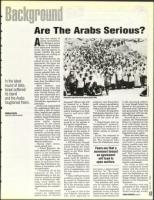
Palestinian deportees march against peace talks.
thousand" officers who will
be headed by a Pales-
tinian, wear a distinctive
Palestinian uniform,
receive training in an Arab
country and carry light
weapons.
• The key issues of land
and water-management
could be on the agenda of
the interim negotiations.
• Three working groups
could be established to
negotiate (a) the nature of
the self-governing Pales-
tinian authority, (b) land
and water management
and (c) human rights.
• UN Security Council
resolutions 242 and 338,
which embody the land-
for-peace formula, would
apply to the West Bank
and Gaza Strip.
• An interlocking mech-
anism would be created to
ensure that the five-year
interim settlement does
not become permanent but
is formally linked to the
start of negotiations over
the final status of the ter-
ritories.
• Some 5,000 permanent
residence permits would
be issued to Palestinians
this year who wish to set-
tle in the territories under
the family reunification
program.
• A total of 126 of the
415 Islamic extremists
who were deported to
Lebanon last December
could return immediately
(the remainder by the end
of this year at the latest).
• A further 30 long-term
Palestinian deportees were
permitted to return on the
eve of the start of the
talks.
• Deportations were an
"exceptional" measure,
implying it would not to
employ this measure in
future, except in extreme
cases.
So far, the response to
all this has been negligi-
ble. The reciprocal echo
from the Palestinian camp
Fears are that a
movement toward
an agreement
will lead to
open warfare.
has been a depressingly
familiar "no." No accep-
tance of any of the Israeli
offers. No halt to the polit-
ically motivated violence.
No initiatives of their own.
The question that must
now be seriously addres-
sed is why the Pales-
tinians have not responded
positively to any of Israel's
initiatives and why they
refuse to hold elections for
a self- governing authori-
ty, even though Israel has
agreed to the presence of
international observers
and guaranteed that this
arrangement will not sig-
nify a final agreement.
According to a senior
analyst, the Palestinians'
failure to respond has less
to do with Israeli conces-
sions and everything to do
with the internal schisms
and tensions within the
Palestinian body politic.
There are fears that any
serious movement toward
an agreement with Israel
will lead to unbearable
strains, possibly open war-
fare, between the "inter-
nal" Palestinians in the
territories and the "exter-
nal" PLO leadership in
Tunis; between the secular
and fundamentalist wings;
between the pragmatists
and the rejectionists.
The irony is that the
more concessions Israel
makes and the closer it
comes to an agreement
with the Palestinians, the
greater the danger of esca-
lating violence and disinte-
gration of the Palestinian
movement.
Yet another view was
presented at the weekend
by the London- based
Arabic-language weekly
ARABS SERIOUS page 48
c)
a)
>-
-tc
2
47