

-
Scratching The Surface
Harvey
Ovshinsky
tells tales
of struggle
and truth
in the
Motor City.
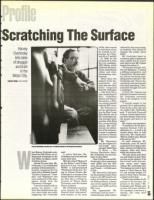
Photo by Glenn Triest
LESLEY PEARL STAFF WRITER
Harvey Ovshinsky recently won a Peabody Award for his latest documentary.
hen Harvey Ovshinsky pub-
lished the Fifth Estate, an un-
derground newspaper in the
mid-1960s, he began a career
of telling stories.
Almost 30 years later, Mr.
Ovshinsky is an established
producer of documentaries —
recently recognized for his
work with a Peabody Award.
"Northern Exposure," "Sein-
feld," and "Nightline" also
were recipients of the pres-
tigious award from the
University of Georgia.
"I always wanted to tell my
stories, our stories — not
their (the establishment) sto-
ries, about what was really
happening," Mr. Ovshinsky
said.
A native Detroiter, Mr.
Ovshinsky has lived and told
many local tales.
He's the voice of "Harvey 0
on the Metro," each Friday
from 6 to 8 p.m. on radio's
WDET. A self-proclaimed
"Workmen's Circle Jew," liv-
ing in Grosse Pointe, Mr.
Ovshinsky is a founder of the
Grosse Pointe Jewish Coun-
cil. He's also a writing in-
structor at Wayne State
University and the Grosse
Pointe Academy.
Mr. Ovshinsky served as
news director for WABX,
Detroit's first "alternative"
rock station, in the early
1970s, then moved
to television where
he worked in pro-
duction for Chan-
nels 20, 4, 7 and 56.
In 1986 he left
Channel 56 to form
his own company,
HKO Media, which
produces documen-
taries, instructional
videos and mini-
documentary com-
mercials.
These days, the
subjects of the doc-
umentaries and
mini-dots are often
better recognized
than Mr. Ovshinsky
— like Barb Wan-
rooy, an employee of
Blue Cross/Blue
Shield, and Tammy
Boccomino, a War-
ren woman infected
with the HIV virus.
Ms. Wanrooy is a
service representa-
tive for Blue Cross/
Blue Shield, one of
Mr. Ovshinsky's cli-
ents through a part-
nership with Ross
Roy, an advertising
agency. Her testi-
monial, her defini-
tion of the company,
is seen in commer-
cial form on Detroit
television stations
daily.
Ms. Boccomino
was the subject of a
full-length docu-
mentary titled Close
To Home — The
Tammy Boccomino Story.
Mr. Ovshinsky won the Pea-
body for this effort.
Close To Home was not Mr.
Ovshinsky's first experience
with AIDS and the HIV
virus. He also produced Tony
and Friends —A Celebration
of Life.
Ms. Boccomino had seen
the documentary about Tony
Caputo, the HIV-positive di-
rector of volunteer services
for Wellness House, a direct-
care service agency for indi-
viduals with AIDS and the
HIV-virus.
She approached Mr.
Ovshinsky with her story —
a heterosexual, white woman
infected by her drug-using,
ex-husband. She wanted to
educate the public about
AIDS.
Mr. Ovshinsky knew he
wanted to make a statement
about AIDS, but he wasn't
sure what it was. Mr. Caputo
helped him define it.
"I'd see gay men get sick,
die and disappear. I wanted
a different perspective. And
I found Tony. He was infect-
ed, and he was doing some-
thing positive about it," Mr.
Ovshinsky said. "All my doc-
umentaries are about people
who want something. I docu-
ment their struggle. It's quite
a cha ll enge."
At first, Mr. Caputo was
hesitant to become involved.
Mr. Ovshinsky convinced
him of the integrity of the
project.
"I include people in the
process. It's a partnership.
They do the work and I get
the credit," Mr. Ovshinsky
said. "I told both Tony and
Tammy I cared about them,
not their disease. Take away
the people and there is no
story."
Mr. Caputo was impressed.
"I decided to do the docu-
mentary because I felt an
obligation to — a need to be
honest about this, to talk
about this," Mr. Caputo said.
"Harvey made it easy. He just
followed my life."
In each endeavor, Mr.
Ovshinsky puts off actual
production for as long as pos-
sible. Instead, he follows his
subjects, talks with them
while the camera rolls.
"We talk, check each other
out and decide our goal. Then
we turn on the camera. If we
feel it won't work, the cam-
eras never even begin
rolling," Mr. Ovshinsky said.
"I'm looking for truth. I don't
know it. I don't have it. But
if I ask enough people, I'll
know it when I see it. It's just
awfully hard to find.
"I don't care whether it's 30
seconds or 30 minutes, the
process is the same," Mr.
Ovshinsky said. "People want
to know the truth, whether
it's a product, a service or a
disease. The rules don't
change."
❑
35