

"A Polish resister had
support; a Jewish
resister had the support
of no one."
to avert "another" Holocaust.
Washington's new Holocaust museum
will push the Holocaust even further into
American Jews' consciousness. Whether
this will be good for U.S. Jewry is un-
certain. Robert Alter, a professor of He-
brew and comparative literature at the
University of California at Berkeley, has
insisted that "any effort to make the
Holocaust the ultimate touchstone of
Jewish values" will distort Jewish life.
'We falsify our lives as Jews," he said,
"by setting them so dramatically in the
shadow of the crematoria."
Expecting the Holocaust to so domi-
nate Jewish life, said Michael Beren-
baum, the museum's project director,
"presumes that the museum will drown
out all the rabbis and all the teachings
of Judaism."
And David Altshuler, director of the
Living Memorial to the Holocaust-Mu- Toiletries of victims.
seum of Jewish Heritage in New York,
said that, for some Jews, the "civic reli-
gion" of Israel and the Holocaust is an
entree to the "real" Judaism.
`There are people who are not 'citizens'
of the community," he said.,"They get in-
volved with 'civil' Judaism and then pick
up some of the values of 'classical' Ju-
daism."
But regardless how central the Holo-
caust is to Jewish life, the museum will
certainly leave visitors, Jewish or other-
wise, with a distinct perception of Jews
— and of Germans.
Some Jews fear the memorial muse-
um will persuade visitors that Jews are
victims — and nothing more. In fact, Je-
shajahu Weinberg, the museum's direc-
tor, implied that this is a strong
possibility.
"Unfortunately," he said, "most vic-
tims were Jews. But we do talk about
Jewish resistance. Yet, for Jews to fight
was 10 times harder than anyone else.
A Polish resister had support; a Jewish
resister had the support of no one."
Nevertheless, Geoffrey Hartman of
Yale believes the museum "will leave vis-
itors with an image ofJews as survivors.
It will present an image of Jews' cre-
ativity and intellectual and social
achievements."
He also thinks the museum will make
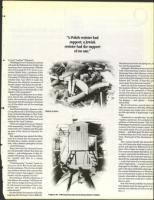
Freight car No. 11688 transported Jews from the Warsaw Ghetto to Treblinka.
forgiving the Germans "more difficult.
But just as survivors are dying out, so,
too, are the persecutors."
Jeshajahu Weinberg is less concerned
with what American visitors think of
Germans than what German visitors
think of themselves. "I would like Ger-
man youth to feel ashamed of what their
fathers did," he said. "I hope they are
more upset than American tourists.',
Above all, said the museum's director,
the museum will be an "upsetting place."
It will have the potential to change
morals and values and the behavior of
people and of nations. It will be a place
where all humanity can learn some of
the deepest — and ugliest — truths
about itself.
But it will not be a sacred place, he
said, not a shrine or a holy site, although,
some people may make what, to them,,
are the equivalent of pilgrimages to get
there.
"Auschwitz is a terrible site," he said,
"maybe a sacred one. It's a cemetery for
millions of unburied people. This [the
Washington museum] is a usual history
museum that tries to make a point. We
may upset people who are too self-cele-
bratory — and that's good. We don't want
to shame them, but we do want to upset
them. That's part of the educational ef-
fect."
How visitors handle this discomfort
may well determine what meaning and
power and legacy the Holocaust has for
them. But at least one thing is certain:
The museum will assure that silence nev-
er again enshrouds the Holocaust. For
starting with the museum's opening on
April 26, the underside of human nature
— a side that most of us would probably
rather forget about — was permanently
disgorged on the Mall, a grim counter-
part to the more celebratory showings at
the nearby Smithsonian or to Washing-
ton's monumental temple to Abraham
Lincoln, who railed at the indecencies of
his own time and would have railed at
them in ours.
And who would probably be pleased
that federal land has been given to re-
member our infamies as well as our glo-
ries. CI