
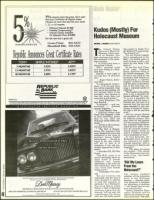

With interest rates this great, don't wait!
Get your Certificate of Deposit today!
Choose the term that best fits your needs
7, 13, or 48 months.
• Minimum Deposit $1,000
• Monthly Compoundine
• Interest Checks Available
On. Deposits Over $10,000
For the rate that is great call:
Grosse Pointe 882-6400
CERTIFICATE
48 MO
Bloomfield
SIMPLE INTEREST
APY*
7 MONTHS
3.25%
3.25%*
13 MONTHS
3.75%
3.82%*
48 MONTHS
5.00%
5.12%*
REPUBLIC
BAJVIc.E.
MEMBER FDIC
a Annual Percentage Yields (APYs) are guaranteed from April 12 thru May 31, 1993 and may change after that date. Substantial Penalty for
• early withdrawallimiteci Time Offer. Not Valid with any other offer. *a Monthly compounding only available on terms longer than 12 months.
DISTINCTLY
BETTER
BANKING
THE DETRO
w
40
ANNOUNCING FULL LUXURY TAX REIMBURSEMENT FROM BENTLEY MOTORS.
PLEASE CALL US TO ARRANGE FOR AN APPOINTMENT.
MICHIGAN'S EXCLUSIVE BENTLEY ROLLS ROYCE
40475 ANN ARBOR RD., PLYMOUTH, MICHIGAN
CIE
ARTHUR J MAGIDA SENIOR WRITER
Hills 258-5300
Republic Announces Great Certiide Races
TERM
Kudos (Mostly) For
Holocaust Museum
DEALER
(313) 453-7500 LOTTERY WINNER SPECIALS
(t) ROLLS-ROYCE MOTOR CARS INC.,1992.
NAME "BENTLEY" AND THE BADGE AM) RADIATOR GRILLE ARE REGISTERED TRADEMARKS.
T
he United States
Holocaust Memorial
Museum, which open-
ed on Monday, has
been receiving some splen-
did comments in the press.
Some samples:
* "It could have been a
Disneyland of Death.
"The... museum could
have gone wrong in a thou-
sand ways.
Instead, it went right in
one big way: It shatters
you."
— Roger Simon, Balti-
more Sun
"A pedagogical master-
piece... It is not just Jews
who will be warned by what
they see in this building. All
are warned. Here is the
precedent. Just because it
was the worst does not
mean that it will be last."
— Leon Wieseltier, The
New Republic
"A powerful — and con-
troversial — fortress
against forgetting..."
— Lance Morrow, Time
* Architect James Ingo
Freed "has designed a work
of such enormous power
that it, too, [like the
Holocaust itself] defies lan-
guage..."
— Herbert Muschamp,
The New York Times
* "The Hall of Remem-
brance [the museum's final
room, designed for solace and
meditation] is the crown of
[architect James] Freed's
achievements . . . He has no
reason to fear that visitors
will fail to find in it
metaphors of loss and con-
solation appropriate to their
needs."
— Brendan Gill, The New
Yorker
"The Mall, home to so
much knowledge about so
many kinds of human
endeavor and human
attainment, is the richer for
this information about the
very worst that human
beings can do."
— Washington Post edito-
rial
But not everyone was
enthralled with the idea of
such a museum, in general,
or with this museum, in
particular. In a Washington
Post op-ed, Melvin James
Bukiet, a child of Holocaust
survivors, expects that the
museum "will not spur the
remembrance the donors
seek, but will finally permit
this country to forget. \It is
the Melting Pot announcing,
`You belong to us.' "
"It's not Jewish tragedy
that's remembered on the
Mall...; it's Jewish power to
which homage is paid... and
that's the only thing I like
about it."
On the New York Times
op-ed page, Jonathan
Rosen, executive editor of
the Jewish newspaper, The
Forward, was irked by the
museum's dual mission of
documenting a specific
tragedy "rooted in Jewish
and European particularity
and, at the same time, cre-
ating a universal symbol of
suffering..."
"The murder of six million
Jews is not a metaphor for
human suffering," he wrote.
"It is not a metaphor for
anything, and the more it
becomes one, the more it is
removed from the time and
place necessary to any true
telling of historical events,
the less it will be anything
at all."
And two writers blasted
the museum's art, although
for different reasons. Five
days after he had gushed
over the museum, Baltimore
Sun columnist Roger Simon
called the four pieces of art
that the museum commis-
sioned "dreck," which, he
said, is "a Yiddish word that
can be translated as 'crap.'"
To Paul Richards, the
Washington Post's art critic,
the museum's art "might
triumph elsewhere. [But in
the museum,] it distorts and
misguides."
"... Why place art among
the corpses?... [The victims
of the Holocaust] turn the
works of art... into hollow
decorations."
`Did We Learn
From the
Holocaust?'
Two writers pondered
whether all the attention
given to the Holocaust
museum — attention impli-
citly designed to heighten
our abhorrence of atrocities
— will change how we con-
duct national policy.
Nation columnist Chris-
topher Hitchens said he
expects the museum to aug-
ment Americans' "self-right-