

TAKE A TIP: MAKE A TRIP
Ava Carmel ,
r a y o u t h ari n e likee
66 D i t as heP ofourth
son
Passover Haggadah; the
one who doesn't know
how to ask," says Elddd Halahmi of the
Youth and Hechalutz Department of the
World Zionist Organization. The ques-
tion? — Jewish identity. The answer? —
Israel Experience.
A wide range of programs for fostering
Jewish identity, which come under the
collective name "Israel Experience", are
sponsored annually by the WZO/ JAFI
Joint Authority for Jewish-Zionist Edu-
cation. The programs last from five weeks
to a year, and include university pro-
grams, kibbutz Ulpans and volunteer
frameworks. Last year alone 12,000
young people took part:
Sociologist Dr. Erik Cohen has re-
searched the effect of the Israel Expe-
rience on about 8,000 Diaspora youth.
Participants filled in questionnaires on
arrival in Israel and just before depar-
ture. Most significantly, after they had
finished their programs the percentage of
those vehemently opposed to intermar-
riage rose from 23% to 33%. Only 30%
wanted to live in Israel and 36% wanted
to return to study in Israel, but over 95%
said they would recommend their parti-
cular program to others.
Alarm bells rang and interest peaked in
the Israel Experience last November,
upon publication of a 1990 Jewish popu-
lation study showing a 50% intermarriage
rate among American Jews.
Jewish continuity was the theme at the
Council of Jewish FederationS' General
Assembly that month. Charles Bronfman
of Montreal announced that he was tak-
ing personal responsibility "to upgrade
the quality and maximize the quantity of
people coming to Israel on educational
tours."
Sociologist David Mittelberg, chair-
person of Project Oren, an Israel Expe-
rience program near Haifa, was
commissioned by the American Jewish
Committee to write a soon to be pub-
lished monograph on the 1990 survey.
His figures, based on interviews with
2,441 U.S. Jewish households and in-
tended to determine which background
swings more weight in a person's Jewish
identity, support Cohen's findings.
"My study shows a direct link between
a visit to Israel and a higher score on
Jewish identification irrespective of Jew-
ish education or the kind of household
the person grew up in," says Mittelberg.
"I'm not saying that the visit to Israel
doesn't build on a good Jewish educa-
tion, but that the effect of Israel isn't
dependent on a prior Jewish education."
According to his research, of the 30-39
year olds who never visited Israel, 60%
married gentile spouses who didn't con-
vert. Of those who visited Israel once,
only 39% out-married and of those who
visited more than once, only 24%.
"The same pattern holds for all levels
of Jewish education, all the denomina-
tions, both genders and any age group,"
says Mittelberg.
Twenty-six year old Stephen Schwager
no longer believes he'll marry out of the
faith. A teacher from New York, he was
raised in a secular, non-Zionist home and
only began to develop an interest in his
Jewish roots while in university. He re-
cently took a year's leave of absence to
study on an Israel Experience program.
"If I had not come to Israel, there is a
good chance I would have married a non-
Jew," he says. "As a result of being here,
the Jewish identity of all the participants
has increased and we now feel a real so-
cial responsibility regarding the erosion
of the Jewish community in the U.S."
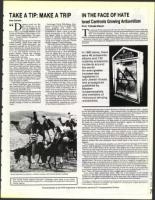
Israel Experience programs combine touring with Jewish identity-building.
The United. Jewish Appeal/ Federation Campaign raises funds in the United
States for the United Israel Appeal, Inc., whose agent for programs in Israel is the
Jewish Agency.
IN THE FACE OF HATE
Israel Confronts Growing Antisemitism
Prof. Yehuda Bauer
he removal of the communist lid from the East European pressure cooker has
caused all the tremendous forces that had accumulated there to start exploding
with ever-increasing intensity. These forces are nationalistic, based on
centuries of ethnic or national history. Some of them, by no means all of them,
and by no means in all ethnic or national communities, exhibit antisemitic tendencies.
Economic systems have changed, social classes have arisen and declined, political
structures have developed and disappeared, but antisemitism and its stereotypes have
persisted.
T
In 1992 alone, there
were 40 antisemitic
attacks and 130
violently antisemitic
incidents around
the world.
An even greater
increase was
registered in
anti-Jewish threats
and propaganda
published by
Moslem
fundamentalists
and members of
Holocaust denying
movements.
.
Antisemitism has become a code in Western civilization, not a genetic code — people
are not born with antisemitic genes — but a cultural code. It is thus not very surprising
that we should see, 50 years after the Holocaust, the continuation of the legacy of latent
antisemitism, which becomes overt when the circumstances are ripe.
One of the interesting things about contemporary antisemitism is the fact that there is
no world center from which it emerges. If there are antisemitic stirrings of different
kinds and different importance in a large number of countries simultaneously, they are
the result of a certain social and political atmosphere, against the background of
antisemitic latency in Western civilization as a whole.
This kind of ideology is very persuasive, especially in light of the decline of left-wing
ideologies. The enemy-figure of the Jew serves as a kind of glue between often disparate
enemy stereotypes. In this ideological vacuum, chauvinistic, anti-left and anti-capitalist
ideologies may occupy center stage. And there appears to be a clear tendency for
antisemitism to be a part, and sometimes a central part, in these configurations.
Should antisemitism become an integral part of ideologies that answer needs of large
populations, then we indeed need to worry. For antisemitism can serve as a weather-
vane for social health. It is a kind of virus that attacks Jews first, but is indicative of a
general sickness that may ultimately cause untold harm to the society in which it
appears.
For example, vile antisemitic speeches can still be heard at meetings of the United
Nations' special agencies. And the Western, democratic countries, with the exception
usually of the United States, do not protest. They appear not to have learned a thing.
They do not understand that while Jews may be in the front line of the attacked, it never
ends with the Jews. The last time a major power turned antisemitism into a central part
of its official ideology it cost the Jews close to six million dead, but it cost the world the
worst war in hist6ry to date, with at least 35 million victims.
There is no doubt in my mind that formal decisions and declarations of UN bodies
already on the books could be used, if the time was ripe, as the foundation for sanctions
against Israel. The point is that Israel, whatever its real or imagined wrongdoings, is
judged en principe by'standards that are different from those applied to other states or
societies. This inequality stems from historical roots and is a clear manifestation both of
the continuity in antisemitism, and the new elements that arise in it as times change.
However, antisemitism is today not supported, at least not openly, by any legitimate
government outside the Islamic countries. And that of course is a great change from the
past. Today, the Jews have allies in their struggle against antisemitism.
Jews cannot fight antisemitism alone. They are a tiny fraction of the world's
population. But they will find allies provided the world around them realizes that the
intellectual fight against antisemitism is, at the same time, also a fight for democracy,
parliamentary regimes, conservative, liberal or social-democratic principles.
Prof Bauer is chairman of the Vidal Sassoon International Center for the Study of Antisemitism,
at the Hebrew University of Jerusalem. His remarks are excerpted from a paper delivered at a
recent academic conference in Berlin.
Presented jointly by the WZO Department of Information and the JAFI Communications Division