
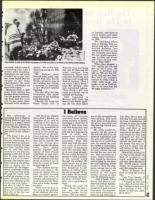

RNS Pho to/Reu ters
Jakub Knskier, a cantor at the Warsaw synagogue, at a Polish monument to the heroes of the Warsaw Ghetto uprising.
ing wood, and we came to
a building that had a
corner still standing.
Somebody (in our crew)
climbed up to get lum-
ber, then called that he
wanted to get down
immediately. He said,
`There's somebody up
there with a gun.'"
Moments later, a shot
came from within the
broken-down building.
The SS guards oversee-
ing Sam and his crew
ran to get help, then
returned with reinforce-
The following is
excerpted from a letter by
Yossel Rakover and was
found in a small bottle
following the destruction
of the Warsaw Ghetto. It
was written during the
last hours of the author's
life.
"The house I am in is
one of the last unburnt
houses remaining. For
several hours an unusual-
ly heavy artillery barrage
has been crashing down
on us, and the walls
around us are disinte-
grating under fire. It will
not be long before the
house I am in is trans-
formed, like almost every
other house of the ghetto,
into a grave for its
defenders. By the dagger-
sharp, unusually crimson
rays of the sun that strike
through the small, half-
walled up window in my
room, through which we
have been shooting at the
enemy day and night, I
see that it must be late
afternoon, just before sun-
down, and I cannot regret
that this is the last sun
that I shall see.
ments. "We could hear
shooting going on like
crazy."
Mr. Seltzer never
learned what really hap-
pened that day, but he
thinks whoever was in
the building was Jewish,
a survivor, or survivors,
of the Warsaw Ghetto
Uprising.
The day after the con-
frontation, the small
remains of the building
were dynamited.
Though far from the
death camp, life in
"(All six of my children
have died.) Rachel, my
daughter of 10, told me
nothing of her plan to
steal out of the ghetto,
which was punishable by
death. She and a girl-
friend of the same age
started out on the per-
ilous journey. She left
home under cover of dark-
ness and at sunrise, she
and her friend were
caught outside the ghetto
walls. Nazi ghetto
guards, together with
dozens of their Polish
underlings, at once start-
ed in pursuit of these two
Jewish children who had
dared to venture out to
hunt for a piece of bread
in a garbage can.
"The children did not
endure very long in the
unequal match. One of
them, my child, running
with her last ounce of
strength, fell exhausted to
the ground, and the Nazis
then put a bullet through
her head.
"There were 12 of us in
this room at the outbreak
of the rebellion. For nine
days, we battled against
Warsaw was anything
but easy for Sam and the
other workers from
Auschwitz. There were
constant beatings and
killings and hundreds
died of typhus. "How I
survived I don't know,"
says Mr. Seltzer, who
also contracted typhus.
"One thing I did was
chew on icicles, which
soothed the burning."
Sam remained in
Warsaw until 1944, the
start of the Polish_ upris-
ing. He was then taken
I Believe
the enemy. All 11 of my
comrades have fallen,
dying silently in battle,
including a small boy of
about 5, who came here
only God knows how, and
who now lies near me,
with his face wearing the
kind of smile that
appears on children's
faces when dreaming
peacefully. Even this
child died with the same
epic calm as his older
comrades. It happened
early this morning. Most
of us were dead already.
The boy scaled the heap of
corpses to catch a glimpse
of the outside world
through the window. He
stood beside me in that
position for several min-
utes. Suddenly, he fell
backward, rolling down
the pile of corpses. He lay
like a stone. On his small,
pale forehead, between
the locks of black hair,
there was a spattering of
blood.
"Death can wait no
longer. From the floors
over me, the firing
becomes weaker by the
minute. The last defend-
to Dachau, and later to
other death and labor
camps. Liberation came
in 1945.
"We had been taken
back to Dachau, then our
group was split and we
started walking. One
morning we woke up and
the Germans were gone.
We saw trucks approach-
ing. As they got closer
and closer we saw writ-
ten on them 'USA.'
"When they stopped, a
U.S. captain got out and
got up on a jeep. He
spoke in German and
told us, 'We are the U.S.
Army and you are free.'
But still we couldn't
believe it. Only when a
rabbi with them, who
spoke to us in Yiddish,
told us we were free did
we begin to believe." ❑
ers of this stronghold are
now falling, and with
them falls and perishes
the great, beautiful and
God-fearing Jewish part
of Warsaw.
"My rabbi would fre-
quently tell the story of
the Jew who fled from the
Spanish Inquisition with
his wife and child, strik-
ing out in a small boat
over the stormy sea until
he reached a rocky island.
A flash of lightning killed
his wife; . a storm rose and
hurled his son into the
sea. Then as lonely as a
stone, naked and bare-
foot, lashed by the storm
and terrified by the thun-
der and lightning, hands
turned to God, the Jew,
again setting out on his
journey through the
wastes of the rocky
island, turned to God
with the following words:
"...`God of Israel, I have
fled to this place to wor-
ship You without molesta-
tion, to obey Your com-
mandments and sanctify
Your name. You, however,
have done everything to
make me stop believing in
You. Now, lest it seem to
You that You will succeed
by these tribulations in
driving me from the right
path, I notify You, my
God, and God of my
father, that it will not
avail you in the least. You
may insult me, You may
castigate me, You may
take from me all that I
cherish and hold dear in
the world. You may tor-
ture me to death, but I
will believe in You and I
will always love You.'
"Eternally praised be
the God of the dead, the
God of vengeance, of
truth, and of law, who
will soon show His face to
the world again and
shake its foundations
with His almighty voice.
"Hear, 0 Israel, the
Lord our God, the Lord is
One.
"Into Your hands, 0
Lord, I consign my soul."
"I believe in the sun
even when it is not shin-
ing. I believe in love, even
when feeling it not. I
believe in God even when
He is silent."
CY)
43