

-4
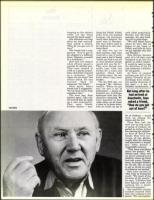
Sam Seltzer
hanging on the electric
wires (of the fence
around the death camp)."
One afternoon not long
after he had arrived,
Sam asked .a friend,
"How do you get out of
here?"
The friend had a sug-
gestion. "You've got to
get shipped to a different
place. Register yourself
as a tradesman."
Sam saw his chance
when officers issued a
request for skilled men.
They were needed to
work on a special project.
Sam identified himself
as a. carpenter. "And
where are you from?" the
officer asked. He was
rejected when he
answered, "I'm Polish."
Once again, Sam's
friend had a suggestion.
"So tell them you're from
someplace else."
The next day, Sam
applied again. Like oth-
ers around him, he made
up a new nationality.
They were Greek,
French, Italian — any-
thing but Polish. Polish
Jews were not wanted
because, the prisoners
would later discover, the
work was in Warsaw.
The men didn't need to
be talking to the resi-
dents there.
As they set out on
their journey, each man
received a can of salty
meat and a loaf of bread
"which you had to eat all
at once because people
would kill you for it."
They were shoved into
cattle cars with one
bucket for a toilet and
another filled with
drinking water. No one
knew where they were
headed.
"On the fifth day, we
stopped," Mr. Seltzer
recalls. "When we got
out, we saw a lot of
destruction — homes all
bombed out, buildings
destroyed with only the
chimneys remaining. We
were marched to bar-
racks where we all found
a place to lie down wher-
ever we could, on top of
each other practically.
Nearby was SS head-
quarters, the only build-
ing still in good shape.
"We still didn't know .4
where we were. But we
began to see signs in 4
Polish, and little by little
we put together that this
was Warsaw."
Sam Seltzer became
part of a 10-man crew 4
assigned to go into the A
ghetto to collect lumber.
It would be used to heat
the facilities of the SS
and construct a kitchen
for the guards.
At first, it seemed
nothing was left of the 4
ghetto. Virtually all the
buildings were rubble,
but painful treasures of
the past — a set of
Shabbat candlesticks, a 414
-
Not long after he
had arrived at
Auschwitz, Sam
asked a friend,
"How do you get
4
out of here?"
4
bit of clothing — would
turn up among the
stones and the dirt.
Then Sam and the A
crew met up with anoth-
er group of workers, all
garbed in civilian clothes
but wearing the obligato-
ry Star of David arm NI
bands. They were sur-
vivors of the ghetto,
caught after the uprising
and now held in a nearby
jail. They proved a
remarkable resource.
"They knew everything
about the ghetto," Mr.
Seltzer says. "They told
us about underground
shelters, where we found
food and water. Through
them, we bought whiskey
for the SS, who we used
to get so drunk we could
do whatever we wanted."
Sam also learned of
what went on during the
revolt. "We heard of the
heroism of the people,"
he says. "Children had
been fighting tanks with
nothing but a bottle
filled with gasoline."
One especially strange
incident occurred while
Sam was working in the
ghetto. "We were gather-