

.r• ,,,x,,--rrwewEsr,,,,, o,,• - eoro,3neaesr ■ FVP.R.,4r.9kAPV
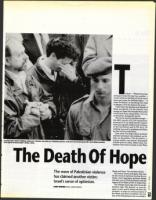
A family's pain: Herbert Friedberg, whose son, Yehoshua, was slain by a Palestinian gunman, at his son's funeral last week at Mt. Herzl military cemetery.
At his right is the dead soldier's brother, David.
-
•
el Aviv — What's been hap-
pening in Israel the last two months —
a wave of terror the likes of which hasn't
been seen since the intifada began — is
cause for despair, or something very close
to despair, over the chances for peace.
Other than the families and friends of
those murdered, it is the hopeful ones
among us, those who thought that peace
would come from compromise, who are,
or should be, feeling the lowest.
The terror itself is horrible enough —
the daily nature of it, the comprehen-
siveness of it: by knife and by subma-
chine gun against soldiers and civilians,
in the territories and in Tel Aviv, by
working men and by professional killers,
by plan and by inspiration.
Last week, five high school students
and their principal were stabbed, not fa-
tally, in Jerusalem. The day before, a
woman soldier was almost kidnapped
at knife point in Afula. Before that, two
soldiers were shot to death in the West
The Death Of Hope
The wave of Palestinian violence
has claimed another victim:
Israel's sense of optimism.
LARRY DERFNER ISRAEL CORRESPONDENT
Bank and Gaza. Two months of this.
But terror comes and goes; this may
be the worst it has been during the in-
tifada, but it has been, at times, almost
this bad, even if Yitzhak Shamir and the
legions of the Right prefer to forget that.
The killings cause rage, but it is an old, —J
CC
familiar rage. The despair, or near-de- cL
.s4C
spair, is new, and it comes not from the
savagery or scope or continuousness of
the terror, but from its politics: the pol-
itics of the Palestinians who are doing it,
53