

This determined lady has also been known to tie
rocks to the ends of branches to change shapes, leav-
ing them on for one to two years. She originally used
hemp to tie the rocks because it looks more natural,
but now she goes with black nylon cord because it lasts
longer.
"I made a weeper out of a Red Jade crab apple in Landscape
back before I realized its more of a spreader. But I like designer Jim
Slezinski of
it." She also uses bamboo stakes to prop branches up
Goldner Walsh
and complains that it's getting harder and harder to Nursery helped
find this precious item.
design this
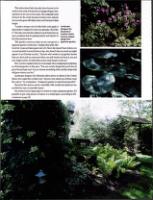
"My garden comes as close as one can get to a Japanese garden.
Japanese garden in this area," explains this artist. She
loves her moss and takes good care of it. Since she doesn't have help to run
out and sprinkle it several times a day, she doesn't have as much as might
appear in an Oriental country. "Anyone who works in my garden knows
that you don't pull up moss and when you pull weeds out from it, you put
your fingers down on both sides so the moss doesn't come up."
Mrs. Gordon explains that one must adapt when designing and planting
an Oriental garden in this area. "You see certain things that you'd love to
grow but perhaps can't So you choose something with a similar shape that
will grow where you live."
Landscape designer Jim Slezinski offers advice to others in the United
States who might like to follow suit.. "Anyone who wants one of these must
like nature," he emphasizes. "A Japanese garden is natural and peaceful."
Elements like stones, ponds, waterfalls, hills, knolls and plants are as-
sembled by man to resemble nature.
One doesn't need a large space in which to create ajapanese garden. It's
possible to get a big picture of nature in a small space, according to Mr.
(continued on page 38)