
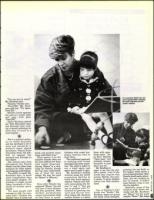

For a long time, Natalie had a two-
word comprehensible vocabulary.
She could understand, but she
couldn't verbalize.
"Can you say my name?"
Ms. Kaufman says.
"Nanzhe," Natalie says.
"NanCEE," Ms. Kauf-
man tells her. "Try again.
NanCEE."
Natalie leans against
the side of a small table
and says with glee,
"NanCEE."
Nancy Kaufman opened
her West Bloomfield clinic
last December after work-
ing in speech pathology for
more than 13 years at a
local hospital.
'2
*)
She is a national author-
ity on verbal dyspraxia
and has developed a set of
tests and standards to
measure motor speech
movement. Wayne State
University Press will pub-
lish in 'August her
research and writings on
the subject.
Her clients come from
throughout the United
States, and she often hosts
seminars for other speech
and language pathologists.
The ability to speak, Ms.
Kaufman says, is much
more complicated than
most people imagine. "To
produce a single sound
takes hundreds of thou-
sands of muscle move-
ments."
Yet most people still
manage to talk "on auto-
matic pilot." Children like
Natalie "have to think and
think and practice many
times until that's true."
What appear to be the
simplest sounds often are
the most difficult for those
with verbal dyspraxia.
Saying "Mama" is a chal-
lenge for Natalie, though
she has clear understand-
ing of what the word
means. For now, her word
for "Mama" is "Mmmm."
c^ 42
Even after Natalie has
mastered "Mama," she still
will have to learn phrases,
and then grammar. Most
children automatically
acquire grammatical skills
as they learn to speak.
Children with verbal dys-
praxia, however, have to
study them.
The traditional approach
to working with verbal
dyspraxia has been repeti-
tion. The child is asked to
say a word again and
again until he gets it right.
Ms. Kaufman's method
involves using the child's
preexisting abilities to
teach him word approxi-
mations. Natalie has diffi-
culty pronouncing the let-
ters "n" and "r." But she
has no problem with "h."
Instead of ignoring any
word with the two trou-
bling letters, Ms. Kaufman
teaches Natalie to replace
them with some-
thing easier. "Op-
en door," becomes
"Opeh doah," and
certainly compre-1
hensible to just
about any ear.
Ms. Kaufman is
eager to see that the chil-
dren speak, even if the
words may require fine
tuning. Speech, she says,
is power. It gives children
control over their environ-
ment.
e n,
One of Natalie's first
words was "Daddy." Ms.
Kaufman began by giving
her client visual examples,
pressing her top teeth to
her tongue which shows a
sound approximation (dha)
Natalie could easily mimic.
Next, the two worked on
the "e" sound. It didn't
take Natalie long to put
the two together.
Similarly, many of the
children with whom she
works call Ms. Kaufman
not "Nancy" but the much
simpler "Nana." She helps