

the committee. It is the
cooperative effort of
JCCouncil and the
Neighborhood Project.
Formed about 14
months ago in response to
demographic studies, the
task force will hold an
open forum on April 29.
After the initial forum, the
task force will meet again
in the fall to implement
suggestions, and hopefully
make the city more livable
for all groups.
Mr. Brown believes
open communication will
be key.
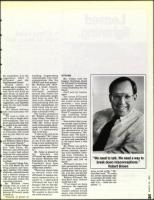
"We need to talk, we
need a way to break down
misconceptions. This is a
great opportunity that will
be wasted if we can't deliv-
er," Mr. Brown said.
'Without the commitment
of JCCouncil, this would
just be one idea by one
person."
Another volunteer, How-
ard Wallach works to keep
Jewish youth "Jewish."
Chairman of the College
Fair Task Force, Mr.
Wallach and JCCouncil
hope to give high school
students the ammunition
to battle anti-Semitism
and anti-Israel sentiment
in college.
The Jewish College Fair,
to be held March 28, will
bring parents and teen-
agers together with college
students, administrators
and a theater troupe to
explore ways of dealing
with diversity within the
university structure.
Mr. Wallach views
College Fair as a way of
building up the Jewish
community — an area he
believes JCCouncil needs
to work on.
"Council is great at
building longstanding
relationships with other
organizations like the
NAACP and Arab groups,"
Mr. Wallach said. "How-
ever, a study commis-
sioned by a former
JCCouncil president
showed that within the
Jewish community, people
don't know we exist. We
need to do a better job of
communicating with our
member organizations, let
them know who we are,
what we do and involve
them in Council's work."
The former president
Mr. Wallach referred to is
Leon Cohan. President of
JCCouncil from 1985 to
1988, Mr. Cohan spent
much of his energies devel-
oping inter-ethnic relation-
ships — a controversial
idea at the time.
"I was at the end of an
era internally," Mr. Cohan
said. "During my presiden-
cy, one of our roles was to
bring in new leadership for
a new generation. Every
organization needs renew-
al."
Mr. Cohan is pleased at
the direction the
JCCouncil has taken since
his tenure. Relations with
Federation are favorable.
Presidents have been
aggressive and pro-active
rather than reactive.
"There has always been
an identity crisis with
JCCouncil. It requires con-
stant communication to
clarify it. I approached
JCCouncil the way I did
because I felt we had fall-
en into 'organization for
organizational self' mode.
We needed to deal with
the world around us."
FUTURE
Mr. • Cohan said the
biggest challenge ahead
for JCCouncil is attracting
intelligent, committed,
young leadership for the
future.
Staff and lay leaders
agree.
The issues JCCouncil
tackles come directly from
the voices of its active
members — they range
from a controversial pro-
choice stand on abortion to
joint statements with the
NAACP expressing out-
rage regarding racist
politicians and newsmak-
ers.
Some believe that is rea-
son enough to get involved.
"Occasionally people are
angered by our stances as
the representative of the
Jewish community," Ms.
Weiner said. "We build a
consensus by researching
an issue and presenting it
to the board where a vote
is taken."
Ms. Weiner was quick to
add that the board is a
diverse collection, consist-
ing of 53 members "vary-
ing from Orthodox to
Humanistic and on both
the right and left on
Israel."
JCCouncil claims it is
that partnership between
liberal and conservative,
professional and lay peo-
ple, and Jew and gentile
which makes it successful.
Without JCCouncil, Mr.
Gad-Harf said, Detroit
would lose a lot.
"If we closed our doors
tomorrow, the organized
Jewish community
couldn't mobilize around
issues. And relationships
between Jews and non-
"We need to talk. We need a way to
break down misconceptions."
Robert Brown
Jews would suffer," Mr.
Gad-Harf said. "To unite
the Jewish community and
to maintain favorable rela-
tions with the people out-
side of it — these are our
pillars." 0
35