

TH E D E T ROI T J E WIS H N EWS
Voice Of The People
tions between residents of
Detroit and its surround-
ing communities — espe-
cially among minorities.
City/suburban relations
is representative of
JCCouncil's thrust toward
building coalitions. In the
past, JCCouncil has
formed alliances with
other minorities, speaking
out against David Duke
and hate politics.
"There are times when
you march in step and
times when you take on a
leadership role," Ms.
'merman said. "Some Jews
want us to be more insu-
lar. But we've learned
from our own bitter experi-
ence — alone, we're weak-
er."
While much of Ms.
'merman's energy is spent
developing relationships
with other minorities, Mr.
Gale's responsibilities
include strengthening the
Jewish circle in Detroit.
The committees he over-
sees are government and
Israel oriented, often link-
ing together with other
Jewish agencies.
Many committees, like
Israel Advocacy, are task
oriented. As no related leg-
islation is before Congress,
there is no active agenda
at the present time.
Instead, the members keep
in touch to plan their next
move.
Mr. Gale views this
active attitude as a posi-
tive change in JCCouncil's
structure.
"During Jeannie's presi-
dency there has been a
feeling that time was not
well-spent in the past. Too
much time was being
spent on deliberation," Mr.
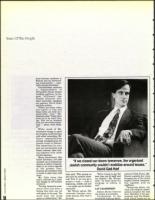
"If we closed our doors tomorrow, the organized
Jewish community couldn't mobilize around issues."
David Gad-Harf
Gale said. "Who among us
has time for another meet-
ing? But if we can-give
people a task — with a
beginning, middle and end
— our goals can be further
advanced."
Ms. Weiner agrees. She
contends changes were
made because they had to
be made.
"We're trying to get the
best time out of staff and
lay leaders," Ms. Weiner
said. "In some cases it's
working; in others, it
isn't."
LAY LEADERSHIP
Robert Brown believes
the system is successful.
Co-chairman of the
Southfield-Lathrup Multi-
cultural Task Force, Mr.
Brown spends his time
bringing one of the area's
largest Jewish communi-
ties together with its
neighbors.
Twenty-two ethnic, cul-
tural and religious organi-
zations comprise the task
force. Members of city gov-
ernment and the South-
field school board sit on