

The Godfather Of Etzel Street
A Tel Aviv
mobster is
murdered ..
and some
prefer to
remember
only his good
deeds.
LARRY REIMER
ISRAEL CORRESPONDENT
T
housands of people
surrounded the
hearse, clogging Etzel
Street, the main drag
of Tel Aviv's poor, southside
Hatikva Quarter.
Many cried and recalled
the endless good deeds and
generosity of the murdered
man, Yehezkel Asian. For
them, he was a hero, a true
legend. Only a few muttered
under their breath about the
other, more widely-known,
infamous side of Mr. Asian's
reputation. To police, he was
probably the most powerful
criminal in the country, a
mafioso with an army of en-
forcers, a man who had his
rivals killed, a multi-
millionaire who had made
his money by bringing
heroin into Israel, mainly
into his beloved home base of
Hatikva.
At 1:30 on the morning of
Feb. 24, Mr. Asian, 46, was
shot five times through the
back while sitting inside his
black BMW after feasting
with friends at a fish restau-
rant in another part of the
city. Later that morning
police arrested a suspect,
Zevik Rosenstein, an Israeli
underworld figure with a
record for robbery and drug
dealing. By the afternoon,
large mourning notices
about Mr. Aslan's "untimely
death" had been tacked up
on walls, bus shelters, trees
and even synagogue door-
ways along Etzel Street and
the adjacent alleys and side
streets.
The hearse stood in front of
Shipudei Hatikva (Hatikva
Grill), Mr. Aslan's restau-
rant. Etzel Street is a
bargain-basement shopping
thoroughfare teeming with
people, but is best known for
its all-night Sephardic
eateries, which draw
celebrities and hip young
people from the richer nor-
thside of Tel Aviv, along
with the better-off Hatikva
locals, including the
criminals.
Shipudei Hatikva is the
biggest of the grills, with
dining rooms on both sides of
the street, and it was there
that Mr. Aslan, a chubby,
unassuming-looking fellow,
used to do his business and
make his presence known,
sitting with a bag of dried
watermelon seeds and his
cordless telephone.
"I used to see him sitting
there every day, and he'd
duck into one of the alleys to
talk on his phone, real
•••
• ''''
•
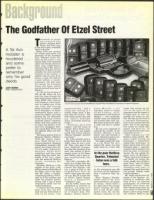
Artwork from the Los Angeles Times by Richard Milholland. Copyright° 1990, Richard Milholland. Distributed by Los Angeles Times Syndicate.
mysterious-like," said a
young man working at a
nearby candy store, a few
days after the funeral. "The
kids used to point to him and
say, 'That's Yehezkel
Aslan.' Everybody looked up
to him."
"Everyone gave him
respect," said the owner of
another Etzel Street grill.
"He'd pass by and people
would wave to him and say,
`Shalom Yehezkel,' and he'd
wave back."
Mr. Asian's family came to
Israel from Iraq in the late
1940s, when he was 1 year
old. They were part of the
great Sephardic immigra-
tion after the founding of the
state that settled in devel-
opment towns in the Negev
and Galilee, and in poor ur-
ban neighborhoods like
Hatikva.
Old folks remember Mr.
Asian as a chubby little boy
who used to sell soap at the
Central Bus Station, who
ran a gang of kids in the
neighborhood when he
wasn't much past bar mitz-
vah age. His life sounds like
an Israeli James Cagney
movie, a Sephardic
"Godfather" saga.
By the 1970s, heroin had
established its presence in
Hatikva, and gang wars
were breaking out, leaving a
lot of dealers dead. Tati
Shabtai, Tzitzon Gilkrov,
Amos Mesika — all
legendary names in Israeli
crime history, well-
remembered on the streets of
Hatikva — were murdered,
and Mr. Aslan was suspected
and arrested after each one.
But police could never make
it stick and had to release
him.
He was even suspected of
ordering the murder of his
brother, Shimon, a drug
dealer who had become a
police informant and an em-
barrassment to Yehezkel.
One night outside his villa
in a rich North Tel Aviv
suburb, Mr. Asian was shot
eight times by a man with
In the poor Hatikva
Quarter, Yehezkel
Asian was a folk
hero.
an Uzi submachine gun. He
survived, and his reputation
took a quantum leap up-
ward.
Haim "Shogun" Pinchas,
former head of Tel Aviv
police detectives, was quoted
as saying: "Asian stood a
few steps above the average
Israeli criminal. He knew
how to pull off the nearly
perfect crime. He was the
ultimate authority in his
world, who carried out his
will on the basis of his
reputation and the respect it
brought him. It was im-
possible (for police) to nail
him. He kept up the front of
a courteous businessman,
even in his run-ins with the
police. But in the interroga-
tion rooms we would talk
openly and he'd say, 'If
you've got me this time, then
more power to you.' "
After taking over the
Hatikva drug market, Mr.
Asian began buying up
businesses — restaurants,
nightclubs, boutiques; in
Israel and in some U.S. and
European cities — using his
contacts with ex-Israelis who
had become criminals
abroad. He also settled the
gang wars in Hatikva.
"There used to be break-ins
and thefts all along the
street; people were afraid to
come here," said the Etzel
Street grill owner. "Once
Yehezkel took over, it
stopped. One word from him
was enough. Nobody made
trouble anymore."
Mr. Asian also became the
patron of the Quarter. Ac-
cording to residents and
shop owners, he repaired
synagogues; he financed
Hatikva's local heroes, the
Bnei Yehuda soccer team; he
gave money to destitute old
people, and to young couples
who couldn't afford to get