
silo° Denizens Of The Deep
A Haifa team
uncovers new
species 4,000
feet deep.
SUSAN SOLOMAN
SPECIAL TO THE JEWISH NEWS
DETROI T JEWISH NEWS
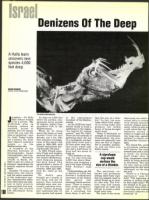
The saber-tooth viper fish.
100
erusalem — Dr. Bella
Galil always wanted
to be a pirate. "My
girlfriends grew up
wanting careers as
teachers, nurses or
dancers, but I've always
loved the sea and the
idea of exploring," says
Dr. Galil. Today (while
not a pirate), Dr. Galil
does explore unknown
waters — in the
Mediterranean Sea.
A scientist at the
National Institute of
Oceanography, Israel
Oceanographic and Lim-
nological Research
(IOLR) in Haifa, Dr.
Galil is part of a team of
pioneers researching the
scantily explored Levant
Basin.
Roughly 70 miles off
Haifa port, the waters
and the entire ecosystem
of this underwater mys-
tery dramatically differ
from other deep sea habi-
tats in their severely
impoverished food sup-
ply, high salt content
and abnormally warm
waters.
As deep as 4,500 feet
below the surface, tem-
peratures hover around
55 degrees, higher than
anywhere else in the
Mediterranean.
What do we know
about life forms at such
depths? Until the last
decade, not a lot-The
first extensive investiga-
tions of the basin took
place in 1890-1893, with
limited explorations dur-
ing the next 100 years.
In 1985, French scien-
tists Fradj and Laubier
declared that only 20% of
the eastern Mediterran-
ean's deep-sea species
had been found. This
spearheaded a series of
12 four-day excursions
between 1988 and 1991,
with Dr. Galil at the
helm.
Dr.
Galil's
crew
brought up a wealth of
new data, and the 37
species they collected
included seven new, pre-
viously unknown crea-
tures. Theses findings
also confirmed that 16
more species had spread
to the easternmost
boundary of the Mediter-
ranean.
As the IOLR has insuf-
ficient funds to send a
submarine to the region,
"we explore by remote
control," says Dr. Galil.
There are two methods of
gathering data: the use
of a rectangular six-foot-
wide beam trawl and a
22-foot-wide semi-bal-
loon trawl, which take
two and a half hours to
drop and two hours to
bring up.
"This method is so ran-
dom, it's like hovering
4,500 feet above Man-
hattan and dropping a
net in the hope of hitting
Fifth Avenue," says
Galil.
Understanding sea life
at depths of 3,000 feet
involves a fundamental
awareness of the factors
that govern this
extremely harsh environ-
ment. "There is tremen-
dous water pressure,"
says Dr. Galil. "If you
put a styrofoam cup
down there, it will sur-
face the size of a thim-
ble." In fact, the crea-
tures which have adapt-
ed to living under this
pressure die within
hours of being brought
up for study.
There is absolutely no
sunlight or nourishment.
Consequently, the crea-
tures are generally less
than one foot in length,
few in number, predato-
ry, and eat their own
bodily wastes.
A styrofoam
cup would
surface the
size of a thimble.
The previously un-
known and grotesque
looking saber-tooth viper
fish has adapted itself to
eating things up to twice
its own size. The five-
inch long fish simply
separates its right and
left jaw to create a much
larger entry area.
The back of the newly
discovered sea shark o
velvet belly is coverer
with dermal denticle
(conicle shaped protru
sions), while its belly ha
a soft velvet-like feel. I
measures around 1
inches in length and ha.
very large eyes, speciall3
adapted to absorb eve
the smallest amount o
light.
The tripod fish, anoth
er previously undiscov-
ered species, has scale
covered eyes and is near
ly blind. Its finrays
much longer than it
body, compensate consid
erably by being sensitive
to movement. The ray
are also used as stilts
supporting the fish whe
stationary on the deep
sea mud.
"There is a Chines
expression," says Dr.
Galil. "The beginning o
wisdom is calling things
by their right name." We
are thrilled to be part o
a research team which is
uncovering and namin:
previously unknown sea
creatures." ❑
Scanned image of the page. Keyboard directions: use + to zoom in, - to zoom out, arrow keys to pan inside the viewer.
February 26, 1993 - Image 100
- Resource type:
- Text
- Publication:
- The Detroit Jewish News, 1993-02-26
Disclaimer: Computer generated plain text may have errors. Read more about this.