

YY
S
A bi-monthly column in which members of the community
offer insight on topical issues.
The Good
Old Days
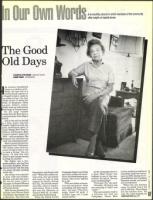
ELIZABETH APPLEBAUM ASSISTANT EDITOR
GLENN TRIEST PHOTOGRAPHY
I
da Levine's Southfield
home is a rainbow of Ju-
daica. On one wall is a
multicolored tapestry of
a Chagall window, made by
her sister-in-law, the late
Goldie Levine. It shows the
Tribe of Benjamin (Miss
Levine's father's name).
Goldie made an entire series
that hangs at Temple Israel.
On the large window
across from the front door is
a stained-glass blue Magen
David.
And on the wall on the left
is a blue, green and red,
slightly faded but still ele-
gant, needlepoint piece. It
reads "Happy New Year" in
Hebrew and Russian. Miss
Levine's mother made it in
1902 — with no pattern. She
designed the intricate art
work and lettering herself.
Miss Levine's parents im-
migrated from Lithuania.
"My father came first be-
cause he had to find a way
to earn a living," she ex-
plains. "It took him four
years to get enough money
to bring my mother."
Her father was a dry-
goods peddler, who had two
sons and a daughter. He set-
tled in Detroit with the help
of a sister already residing
in the city.
Ida always was especial-
ly close with her brother,
Reuben, who died last year.
He was for many years a
manager at General Motors
and was a founding member
of Temple Israel.
Miss Levine attended City
College (now Wayne State
University). She hoped to be
a librarian. "But then the
Depression and illness took
over." When Ida's father be-
came sick, she quit school
and went to work to help
support the family. During
the day, she found tempo-
rary jobs, often in depart-
ment stores. Twice a week,
she was the librarian at
Temple Beth El. At night,
she studied bookkeeping.
When the Allied Jewish
Campaign began recruiting
part-time workers for secre-
tarial and bookkeeping po-
sitions, Ida Levine applied
for a job.
"This was before automa-
tion and computers, when
everything was done manu-
ally," she says. "The Cam-
paign hired 30 girls. I
couldn't type, but I made
myself useful."
As the Campaign drew to
a close, Miss Levine was
talking to one of the con-
trollers. He asked, "Do you
know bookkeeping?"
"Of course I do," she said.
"Actually, all I knew was
the meaning of 'debit' and
`credit.' "
The conversation lead to
a full-time job with the
Campaign, where Miss
Levine worked as assistant
controller until her retire-
ment in 1976. Among her re-
sponsibilities were handling
financial records, real estate
and investments.
"When the new director
came, he asked what I did
and I told him, 'Everything
but the kitchen floor.' He
said, 'So, what stopped you
GOOD OLD DAYS page 109