

BUSINESS
employees, many recent
Russian immigrants, are em-
ployed at Deutch-Dagan. And
Deco-Grand has profited
from the exceptional prod-
ucts, Mr. Grand said.
"I wouldn't have sought
,them out if I didn't have a
'concern for Israel, but what
I found was an efficient com-
petitive vendor that is capa-
ble of producing a zero defect
product," Mr. Grand said.
"And today's standards are
such that you truly have to
produce parts with zero de-
fects."
For several years, Israel
has been viewed as a super-
power on the world military
scene. Yet in recent years,
many Americans have rev-
eled in its business opportu-
nities.
It is a nation filled with ex-
port potential, and the bot-
tom line is profit, business
leaders reiterate.
Countless American busi-
nesspeople have entered the
' market to help create match-
es, business plans and pro-
vide marketing and legal
advice between the United
States and Israel.
In Milwaukee, Manpower
founder Elmer Winter runs
his think tank, the Econom-
ic Committee for Israel. Op-
eration Independence, which
aims to make Israel econom-
ically independent, recently
created the O.I. Business
Network to link Jewish fed-
erations with American-Is-
rael chambers of commerce.
In Michigan, Shelly
Komer Jackier runs the
American-Israel Chamber of
Commerce, which hosts sem-
inars, sets up business mis-
sions to Israel and serves as
a business matchmaker.
Included in a long list of
Michiganders doing business
with or in Israel are Michael
Neuvirth, a patent attorney
who moved to Israel and is
helping create business plans
for those who want to start
their own companies; and
Troy patent attorney Ken
' Kohn, who is working with
university research and de-
velopment companies to se-
cure proper legal papers to
bring products into the U.S.
marketplace.
"Israel could become a real
economic powerhouse," said
Doug Ross, the former Michi-
gan Commerce Director who
drafted the current Michigan
Israel free trade agreement
while he worked for the Blan-
chard administration.
"Most of the world would
do anything to have Israel's
intellectual capacity," said
Mr. Ross, who now heads
Michigan Future, a non-prof-
it, non-partisan think tank
that Mr. Ross hopes will cre-
ate a new strategic vision for
the state.
American investors are re-
which saw gains of 30 per-
cent; Hong Kong, 22 percent;
Sweden, 14 percent; and the
United States, 5 percent.
Just 45 years old this year,
Israel — the only democracy
in the Middle East — has
faced its share of growing
problems. Thrust in the mid-
dle of a religious battle zone,
Israel for a long time was
viewed by the American Jew-
ish community as a country
in need of charitable dollars.
Doing business there was
viewed as difficult. Some felt
investing in business there
about its dedication to in-
vestment growth and eco-
nomic stability," Mr. Shochat
said.
During the past seven
months, Israel's range of in-
vestors has broadened.
Among current investors are
foreign governments, foreign
banks, private investors —
both Jewish and non-Jewish.
They are Japanese, Euro-
peans and Americans.
"This is due in part to a po-
litical tone," Mr. Shochat
said. "But it also is due in
part because it is clear we are
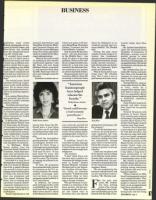
"American
businesspeople
have helped
educate the
Israelis."
Shelly Komer Jackier
•
"Israel could become
a real economic
powerhouse."
Doug Ross
Shelly Komer Jackier
alizing that those like Mr.
Grand know a good thing
when they see it, and they
are taking serious looks at Is-
rael's potential profit mar-
gins.
"Israel has tremendous
growth potential," said Fran-
cis Gallagher, director of re-
search for Oscar Gruss, a
brokerage house specializing
in Israel with offices in New
York and Tel Aviv. "It has
been there for years. But
business has exploded in the
last few years. The technolo-
gy coming out of Israel is in-
credible."
To date, 38 companies
have generated hefty returns
for investors on the U.S. se-
curities markets. No country
as small — or as young — as Is-
rael can boast of as many
companies traded publicly in
the United States.
In addition, the Israeli
stock exchange led the world
in profitability last year. Prof-
its of more than 70 percent in
dollar terms placed it ahead
of the Mexican stock market,
Doug Ross
was a mitzvah, and did not
research properly before en-
tering into business arrange-
ments. These people failed,
prompting other would-be in-
vestors to shy away from Is-
rael.
In addition, Israel's bu-
reaucratic red tape, language
barriers and distance to the
United States were seen as
negatives to the average busi-
nessperson.
Not anymore.
"I don't think there ever
has been such a positive en-
vironment for foreign invest-
ment in Israel," Israel's
Finance Minister Avraham
Shochat said in the Decem-
ber 18 edition of Israel Busi-
ness Today, an economic
newsletter. "I think the most
important thing we have
done is send a two-part mes-
sage to foreign investors.
"The government is com-
mitted to a resolution of the
peace process, and this gov-
ernment speaks with a sin-
gle and united voice to
investors here and abroad
getting down to business with
the economy."
To aid the business envi-
ronment, the Israel govern-
ment gradually has been
selling off its publicly owned
ventures, turning away from
the nationalistic concept
upon which it was formed by
David Ben-Gurion, and fo-
cusing on growth in private
industry.
Under way are plans to sell
El Al Airlines and its holding
in the Shekem retail outlets.
Among other companies un-
der consideration, the gov-
ernment is studying the sale
of the telecommunications
company, Bezeq.
"We are reorganizing the
business infrastructure and
we are committed to priva-
tization," Mr. Shochat said.
F
or the past nine
years, Ms. Jackier
has been putting
much of her energy
into a Michigan-Israel busi-
ness matchmaking group she
formed with the help of com-
munity leader Jane Sher-
man.
Ms. Jackier's brainchild be-
came the American-Israel
Chamber of Commerce of
Michigan, joining several
similar groups in other
states. Her goal: to educate
American businesspeople, set
up appointments with Israeli
counterparts and educate the
community.
Her membership list in-
cludes Mr. Grand, and his fa-
ther, Sam, who founded the
company 45 years ago; and
others who are doing busi-
ness with Israel.
George Herrera, interna-
tional sales director for Mas-
co Corp., works for a
company that exports indus-
trial doors to Israel, where
they are assembled. Masco
also imports shower heads for
a Southfield subsidiary,
BrassCraft.
Jules Schubot imports di-
amonds and other stones
from Israel for his jewelry
business.
General Dynamics sells
products to Israel. Kmart
Corp. imports some products
for its stores. Chamber Board
member Mark Kahn's Pro-
duction Tool Supply imports
machine tools from Israel.
Investor David Hermelin
is part owner in a glass fac-
tor with Bill Davidson. The
duo also are major stock hold-
ers in two Israeli companies
in Yavne, Orbot and Ormat.
Though her phone at the
Maple-Drake Jewish Com-
munity Center rings con-
stantly with requests from
curious information seekers,
it has taken a long time to
build membership in the
Chamber, which now boasts
a membership roster of 160.
Ms. Jackier is optimistic
that the group will continue
to grow, as the attitude is im-
proving among Americans
and Israelis who want to do
business together.
"When I started in 1984,
Israel businesspeople seemed
very unsophisticated. They
expected American business-
people to respond very posi-
tively, to set up appointments
with them immediately.
"They had the wrong mar-
keting tools and the wrong
BOOMING page 13