
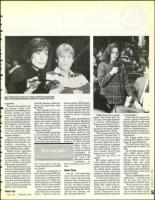

Above: Margie Fuller and her son Tommie shared their personal story.
Right: Jenna Goldenberg discusses talking to her parents about AIDS.
suggested.
Parents then broke into
two groups. Cards were
passed out with different be-
haviors written on them,
such as -"sex without a con-
dom" or "shooting heroin
with works (equipment) that
have been cleaned in bleach."
Each person read his card,
and the group decided
whether the behavior fit into
a no-risk, some-risk, high-
risk or more-information-
needed category.
Like several parts of the
program, the activity was
adapted from Cornell Uni-
versity's curriculum on
teaching parents to talk to
their children about AIDS.
Debate arose regarding
questions of insect bites —
mosquitoes cannot carry and
transmit the AIDS virus; and
having a baby — risk is min-
imal if medical personnel
take proper precautions.
Following the activity, par-
ents were challenged to talk
to their children about AIDS.
A copy of the answers to the
quiz, a glossary of terms, a
listing of AIDS support ser-
vices and volunteer opportu-
nities, and an information
card and phone number for
MJAC were distributed.
Week Two
Jan. 18 — Parents met
with Ms. Dressler while stu-
dents met separately with
Mr. Wise.
"We're going to try to un-
derstand Jewish values un-
derlying decisions about sex
and other behaviors," Mr.
Wise told the students. "Ju-
daism does teach to abstain
from sex until marriage..
However, we want to teach
you how to go safely if you
choose otherwise."
Students broke into groups
of 10, meeting with an in-
structor and MJAC facilita-
tor. They followed the same
curriculum their parents did
VO,
the week before and dis-
cussed talking about AIDS
as a family.
Responses varied from "I
knew more about AIDS than
my parents" to "They told me
not to share a shaving razor
or pierce my ear." Many stu-
dents said they are learning
about AIDS in their public
schools or at youth retreats.
Each group then created a
video from one of six situa-
tions — such as a new stu-
dent at school is HIV-positive
or a couple has been dating
a long time and one partner
is pressuring the other for
sex. Each scenario was dis-
cussed in terms of Jewish
values.
The adults also broke into
smaller groups to talk about
their discussions with their
children and to engage in
role playing. Steve Wood
from Midwest AIDS Preven-
tion Project spoke to the
group, answering technical
questions about such issues
as the possibility of trans-
mission of AIDS through
saliva and tears.
(More than a
quart of saliva
would have to be
exchanged to
possibly transmit
the virus.) He
also gave a dem-
onstration on
how to properly use a con-
dom.
Week Three
Jan. 25 — Two televisions
sat at the front of the room
with a table and four seats
between them. Parents and
students watched portions of
the Jan. 18 videos. A panel
presentation, featuring Mr.
Lebow, Ms. Efros, Ms. Fuller
and her son, Tommie, and
Ms. Gonzales followed.
"AIDS often drives people
apart," Ms. Fuller said. "In
our case, it brought together
a 13-year estrangement.
Tommie came home to live."
Tommie, not scheduled to
be part of the panel, spoke.
The students grew silent.
"This disease doesn't dis-
criminate," Tommie said. "I
can narrow it down to how I
got it. I had a lot of troubles
as a kid; I didn't fit in. So I
started drinking, drugging
and engaging in risky be-
havior for money. Listen to
your friends. They'll help
keep you out of trouble."
"And sex can wait," he
added.
Mr. Lebow spoke of his
lover, Grant, who had con-
tracted the disease 10 years
before showing symptoms.
He talked about quitting
work to become a full-time
caregiver. And he addressed
how society deals with AIDS.
"I think the videos are a
great example of the thin dis-
guise of fear in dealing with
AIDS," Mr. Lebow said, re-
ferring to the laughter
throughout the student sce-
narios. "Please don't try to
hide behind either ignorance
or knowledge."
Following the panel dis-
cussion, groups of families
joined together to talk with
the presenters. Each group
had the opportunity to speak
with two representatives —
asking questions and hear-
ing the details of individual
experiences.
Mr. Lebow spoke of re-
maining HIV-negative after
years of unprotected sex.
"We don't know why it tar-
gets some and not others," he
said.
He recalled reading in the
early 1980s about AIDS,
then known as the gay can-
cer. He spoke of doctors
telling Grant that his
lifestyle was less than
healthy and that was why he
was always sick. Medical
knowledge today would have
identified him in the early
stages of AIDS.
Issues of affordability were
addressed — medical costs
for the last two years of
Grant's life ran $2,000 a day.
"And if you're in a situa-
tion where someone says,
`Don't wear a condom; I trust
you' or some other excuse,
pull up your pants and get