

Background
Israe Cuts A Deal
T Rabin agreed to a
U.S.-brokered
compromise on
the deportees that
was designed,
above all, to
guarantee
\_ American support
at the U.N.
INA FRIEDMAN
ISRAEL CORRESPONDENT
/-
/-
Photo by RNS/ Reu ters
T
he very fact that the
compromise reached
between Washington
and Jerusalem over
the 400 Hamas deportees
languishing in south Leb-
anon was promptly de-
nounced by both the Palesti-
nians (P.L.O. and Hamas)
and by the Likud has led
cynics to comment that it
must have something to
commend it.
Nevertheless, its most ob-
vious weakness is precisely
the fact that it was reached
between Washington and
Jerusalem — not between
Israel and the U.N. Security
Council, or the deportees or,
indeed, any other Arab party
that might have legitimized
it — and, therefore, cannot
guarantee that it will actu-
ally lay the problem to rest.
So far, the 100 deportees
that Israel has agreed to
take back have rejected the
compromise. Spokesman Dr.
Abdel Aziz Rantisi, far from
cooperating with any deci-
sion of the Israeli govern-
ment, said the deportees will
remain in place "even if we
die."
Nor was it clearer at press
time whether the Security
Council would accept
Israel's agreement to return
a quarter of the deportees
now and reduce by half the
term of banishment of the
rest as compliance with the
demands of Resolution 799,
which speaks of reversing
the deportations uncondi-
tionally and forthwith.
U.S. Secretary of State
Warren Christopher seemed
to be practicing a bit of ho-
cus-pocus when he told a
news conference on Monday
that the compromise ob-
viated any further action on
the issue by the Security
Council. Still, the bottom
line for Israel is that if the
council does insist on
deliberating and acting upon
the harsh report issued by
Secretary-General Boutros
Boutros-Ghali in the wake of
Israel's refusal to implement
Resolution 799, at least
Jerusalem will have the
Clinton administration (and
its veto) firmly on its side.
That is the major achiev-
ement of this otherwise
imperfect solution to a situa-
tion that, in the words of
Ha'aretz columnist Uzi Ben-
ziman, has engendered "a
halt in the peace negotia-
tions, new tension in Israeli-
American relations, the
pressure that Israel has been
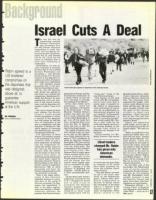
Israeli Arabs take supplies for deportees to the Lebanese border.
getting from Europe and the
international community as
a whole [while it] has not
even managed to damage
the standing of the Hamas."
Given that rather grim
assessment — which has
been repeated relentlessly
by the Israeli press — Prime
Minister Yitzhak Rabin's
problem has been not only
how to reach a formula that
would enable Washington to
get him off the hook he's
been swinging from ever
since the Dec. 17 deporta-
tions, but how to sell the
deal to the Israeli people.
For weeks the prime min-
ister refused to give so much
as an inch on the deporta-
tion, firmly rejecting the ap-
peals of U.N. emissaries to
abide by Security Council
Resolution 799, thus setting
himself on a collision course
with the world body. The
combination of the council's
new-found clout, Mr.
Boutros-Ghali's tough report
(which accused Israel of re-
peated violations of the
Fourth Geneva Convention),
and the threat that the
council would impose sanc-
tions on Jerusalem for defy-
ing it — placing it in the
category of Baghdad and
Belgrade — left Mr. Rabin in
a most uncomfortable posi-
tion.
On the other hand, Israel's
traditional contempt for the
U.N.'s disapproval forced
him to seek a way to
neutralize the Security
Council's pressure without
appearing to have been con-
cerned by it, which would
have played havoc with his
"tough guy" image in the
eyes of his countrymen.
The beauty of the deal
struck with Mr. Christopher
was to have been that it
would make it possible for
Mr. Rabin to compromise
while portraying his conces-
sion not as capitulation to
international pressure but
as a "gesture" to the nascent
Clinton Administration — a
kind of welcoming present"
that would enable Mr. Clin-
ton to take credit for the
swift and elegant solution to
an irksome problem on the
foreign front (which is
otherwise not thought to be
his forte).
Unfortunately for Mr.
Rabin, however, this version
Likud leaders
charged Mr. Rabin
has given into
American
demands.
of events has not gone down
as smoothly as he would
have liked, primarily be-
cause the problem hasn't
been solved yet.
"The deal doesn't promise
an end to the crisis, espe-
cially on the Palestinian
plane," defense editor Ze'ev
Schiff commented in
Ha'aretz. "It doesn't ensure
the resumption of the peace
talks or a solution of the
deportee problem," diplo-
matic correspondent Chemi
Shalev echoed in the
Histadrut daily Davar, while
Yediot Aharonot columnist
Nahum Barnea observed
that "the Americans have
supplied the ladder with
whose help [Rabin] has
fallen off the tree. He has
again branded himself with
the label of the 'eternal
yielder to American
pressure,' which haunted
him in the '70s, and that
won't help him get decisions
passed in Israel."
Indeed, the opposition
could hardly wait to get to
the microphones and tell the
Israeli people, "We told you
so!"
"Rabin surrendered to the
Americans before they ever
fired the first shot," mocked
former Prime Minister Yit-
zhak Shamir, whose own
government, he was quick to
remind the public, had had
the mettle to defy the Bush
administration. Mr. Shamir
was joined in his jabs by
David Levy, Benyamin
Netanyahu, Benny Begin,
and Moshe Katzav — all of
whom will be running in the
March primary for the
Likud's top position.
On the other side of the
barricades, the Palestinians
were of course equally
angered by the deal and par-
ticularly by the prospect
that Mr. Christopher would
actually maneuver it past
the Security Council and
again leave them with their
impotence on broad display.
Palestinian officials — in-
cluding Faisal al-Husseini
and delegation head Haidar
Abdel Shafi — went out on a
DEAL gage 38