
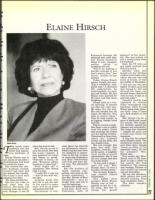

ELAINE HIRSCH
Elaine Hirsch
T
he music came
suddenly into the
silent and oppres-
sive darkness of
night.
Elaine Hirsch was in
bed, asleep at last after a
thunderstorm had kept
her awake for hours.
She needed the rest.
Her husband, Joseph,
recently had died, and
she missed him terribly.
She'd had a hard time
sleeping ever since.
The noise startled her.
She put her robe on
and went into the
library. The music was
coming from the televi-
sion. Strange. It was off
when she went to bed.
Mrs. Hirsch moved to
turn the set off. But then
the music stopped. A
man appeared on screen
and began to speak.
"Everyone is lonely," he
said. "Everyone suffers
loneliness of some kind."
Some might call it
coincidence. Mrs. Hirsch
calls it a sign.
"I really felt it was Joe
— that he was with me,"
she says.
Judaism holds that
this life is not the end.
In the world to come,
souls will be at peace
and united with God.
Discussions in Jud-
aism about the afterlife
are deliberately obscure.
Rabbis explain that Jews
are obligated to concen-
trate on this life, to focus
on improving themselves
and their relationship
with God and their fel-
low man. The afterworld
can wait.
But the mystery of
death remains com-
pelling. And some in the
Jewish community —
like Mrs. Hirsch of West
Bloomfield — have no
doubts that this life is
just the beginning.
Elaine met Joseph on a
blind date. Both were
Detroiters, both of
Rumanian heritage. He
proposed soon after they
met. Elaine wanted to
think it over. Joseph's
mother called to
straighten her out.
"You'll be making a
terrible mistake if you
don't marry him," her
future mother-in-law
advised.
Today, Elaine Hirsch
agrees. Joseph, she says,
"was a wonderful, won-
derful man." A chartered
life underwriter, he
loved baseball, ice skat-
ing and hockey. He and
Elaine were married for
29 years and had three
daughters.
Joseph died on a win-
ter morning. It started
out like any other day.
He came into the den.
His wife handed him his
watch. He told her, "You
look so pretty today."
Then he went outside, to
go jogging. Joseph loved
exercise.
Elaine stayed inside.
She fixed a cup of coffee,
read the paper. Later
that morning, she looked
out the kitchen window.
Underneath a thorn tree,
where her husband
always fed the birds, she
saw Joseph lying.
She ran outside. His
body was stiff. Her
daughter, Jennifer, call-
ed the police. A neighbor
tried mouth-to-mouth
resuscitation. But it was
all over. Joseph had died
of a heart attack.
"It was such a shock I
can't tell you," Mrs.
Hirsch says. "It was a
horrible, horrible shock."
The strange happen-
ings started almost
immediately.
Two nights after
Joseph's death, Elaine
Hirsch was in bed —
grateful at last for a lit-
tle sleep. She felt "a
strong but gentle
squeeze" on her shoul-
der. She was certain it
was a loving touch from
her husband.
Next, the TV went on
one night without the
flick of a switch.
Another time, she
looked out her kitchen
window to the back yard,
where she saw two red
roses in bloom. It was
the middle of November.
"I did not cry, but felt
lighter of heart, as if Joe
was trying to tell me
through the roses, our
favorite flower, that he is
with me still, if only in a
spiritual sense."
Joseph's profile has
appeared at various
times throughout the
basement, where he and
Elaine spent many pleas-
ant hours. Once, it came
as a dark shadow on the
floor.
Mrs. Hirsch ran for a
piece of chalk and traced
the outline. Her daugh-
ter, Jennifer, agreed the
likeness was remarkable.
The image has remained
— despite the years and
a flood that filled the
basement.
A long time has passed
since Joseph's death. The
mysterious incidents are
rare these days, though
"every so often, if I'm
especially lonely, I'll feel
his presence," Mrs.
Hirsch says.
Two weeks ago, Mrs.
Hirsch went to the base-
ment to take a photo of
the profile she had
chalked in. The camera
was working. Pictures of
Joe's profile had turned
out just fine before.
But not this afternoon.
Both photos she took
showed nothing. They
were completely white.
The date: Joseph's
yahrtzeit.