

Sephardi
Baton
Ann Arbor musicians, a Brazilian
conductor and Sephardi music will
be featured Sunday at Temple Beth El.
SUZANNE CHESSLER
SPECIAL TO THE JEWISH NEWS
onductor and
composer
Ricardo Aver-
back brings a
strong sense
of the Sephardic culture
to a special concert this
weekend.
Mr. Averbach, who was
born and raised in Brazil
and who served as con-
ductor of the Sao Paulo
Symphony Orchestra, will
lead 13 string musicians
in a 7:30 p.m. Sunday,
Jan. 31 performance at
Temple Beth El.
In addition to Sep-
hardic selections and
other favorite pieces, Mr.
Averbach will conduct
two of his own composi-
tions created for the occa-
sion: "Tree of Life," a tone
poem, and "Sephardic
Song Cycle," a piece based
on music of 14th-century
Spain.
The program is present-
ed by Musica Viva
International Concerts,
whose founder, Ginka
Gerova Ortega, met Mr.
Averbach at a University
of Michigan recital.
"This is the first concert
we are doing with a new
orchestra, Camerata
(Chamber) Musica Viva,
formed with some of the
most talented young
musicians in Ann Arbor,"
Mr. Averbach said.
Also to be featured are
Cantor Gail Hirschenfang
of Temple Beth El, violist
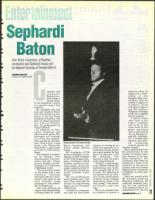
Ricardo Averbach will conduct Sunday.
Maria Vassileva and
flutist Ginka Gerova
Ortega.
Mr. Averbach, a U-M
doctoral candidate in con-
ducting, is chief conductor
of the U-M Campus Sym-
phony Orchestra, which
consists mainly of non-
music majors, and is occa-
sional conductor of the U-
M Symphony Orchestra,
which includes music
majors.
His own professional
music studies got a late
start. They came after he
earned an engineering
degree at the University
of Sao Paulo.
"In Brazil, a young per-
son does not have many
chances to develop as an
artist and especially as a
musician because there's
not a good market for this
kind of profession," said
Mr. Averbach, who
learned to play the piano
as he was growing up.
"Usually, young people
study different things like
engineering, law, medi-
cine, sciences and so on,"
he said. "By influence of
my parents and by influ-
ence of the environment
in which I lived, I studied
engineering. Since I was
very young, I was direct-
ed toward a goal like
this."
When he decided that
he wanted to pursue a
career in music, he
applied for a schol-
arship at the
Bulgaria State Con-
servatory, where he
earned a degree in
orchestra, choral
and opera conduct-
ing. His mother's
Bulgarian heritage
made him eligible
for the program.
"I had to study
very hard to be-
come a musician
and to be at the
same level as the
great musicians
that I had around
me in Bulgaria,"
said Mr. Averbach,
36. "I studied com-
position and start-
ed composing,
mainly pieces for
chamber groups."
Upon graduating from
the conservatory, he was
invited to become assis-
tant director of the Sao
Paulo Symphony. The
invitation came after he
performed a series of 34
concerts in his native
country with the Pioneer
Philharmonic Orchestra
of Bulgaria, a youth orga-
nization.
Just one month after
Mr. Averbach joined the
Brazilian symphony, the
conductor resigned, leav-
ing the new assistant
with administrative re-
sponsibilities for the rest
SEPHARDI BATON page 78